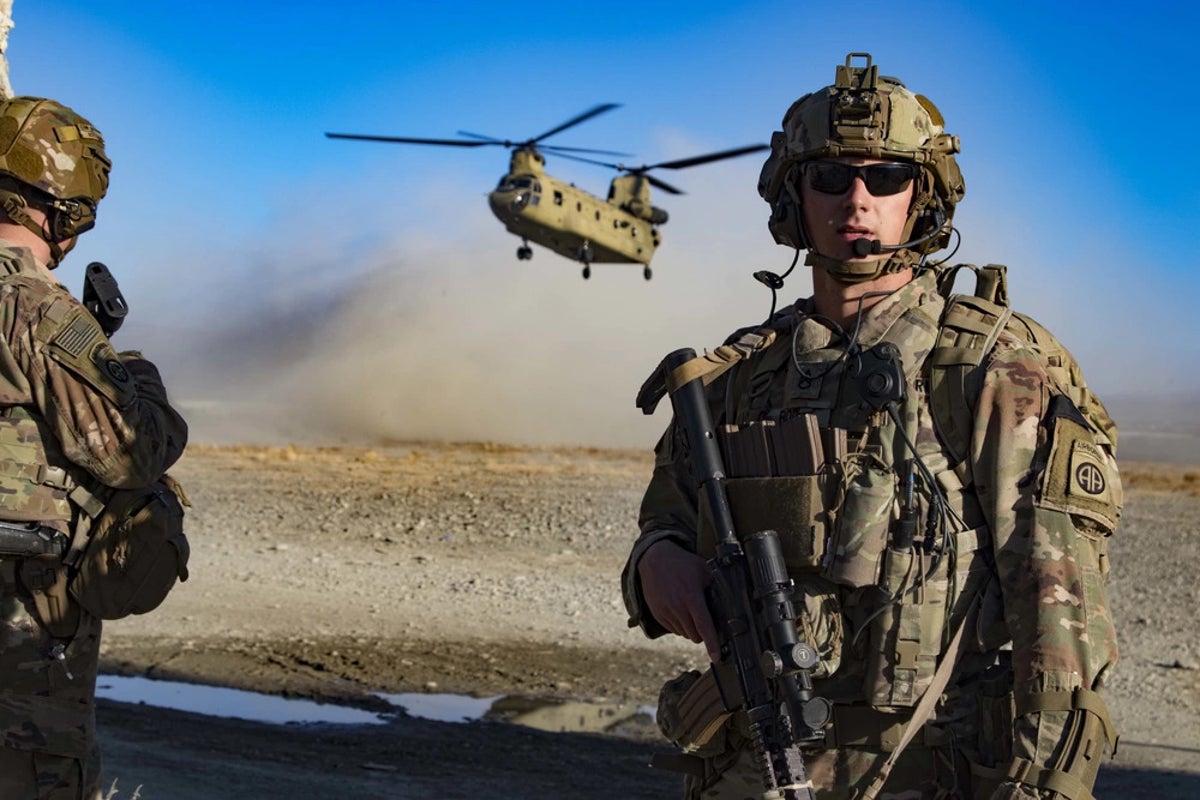
When the White House needs boots on the ground in a hurry, they don't call a committee. They call Fort Liberty. Specifically, they call the 82nd Airborne Division. You've likely seen the headlines about thousands of paratroopers heading to the Middle East. It's a recurring theme in American foreign policy. But if you think this is just another standard troop movement, you're missing the point.
The 82nd Airborne isn't just another unit in the US Army. They are the "Global Response Force." That’s a fancy way of saying they stay on a permanent leash. At any given moment, a battalion-sized element is on a two-hour string. That means from the second the phone rings, they have 120 minutes to be rigged, parachutes checked, and sitting on a C-17 Globemaster. No other conventional unit in the world moves that fast.
They’re heading back to a familiar sandbox. With tensions spiked across the Middle East—from the Red Sea to the borders of Lebanon—the Pentagon is leaning on its most reliable blunt-force instrument. These soldiers aren't there to build schools or manage long-term transitions. They're there to "seize, retain, and exploit" the initiative. In plain English? They’re the insurance policy against a total regional meltdown.
Why the All American Division is Different
Most people see the maroon beret and think "jumpers." That’s only half the story. The 82nd Airborne is an airborne infantry division, but their real value lies in their logistical insanity. They’re designed to be completely self-sufficient for the first few days of a high-intensity conflict.
Think about the sheer scale of moving 3,500 people and their gear across an ocean in under 18 hours. It’s a nightmare. Yet, the 82nd treats it like a Tuesday morning workout. They use a system called the "Joint Forcible Entry" capability. This isn't just about dropping guys behind enemy lines. It’s about taking an airfield, holding it against a counter-attack, and opening the door for the heavy stuff—the tanks and the massive supply chains—to land safely.
I’ve seen how this works up close. It’s chaotic, loud, and incredibly violent by design. The goal is to overwhelm an opponent before they even realize the US has committed to the fight. When they deploy to the Middle East now, they’re bringing a specific set of tools. We’re talking about enhanced night-vision goggles (ENVG-B) that look like something out of a sci-fi movie and the latest shoulder-fired anti-armor tech. They aren't just showing up; they're showing up with an overmatch capability that makes local militias think twice.
The Middle East Chessboard in 2026
The current deployment isn't happening in a vacuum. We’re looking at a region that’s more volatile than it’s been in decades. You have proxy groups with sophisticated drone technology and ballistic missiles that can actually hit their targets. The 82nd is being positioned as a "tripwire" and a "fire brigade" simultaneously.
If a major embassy needs an evacuation, it’s the 82nd. If a strategic port is threatened, it’s the 82nd. They provide the President with options that don't involve a decade-long war. By putting a highly mobile, lethal force in the neighborhood, the US is trying to deter a full-scale regional conflict. It’s a classic power move. You put the toughest guy in the room by the door so nobody tries to lock it.
Many critics argue that sending the 82nd is an escalatory step. They aren't wrong. Moving the most decorated division in the Army sends a message. It says the "talking phase" is getting dangerously short. But from a strategic standpoint, it’s the only move left when diplomacy hits a wall. You don't send the 82nd to negotiate. You send them to end the argument.
Life on the Two Hour String
It’s easy to talk about "units" and "divisions" as abstract concepts. It’s harder to remember these are mostly 19 and 20-year-olds from places like Ohio and Texas. For a paratrooper in the 82nd, life is a constant state of "maybe today."
They live in a culture of extreme readiness. Their cars have to be parked in specific spots. Their "A-bags" and "B-bags" stay packed. They can't go more than a certain distance from base. It’s a grueling way to live. When the order comes to head to the Middle East, there’s often a sense of relief. The waiting is finally over.
The training they undergo at the Joint Readiness Training Center (JRTC) is designed to break them. They spend weeks in the woods, sleep-deprived, being hunted by a professional "opposing force" that knows the terrain better than they do. By the time they actually get to a real combat zone, they’re often better prepared than the people they’re fighting. That’s the edge. It’s not just the gear; it’s the institutional memory of a unit that’s been doing this since World War I.
Myths About the 82nd Airborne
Let's clear some things up. People love the "Band of Brothers" imagery. They think every deployment involves thousands of white parachutes filling the sky. In reality, the 82nd spends a lot of time doing "air-land" operations. They fly into secured airfields and drive out of the back of the planes.
Jumping is just one way to get to work. It’s a tool, not the whole job. Another myth? That they’re just "light" infantry. While they don't have the heavy M1 Abrams tanks of the 1st Armored Division, they carry an absurd amount of firepower. Between Javelin missiles, mortars, and integrated air defense, they can punch way above their weight class.
The biggest misconception is that they’re invincible. They aren't. Being "light" means you’re vulnerable to heavy artillery and sustained armor pushes. That’s why their mission is always about speed. If a fight lasts too long, the 82nd is in trouble. They need to win fast, or they need the heavy reinforcements to show up behind them. In the Middle East, where the terrain is often wide open and favors long-range fires, this speed-versus-protection trade-off is the primary concern for commanders.
What Happens Next
This deployment likely won't be a short one. Once the 82nd establishes a footprint, they tend to stay until the "temperature" of the region drops. For the families back at Fort Liberty, this is a familiar routine. It’s the "Division's" turn again.
If you’re tracking this movement, keep an eye on where they actually land. If they’re heading to Kuwait, it’s a staging move. If they’re going straight into places like Jordan or Iraq, the situation is much more serious than the official press briefings suggest.
The 82nd Airborne remains the most flexible tool in the American kit. They’re the only ones who can turn a "what if" scenario into a "done deal" in less than a day. As the Middle East continues to boil, the presence of the AA patch on the ground is the clearest indicator of how worried the Pentagon actually is.
If you want to understand the modern military, stop looking at the tech and start looking at the readiness cycles. The 82nd wins because they’re ready when everyone else is still looking for their boots. For now, watch the flight trackers out of Pope Army Airfield. That’s where the real story is written. Check the Department of Defense's official deployment notices for specific Brigade Combat Team numbers to see which part of the division is leading the charge.