The era of the "Davos Man" is over. For decades, the global elite met in the Swiss Alps to dictate the future of markets and nations, operating under the assumption that the West was the only relevant driver of history. That assumption has been shattered.
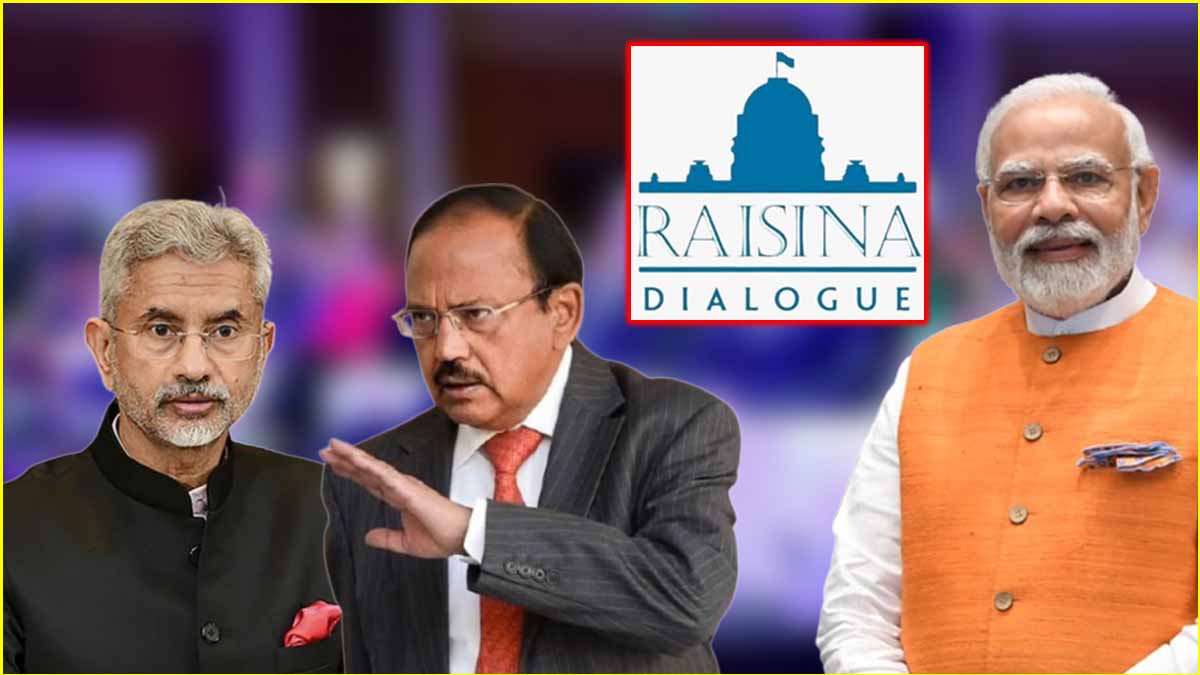
Former Australian Prime Minister Tony Abbott recently went public with what many in the diplomatic trenches have whispered for years: the Raisina Dialogue in New Delhi has surpassed Davos in both relevance and substance. This is not just a polite endorsement of Indian hospitality. It is a fundamental acknowledgment that the center of gravity has shifted from the Atlantic to the Indo-Pacific. While Davos has become a sanctuary for "politically correct plutocrats" performing rituals of corporate social responsibility, Raisina has evolved into a high-stakes arena where the world’s actual movers—military commanders, intelligence chiefs, and emerging market titans—confront a reality that is increasingly messy and multipolar.
The Death of the Davos Consensus
The World Economic Forum was built on the premise of a "flat world" where trade would eventually iron out ideological differences. That world no longer exists. Today, we live in an age of militant mercantilism and weaponized supply chains.
Davos continues to focus on abstract ESG goals and sanitized panels, but these discussions feel increasingly hollow against the backdrop of hot wars in Europe and the Middle East. Abbott’s critique is sharp: he describes the Swiss gathering as dominated by a specific brand of conformist thinking that often ignores the "hard power and national interests" that govern the real world. In contrast, the Raisina Dialogue has embraced a "no-limits" approach to debate. It is one of the few places on the planet where you can find an Israeli foreign minister and an Iranian deputy foreign minister effectively sharing a platform, even if only virtually or within the same three-day window.
This is the "brainchild" of S. Jaishankar, India’s External Affairs Minister, who has transformed the event from a local talk shop into a global "intelligence diplomacy" hub. Unlike traditional summits where leaders deliver scripted speeches and vanish, Raisina forces interaction.
Why the Global South Stopped Listening to the West
For a long time, the "Global South" was a category used by Western academics to describe countries that were expected to follow a pre-written developmental script. At Raisina 2026, themed "Saṁskāra – Assertion, Accommodation, Advancement," that script was burned.
The conversation in New Delhi is no longer about how India or Brazil can fit into a Western-led order. It is about how that order is broken and what will replace it. The United States, once the undisputed architect of global stability, is now viewed with a mix of exhaustion and skepticism. During the 2026 sessions, Abbott and former Swedish PM Carl Bildt were remarkably blunt, characterizing American diplomacy as "profoundly unimpressive" and noting that the U.S. has essentially opted out of its traditional leadership role in key conflicts.
This vacuum is being filled by what Jaishankar calls "multi-alignment." India is not looking for a new master; it is looking to build a network of overlapping interests. This is why Raisina is more valuable to a modern CEO or strategist than Davos. In Switzerland, you hear what the world should look like. In New Delhi, you see what it actually looks like.
The Rise of Science Diplomacy
A major differentiator emerged at the 11th edition of the Dialogue: the launch of the Raisina Science Diplomacy Initiative. This acknowledges a hard truth that Davos often obscures: technology is the new geography.
- Semiconductor Sovereignty: No longer just a business concern, chip supply chains are now treated with the same strategic weight as oil reserves.
- AI Governance: While the West focuses on the ethics of AI, Raisina focuses on the agency of AI—how it can be used to leapfrog traditional development hurdles in the Global South.
- Digital Public Infrastructure (DPI): India’s success with UPI and digital IDs is being pitched as a "new playbook" for growth, independent of Silicon Valley’s proprietary models.
The Brutal Reality of Hard Power
We are seeing a return to "values-based realism." This sounds like a contradiction, but it is the defining philosophy of the new era. Finland’s President Alexander Stubb articulated this during his keynote, declaring that the age of Western dominance has ended and that "might makes right" is once again the operating principle of the international system.
Davos struggles with this reality. It wants to believe in the "rules-based order" even as those rules are being ignored by the very people who wrote them. Raisina doesn't have that luxury. The participants here are often the ones on the front lines of these shifts. When the Dialogue discusses maritime security, they aren't talking about abstract trade routes; they are talking about the Red Sea, the Indian Ocean, and the undersea cables that carry 99% of global data.
The Specter of Credibility
There is a risk, of course. Any forum that grows this fast can become a victim of its own success. The sheer scale of Raisina 2026—with over 3,000 participants and 130 countries—threatens to dilute the very "robust debate" that Abbott praised. There is a danger of it becoming an echo chamber for Indian national interest rather than a truly global forum.
However, the willingness to host dissenters and maintain a "riotously free" atmosphere has so far kept that at bay. The fact that high-ranking officials from rival nations feel compelled to show up speaks to a credibility that Davos has lost. In Davos, you pay for access. In Delhi, you show up because you cannot afford to be absent from the conversation.
The shift is permanent. The world is no longer waiting for a signal from a Swiss ski resort to know which way the wind is blowing. The wheel of time—the Kālachakra—has turned, and New Delhi is currently where the friction of the future is most visible.
Assess your organization's presence at these "plurilateral" forums; if you are still prioritizing the Alps over the heat of the Indo-Pacific, you are analyzing a world that has already passed away.