Sirens in Kyiv do not sound like a movie. They do not arrive with a cinematic brass fanfare or a dramatic crescendo. They start as a low, mechanical shudder through the floorboards—a groan of electricity that makes the coffee in your paper cup ripple—before rising into a thin, wailing shriek that cuts straight through the bone.
By now, the city knows the rhythm of the air. People do not panic. They simply pause, fold their maps, close their laptops, and move toward the concrete belly of the nearest metro station.
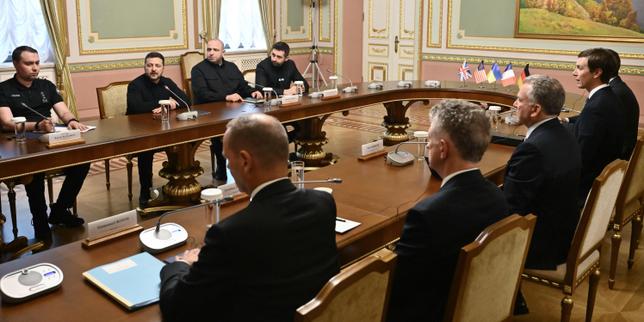
Yet, deep inside a nondescript government office protected by sandbags and the heavy, grim presence of armed security, another kind of movement was happening behind closed doors. There were no sirens here, only the quiet, rhythmic clicking of a ballpoint pen against a mahogany desk.
Steve Witkoff and Jared Kushner sat across from Volodymyr Zelensky.
To the casual observer scrolling past a news alert on a crowded morning train, the headline was just another line in a relentless scroll of war updates. First discussions are very significant. That was the official phrasing. Cold. Diplomatic. Sanitized for public consumption. It is the language governments use when they want to signal movement without risking the ground beneath their feet.
But words like "significant" hide the human cost of the room. They hide the exhaustion in the eyes of a president who has spent years watching his country turn into a cratered ledger of grief. They hide the heavy calculations of American envoys carrying whispered messages across oceans, trying to map out a geometry of peace where no straight lines exist.
Consider what happens inside that room when the cameras blink off.
The press statements vanish. The stiff posture dissolves. You are left with human beings staring at maps marked with red and blue lines that represent thousands of lives, ruined granaries, shattered power grids, and children sleeping in cold basements.
Diplomacy is often imagined as a grand theater of stately dining rooms and roaring fireplaces. In reality, it smells like stale coffee, wet wool, and ozone from backup generators. It is exhausting. It is tedious. And it is entirely dependent on the fragile willingness of people to sit across from one another and pretend, against all statistical probability, that an ending is possible.
For months, the narrative of the war has been locked into a binary code. Resistance versus submission. Victory versus defeat. The world chose its sides, pinned flags to social media profiles, and settled into a grim endurance test. But wars do not end because the combatants simply run out of anger. They end because the exhaustion finally outweighs the grievances, or because someone, somewhere, finds a thread worth pulling.
Witkoff and Kushner did not arrive in Kyiv with a magic wand. They arrived as emissaries of a different kind of pressure—the quiet, relentless gravity of American political and economic calculus shifting beneath a new administration.
When a foreign delegation visits a nation under siege, the local residents watch the motorcades with a complex mix of hope and cynicism. They have seen delegations come and go. They have heard promises whispered in grand halls, only to watch the artillery fall heavier the next week. Every handshake is scrutinized. Every leaked phrase is weighed for hidden meanings.
Was the meeting significant because it brought a breakthrough? Or was it significant because it simply happened at all?
In a conflict this vast, the mere act of communication is an anomaly. When trust has been bombed out of existence, talking to the other side feels like walking across a suspension bridge made of rusted wire. One wrong step, one careless word interpreted as weakness, and the whole structure plunges into the abyss.
Yet, conversations must begin somewhere. They rarely start with a grand treaty. They start in the uncomfortable silence between two sentences, when a translator pauses to find the exact equivalent of a word that does not quite translate, and everyone in the room holds their breath.
We often forget that geopolitics is fundamentally a human endeavor. We speak of gross domestic product, artillery shells, territorial integrity, and ceasefire lines as if they were pieces on a grand chessboard moved by invisible hands. We forget the mother checking her phone for news of her son in the trenches. We forget the diplomat staring at the ceiling at 3:00 AM, wondering if a compromise they are considering is an act of realism or an act of betrayal.
The discussions in Kyiv were described as significant because they brushed against the untouchable. They touched the taboo subject of an end game.
For a country fighting for its literal survival, talking about an end game feels perilous. To discuss terms while enemy missiles are still falling is to negotiate with a knife at your throat. Yet, ignoring the architecture of peace until the final shell drops is how endless wars are born.
History is littered with the ruins of nations that won the military engagement only to lose the peace because they refused to talk while the smoke was still thick.
As the delegation’s armored vehicles rolled back toward the border under the heavy shroud of a Ukrainian dusk, the sirens in Kyiv began to wail again. The ordinary citizens emerged from the metro stations, shaking the damp chill from their coats, looking up at a darkening sky that offered no answers.
The meetings are over for now. The communiques have been filed. The pundits on television will dissect every syllable uttered by the envoys, spinning theories about secret deals and sudden shifts in global strategy.
But back in the room, the chairs are empty. The coffee cups are cold. The maps are rolled up. And somewhere out in the dark, the quiet, grinding machinery of war and diplomacy continues its relentless turn, waiting for the moment when words might finally prove stronger than iron.