Arthur stood at the edge of the grass, his hand hovering inches above his daughter’s arm. The sun beat down on the suburban playground, a chaotic storm of shouting children, clanging steel chains, and shimmering heat waves bouncing off dark asphalt. To anyone else, it was a pleasant Saturday afternoon. To Arthur, who was diagnosed with vascular dementia two years ago, it was a wall of noise and confusing visual depth. The dark shadow cast by a oak tree looked like an abyss in the ground. The abrupt end of the concrete walkway felt like a trap.
He froze. He turned around. He wanted to go home.
For millions of families living alongside cognitive decline, the outdoors gradually becomes a minefield. Standard public parks, designed with bright primary colors, dead-end trails, and open perimeters, often trigger intense disorientation, paranoia, or sensory overload. So, people stay inside. The living room shrinks. The world gets smaller.
That isolation is precisely what a pioneering project in Alberta aims to undo. By autumn 2026, Calgary will open Canada’s first dedicated dementia-inclusive public park, turning sensory urban design on its head to give people like Arthur their freedom back.
The Architecture of Safety
To understand why a specialized green space matters, consider how a damaged brain interprets a standard environment. When neurodegeneration erodes spatial awareness, subtle details become overwhelming obstacles. High-contrast shadows are misread as physical holes. Complex intersection choices induce panic. Flat black doormats look like deep pits.
Calgary’s new park addresses these invisible barriers through deliberate, evidence-based environmental design.
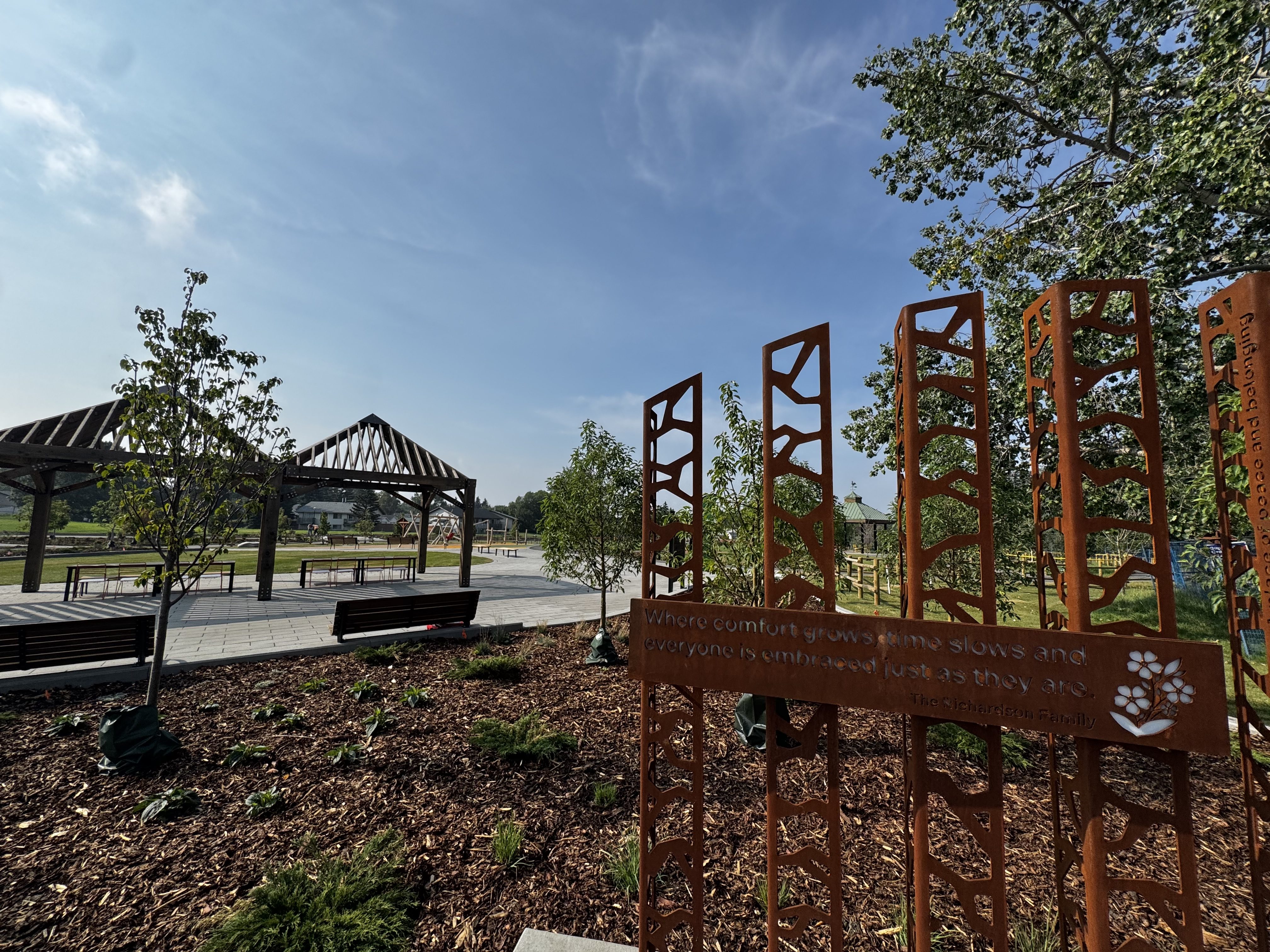
Instead of sharp corners or dead-end paths that force a disoriented walker to turn around in frustration, the park utilizes continuous looping pathways. A person can walk indefinitely without ever feeling stuck or lost, naturally guided back toward central seating areas.
Color palettes are curated with intention. The park avoids stark black-and-white contrasts that trick perception, opting instead for gentle, natural tones with clear, low-glare visibility. Perimeters are secured naturally through dense hedging and subtle fencing, preventing wandering without making visitors feel caged or institutionalized.
Notice the difference in approach:
| Traditional Public Park | Dementia-Inclusive Park |
|---|---|
| Complex, branching paths with dead ends | Continuous loop pathways that guide movement |
| High-contrast surfaces and harsh shadows | Low-glare paving and smooth visual transitions |
| Open perimeters with multiple escape routes | Secure, naturally bounded physical boundaries |
| Loud, sharp auditory environments | Acoustic buffers using soft earth and foliage |
| Generic ornamental plants | Non-toxic, tactile, and aromatic native flora |
Triggering the Past Through Sensation
Memory is complex. While short-term recall often fades early in conditions like Alzheimer's, deep sensory memories remain intact far longer. The smell of crushed lavender. The feel of rough pine bark. The sound of water running over smooth river stones.
The park integrates sensory zones specifically calibrated to evoke deep-seated comfort. Non-toxic plants with distinct textures and scents—like lilac, sage, and mint—line the walkways at waist height, encouraging hands-on interaction. Soundscapes are softened using natural earth mounds and tall grasses that filter surrounding city traffic, replacing jarring noise with the rhythmic rustle of leaves.
Consider a hypothetical visitor named Margaret. She might not remember what she ate for breakfast or the name of the current prime minister. But when she brushes her fingers against a patch of sweet clover along a curving path, her brain connects instantly to her childhood garden in Saskatchewan. The anxiety spikes melt away. Her posture softens. She is home again, if only for an hour.
Reclaiming the Civic Square
This initiative is not merely a feel-good community venture. It is a necessary response to a looming demographic shift.
By 2030, nearly one million Canadians are expected to be living with dementia. The economic and emotional weight on family caregivers is immense, often leading to burnout, depression, and premature institutionalization of loved ones. When cities fail to build accessible spaces for individuals with cognitive impairments, they effectively lock out both the patient and the caregiver from public life.
Calgary's project marks a critical shift in urban planning. It moves past basic physical accessibility—like wheelchair ramps and wide doors—toward cognitive accessibility. It asserts that public spaces belong equally to those whose minds navigate reality differently.
The afternoon sun settles over the Alberta foothills. Light filters through poplar leaves, casting soft, warm patterns across a wide, gently curving path. There are no sudden dead ends here. No sharp, frightening shadows. Just a smooth loop ahead, an open bench nearby, and the quiet assurance that a fading memory does not mean the end of wandering under an open sky.


.png?width=1200&auto=webp&trim=0%2C0%2C0%2C0)