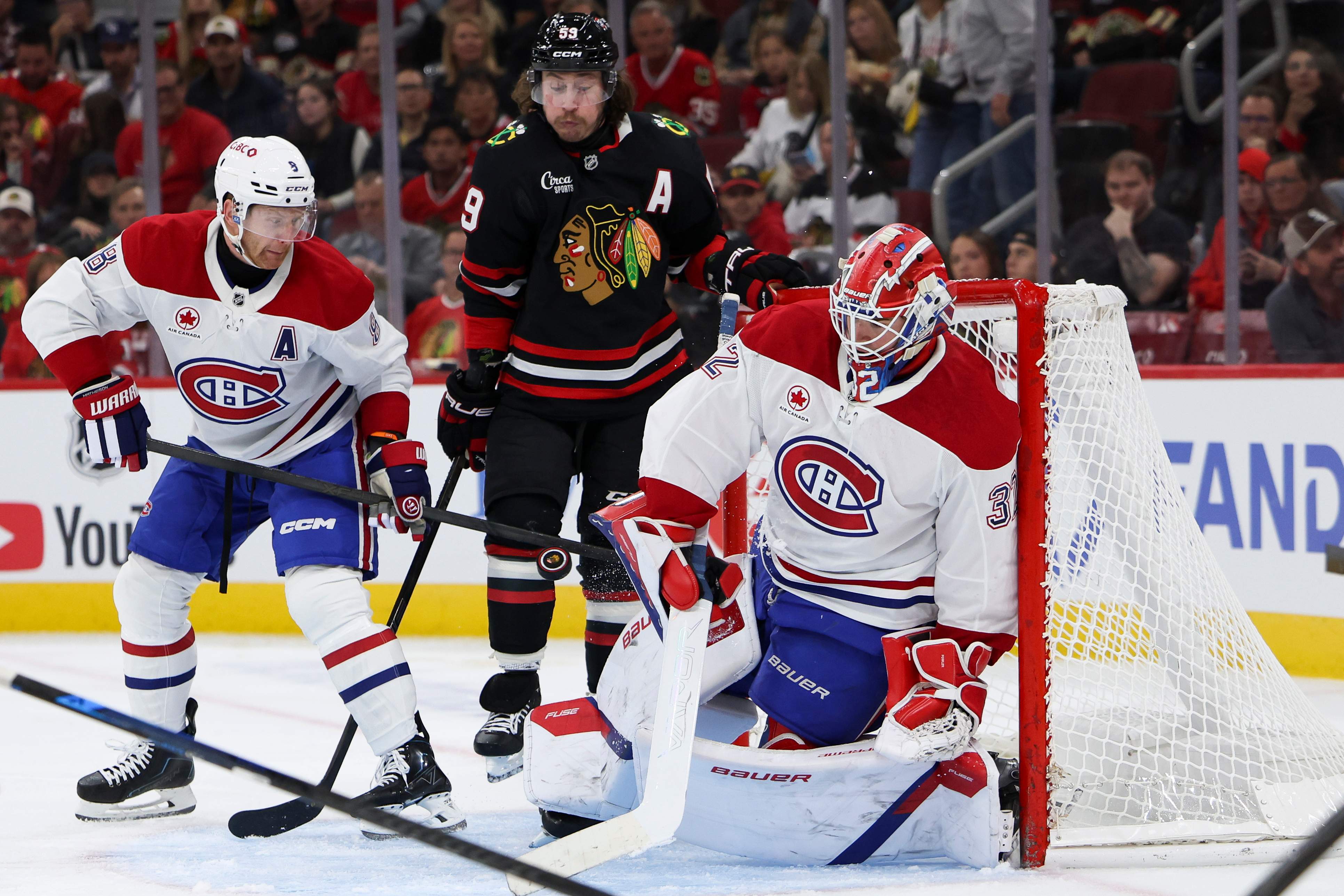
Silence in an opposing arena has a very specific weight.
If you have ever stood near the glass during a road game in Chicago, you know the United Center does not easily surrender its noise. The concrete holds the roar of decades, the echoes of banner-raising nights and deafening anthems that rattle the fillings in your teeth. When the home crowd falls quiet, it is rarely out of politeness. It is usually because someone wearing the wrong sweater has just stolen the air right out of the building. For an alternative look, consider: this related article.
Jacob Fowler did not kick down the door in Chicago. He simply locked it from the inside.
For years, the conversation surrounding the Montreal Canadiens has been a study in collective anxiety. Every rebuild carries an invisible tax paid in patience, and in Montreal, patience is the scarcest currency on earth. Fans there do not merely watch hockey; they inherit it, along with the ghost stories of Ken Dryden, Patrick Roy, and Carey Price. To step into the crease for this franchise is to step onto a stage where the spotlight burns hot enough to blister. Every rebound is a referendum. Every goal against is an autopsy. Similar insight on this matter has been provided by The Athletic.
So when a young goaltender like Jacob Fowler walks into the Windy City and delivers a commanding, convincing victory—shining again when the organization needed a steady pulse—it is tempting to reduce the night to box-score arithmetic. Saves made. Goals allowed. Two points banked in the standings.
That would be a mistake. Because what happened on the ice in Chicago was never really about the Blackhawks, and it wasn't even entirely about the final score. It was about what happens when a young athlete refuses to carry the weight of a city's history on his shoulders and decides, instead, to simply play the puck in front of him.
The Anatomy of a Calm Crease
To understand why Fowler’s performance felt so different, you have to understand what panic looks like in a hockey rink.
Panic is loud. It looks like a defenseman throwing a blind backhand pass up the middle of the ice because footsteps are closing in. It looks like a goaltender swimming out of his crease, scrambling on his stomach, reaching desperately with a paddle while a loose puck sits two feet behind his heels. When a rebuilding team starts to bleed chances on the road, panic spreads across the bench faster than a bad line change. You can see it in the way players grip their sticks—white-knuckled, stiff, waiting for the inevitable collapse.
Imagine, for a moment, a hypothetical young fan sitting in a cramped apartment in Verdun, watching the game on a flickering television screen. Let’s call him Marc. Marc has spent the last several winters bracing himself every time an opponent crosses the Montreal blue line with speed. He knows the script by heart: a missed assignment in the slot, a clean look from the hash marks, the red light flashing before he can even set down his coffee. For fans like Marc, watching the Canadiens has often meant enduring ninety minutes of low-grade dread punctuated by brief flashes of hope.
Now watch what happens to Marc’s posture when Jacob Fowler is square to the shooter.
There is no wasted motion in Fowler’s game. Watch his edges. Watch the way his hips stay level as he tracks a cross-ice pass through traffic. While younger goaltenders often rely on athleticism—diving, sprawling, turning routine stops into highlight-reel gymnastics—Fowler plays with an almost unsettling economy. He arrives at the top of his crease early, takes away the bottom of the net without dropping prematurely, and absorbs pucks into his chest as if they were tossed underhand from ten feet away.
Rebounds die in his gear.
And when rebounds die, the entire geometry of the game changes for the five skaters in front of him. Suddenly, the Canadiens' defensemen are not spinning in circles, chasing ghosts in the corners. They are retrieving dead pucks, turning up ice with their heads up, and transitioning from survival mode into attack. A convincing win on the road is rarely built on flashy breakaways alone; it is built on the quiet assurance that the first mistake will not automatically end up in the back of the net.
The Myth of the Savior
Hockey has a bad habit of turning twenty-something kids into messiahs before they have even figured out how to pack for a four-game road trip.
Look back across the history of the sport, particularly in Original Six markets, and a clear behavioral pattern emerges. Whenever a storied franchise hits a rough patch, the fanbase immediately begins scanning the horizon for a single, transcendent figure to rescue them. In Montreal, that obsession always gravitates toward the net. Because the franchise’s greatest eras were anchored by Hall of Fame goaltenders, the local culture treats elite goaltending not as a luxury, but as a birthright.
I remember the suffocating pressure that surrounded Carey Price during his earliest seasons in the league. Before he became the gold standard of technical perfection, he was a young man trying to survive a microscope that magnified every flawed angle and every bad bounce. The city wanted him to be a finished masterpiece while he was still learning how to mix the paint. It is a brutal, unforgiving environment for development, and it has swallowed plenty of promising prospects whole.
This is where the human element of Fowler’s rise becomes so compelling. He has grown up in an era where every shift is clipped, analyzed, and dissected on social media before the Zamboni even finishes its first lap. He knows the expectations attached to the crest on his chest. Pretending otherwise would be naive.
Yet watching him operate in Chicago, you got the distinct impression that he has figured out how to shrink the world down to sixty-four square feet of painted ice.
Think of an air traffic controller working a thunderstorm at O'Hare. Outside the tower window, there is chaos—crosswinds, delays, dozens of blinking radar blips converging at once. If the controller stares at the storm as a whole, paralysis sets in. The only way to survive the shift is to handle one plane, one altitude, one vector at a time.
Fowler plays the crease like that controller. He does not look at the standings. He does not look at the rebuild timeline. He reads the blade of the shooter's stick, adjusts his depth by six inches, and makes the stop. When Chicago pushed back, trying to manufacture momentum in front of their home crowd, Fowler didn't match their urgency with frantic energy. He answered it with stillness.
How a Road Win Actually Happens
If you ask ten coaches what defines a convincing road victory, nine of them will talk about structure. The tenth will tell you the truth: it is about surviving the other team's best ten minutes without breaking.
In Chicago, those minutes inevitably arrived. Even a Blackhawks squad navigating its own long road back to contention possesses enough raw speed and young skill to tilt the ice in bursts. They forechecked aggressively, pinched down the walls, and funneled pucks toward the net front hoping for chaos.
In past versions of this Montreal roster, that pressure would have cracked the foundation. A penalty would have followed a turnover; a power-play goal would have followed the penalty; and within four minutes, a tight game would have unraveled into another moral victory.
Instead, the Canadiens bent without snapping.
When the coverage broke down in the defensive zone—and it did, because hockey is a game of errors—Fowler erased the mistake before it could leave a scar on the scoreboard. A backdoor tap-in denied with a sharp lateral push. A screened wrist shot from the point swallowed cleanly through a maze of shin pads. Each save acted like a pressure valve, bleeding the momentum out of the Chicago bench and feeding confidence straight back into Montreal's lineup.
Watch the body language of forwards when their goalie is locked in. They stop cheating for offense because they trust the structure behind them, and paradoxically, that trust makes them far more dangerous when they finally get the puck. They support each other through the neutral zone. They attack the middle of the ice with speed instead of dumping the puck in and retreating.
By the time Montreal began pulling away on the scoreboard, the outcome felt less like a lucky break and more like an inevitability. The Canadiens dictated the pace, protected the house, and closed out the third period with the kind of professional poise that has eluded them for far too long.
The Invisible Stakes of Progress
Why does one night in November or December—one road win against a fellow rebuilding club—matter so much in the grand scheme of an eighty-two-game grind?
Because confidence in professional sports is not an abstract concept. It is physiological. It changes how fast a player processes information, how willing they are to take a hit to make a play, and how quickly they recover from a bad shift. Without tangible proof that the process works, a rebuild is just a prolonged exercise in losing.
For years, the skeptics have looked at Montreal’s young core and asked the same nagging questions. Is the defensive structure actually improving, or are they just surviving on unsustainable shooting percentages? Can their young goaltending hold up when the games tighten up away from the Bell Centre? Do they know how to win a game they are supposed to win?
Those are fair questions. Anyone who has watched this team stumble through multi-goal third-period collapses over the past few seasons has earned the right to be cynical. Blind optimism is cheap; earned belief is expensive.
Fowler’s performance in Chicago was a down payment on that belief.
He didn't just steal a game while his teammates got outshot two-to-one. He anchored a complete, cohesive team effort where the goaltending and the skaters elevated one another. When the Canadiens needed a big save early to settle their legs, he gave it to them. When they built a lead and needed someone to slam the door on any thought of a Chicago comeback, he stood tall and made difficult stops look routine.
There is a subtle magic in watching a young player realize, in real time, that he belongs at the highest level. You can see it in the way Fowler handles the puck behind his net, communicating with his defensemen, acting as a third blueliner to break pressure before it even forms. He isn't hiding in his crease hoping the clock runs out. He is actively managing the game.
Beyond the Box Score
Later that night, after the equipment bags were zipped shut and the charter plane lifted off from Illinois, the statistical summaries would tell a neat, tidy story. A strong save percentage. Another notch in the win column. Another encouraging chapter in Jacob Fowler’s burgeoning resume.
Numbers are useful, of course. They keep us honest. They strip away nostalgia and force us to confront reality.
Yet numbers cannot capture the exact second when an entire bench exhales. They cannot measure the subtle shift in a locker room when players look down at the crease and realize they no longer have to play scared. For a franchise that has spent years wandering through the wilderness of transition, searching for solid ground beneath its skates, that feeling is worth far more than two points in the standings.
Back in that apartment in Verdun, the television is turned off. The room is quiet now, too—not the heavy, anxious silence of another late-game collapse, but the easy, unhurried quiet of a night that went exactly the way it was supposed to go.
The red light stayed dark. The kid held the line. And for the first time in a long time, the noise in Montreal didn't sound like worry.


