The fluorescent lights in the VFW hall buzz like trapped wasps. It is a Tuesday evening in suburban Ohio, and the air smells faintly of burnt coffee, damp wool, and the kind of low-grade anxiety that settles into a room when the news on the corner television stays muted because nobody wants to hear the casualty count again.
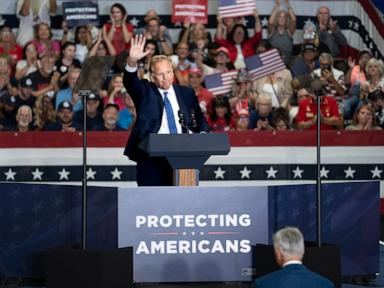
At the front of the room stands a candidate in a crisp blue oxford shirt. His sleeves are rolled precisely two turns up his forearms. Six months ago, his talking points were written in Washington by consultants who measure patriotism in decibels and think foreign policy is a game of chicken played with someone else's children. Back then, he talked about resolve. He talked about strength. He talked about projecting power across the Strait of Hormuz until the cameras clicked and the donors nodded.
Tonight, he is looking at the calloused hands of a retired machinist in the third row. The machinist's grandson is stationed on a destroyer in the Persian Gulf.
"We cannot afford another endless war in the Middle East," the candidate says. His voice drops an octave, losing the campaign-trail cadence. "Not with our blood. Not with our treasury. It is time to bring our people home and end this conflict with Iran."
Silence. Then, a slow, heavy wave of applause rolls from the back of the hall to the front.
If you only read the cable news chyrons or the glossy fundraising emails from party committees, you might miss what is happening in rooms like this across the country. On paper, it looks like a dry political trend—a statistical blip in campaign messaging. A growing number of Republicans running in tight, competitive congressional and Senate races are breaking away from traditional hawkish orthodoxy and calling for an end to the war with Iran.
Look closer, though. This is not a policy shift. It is a survival instinct.
The Kitchen Table Math of Foreign Entanglements
To understand why conservative candidates in swing districts are suddenly sounding like anti-war realists, you have to leave the think tanks of K Street and sit at a kitchen table in Pennsylvania, Michigan, or Arizona.
Consider a hypothetical voter—let's call her Sarah. Sarah is forty-two, manages a regional logistics office, and voted Republican in the last two cycles because she wanted lower taxes and cheaper gas. She does not subscribe to foreign policy journals. She does not care about the doctrinal debates between neoconservatives and isolationists.
What Sarah cares about is the receipt she gets at the pump every Thursday morning.
When conflict flares in the Middle East, the shockwaves do not stay politely confined to the desert. They travel through oil tankers, through shipping insurance premiums, through the diesel tanks of eighteen-wheelers hauling groceries to Sarah's local supermarket. A missile strike seven thousand miles away shows up three weeks later as a forty-dollar spike in her monthly electric bill and a quiet cancellation of her family's summer road trip.
Politicians in safe districts—places drawn with sharpie markers so the outcome is decided in the primary—can afford to treat war like an abstract sporting event. They get rewarded for sounding tough. Their voters rarely punish them for the second-order consequences of military intervention because the primary electorate is insulated by ideological loyalty.
Swing districts are different. Swing districts are merciless.
In a race decided by two percentage points, every voter is doing quiet, ruthless arithmetic. When an incumbent or a challenger stands on a stage and argues for prolonged military engagement in Iran, swing voters hear something very specific: Your paycheck is going to shrink, your gas is going to cost more, and your neighbor's kid might come home in a flag-draped box—all for an objective nobody can clearly define.
Candidates running in battleground seats feel that math in their bones. They see it in their internal polling. They hear it when they knock on doors on Saturday afternoons and the person answering refuses to take a flyer until they know where the candidate stands on the war.
Ghosts of the Twenty-Year Loop
There is a particular kind of exhaustion that settles over a nation when it realizes it is reading the same chapter of a book it swore it threw away.
For anyone who lived through the early 2000s, the language surrounding the conflict with Iran carries an eerie, sickening familiarity. We have heard the promises of surgical precision before. We have been told that a show of force will restore deterrence, that stability is just around the corner, that backing down now would invite chaos later.
I remember watching the grainy night-vision broadcasts from Baghdad in 2003, sitting on a threadbare couch while commentators drew arrows on maps with digital pens. Everything looked clean on those maps. The arrows were bright, decisive, and bloodless. It took years for the country to realize that maps do not bleed, and arrows do not have to relearn how to walk at Walter Reed.
Today's voters—especially the working-class coalition that now forms the backbone of the Republican Party—carry that scar tissue. Many of them are the exact families who sent sons and daughters to Fallujah and Helmand Province. They watched trillion-dollar price tags vanish into sand while bridges rusted in their own hometowns and manufacturing plants shuttered down the road.
When these voters hear calls to escalate against Iran, they do not feel a surge of patriotic pride. They feel a cold spike of recognition. They know how this movie ends. It starts with limited strikes and ends with ten thousand troops guarding a perimeter nobody understands, funded by debt their grandchildren will still be paying off.
Think of foreign intervention like a credit card with an introductory zero-percent interest rate. At first, the swipe feels effortless. You get the immediate rush of action, the illusion of control, the applause of pundits who never have to pay the bill. Then the promotional period expires. Suddenly, the compounding interest—measured in retaliatory strikes, fractured alliances, spiked energy prices, and crippled veterans—starts eating every dollar you earn.
Republicans in tight races have looked at the statement, and they are cutting up the card.
The Fracture Inside the Party
This rebellion has exposed a deep, jagged fault line running straight through the modern conservative movement.
On one side sits the old guard: lawmakers in safe seats, defense-aligned commentators, and party elders who still view American power through a late-twentieth-century lens. To them, projecting overwhelming military force is the ultimate conservative virtue. Anything less looks like weakness. When they look at Iran, they see an adversary that must be confronted, contained, and broken, regardless of the immediate domestic cost.
On the other side stands a new breed of pragmatic populist—candidates who realize that the Republican coalition has fundamentally changed.
Over the past decade, the GOP traded college-educated suburban hawks for blue-collar workers, small-business owners, and non-interventionist independents. That new base does not want the United States to police the globe. They view foreign wars as a luxury project designed by elites who profit from defense contracts while ordinary families absorb the inflation and the casualties.
For a Republican running in a purple district in New York, Virginia, or California, hugging the old hawkish line is political suicide. It alienates the anti-war independents they desperately need to win, while simultaneously deflating the populist base that expects them to put domestic economic survival first.
So, quietly at first, and now with growing volume, these candidates are breaking ranks.
They are framing their opposition to the Iran war not as a retreat, but as common sense. They are asking pointed, uncomfortable questions on the debate stage: What does victory actually look like? How much will this cost per household? Why are we subsidizing global shipping lanes while our own border and infrastructure remain neglected?
These are not radical questions. They are the questions people ask when they are paying their own bills.
What Happens When the Bill Comes Due
The real danger of any prolonged conflict is not just the explosions you see on television; it is the quiet theft of everything you cannot build while you are paying for them.
Every billion dollars routed toward naval deployments, interceptor missiles, and regional air defense in the Middle East is a billion dollars stripped away from the domestic ledger. It is money that does not go toward lowering the national debt, stabilizing interest rates, or keeping small businesses afloat when credit tightens.
Voters might not be able to cite the exact Pentagon budget allocations, but they feel the squeeze every time they apply for a mortgage or look at their grocery receipt. Inflation is an invisible tax, and war is its most reliable engine.
And then there is the human ledger—the part that never makes it into the economic forecasts.
In small towns across the Midwest and the South, military service is not an abstraction; it is a family tradition. When tensions escalate in the Persian Gulf, the anxiety is immediate and personal. High school seniors stare at recruitment brochures with a sudden, sobering clarity. Parents check their phones at three in the morning every time a news alert chimes. National Guard units get quietly placed on standby, pulling mechanics, nurses, and teachers out of local communities that are already stretched thin.
A candidate standing in front of those families cannot bluff his way through with Cold War slogans. If he tries, he sees the shutters come down behind their eyes.
The Republicans calling for an end to the Iran war have figured out something that their party leadership in Washington still struggles to grasp: you cannot tell people you are fighting for their freedom abroad while ignoring the fact that they are drowning at home.
The Shift That Cannot Be Undone
It would be easy to dismiss this trend as mere campaign cynicism—politicians shifting their sails because the wind changed direction in October. Doubtless, some of it is. Politicians are, by nature, creatures of survival.
Yet cynicism alone does not explain the sheer speed with which the anti-war message has taken root in battleground races. You cannot manufacture an emotional nerve; you can only strike one that is already exposed.
What we are watching in these swing districts is the death of an old political consensus. For decades, both parties operated under the assumption that toughness meant intervention, and restraint meant appeasement. Questioning a military buildup was the fastest way to get labeled naive or unpatriotic.
That spell is broken.
The voter who shows up to a town hall in Michigan or Nevada today is skeptical, weary, and fiercely protective of their own household's stability. They have watched too many leaders promise quick victories that turned into generational quagmires. They no longer trust the experts who assure them that this time the escalation will be contained, this time the objectives are clear, this time the cost will be manageable.
They want an exit ramp. And they are rewarding the candidates brave enough to build one.
Back in that Ohio VFW hall, the applause finally dies down. The candidate steps off the low wooden stage and walks toward the back of the room, shaking hands as he goes.
He stops in front of the retired machinist in the third row. The two men do not talk about geopolitical strategy, oil futures, or party platforms. The older man pulls a creased photograph from his wallet—a young sailor standing on a gray steel deck against a flat, blinding horizon—and holds it out under the humming fluorescent light.
The candidate looks at the photo, nods once, and slips his hands back into his pockets as he walks out into the cold night air.