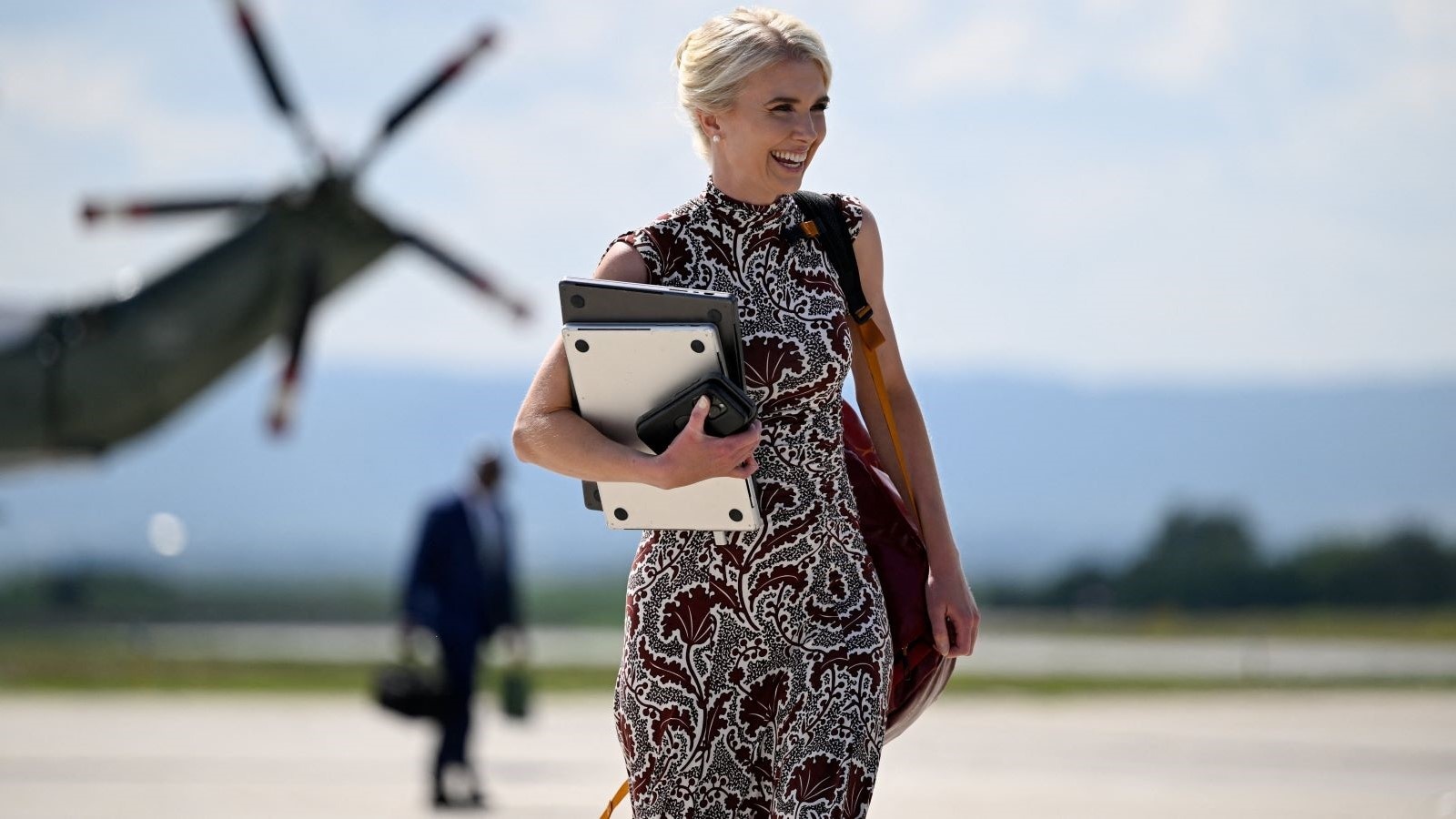
Natalie Harp holds a position of influence within the current administration that defies traditional organizational charts. Often identified as the president’s "human printer," she serves as an executive assistant to Donald Trump, functioning as a high-speed conduit between the unfiltered flow of digital information and the president’s preference for physical, paper-based briefings. While critics and political opponents suggest her role reflects a detachment from formal governance, her presence represents a shift in how information moves through the highest levels of the executive branch.
The nickname stems from her practice of carrying portable hardware to provide immediate, hard-copy printouts of news articles, social media sentiment, and urgent briefings. For a leader who famously resists consuming information via screens, Harp acts as the necessary interface. This isn't merely an administrative convenience. By curating the physical pile of documents that sits on the Resolute Desk or travels on Marine One, she dictates the rhythm of the president’s daily intake. Read more on a connected topic: this related article.
Her ascent from a vocal supporter to a permanent fixtures in the president’s inner circle began with a singular, compelling narrative. In 2019, she publicly credited the administration's Right to Try legislation for her survival while battling bone cancer. This story provided the ideological foundation for her loyalty. She translated that personal gratitude into a professional trajectory that moved through right-wing media circles before securing a role at the center of the Trump campaign and, ultimately, the White House.
The operational reality of her job is distinct from that of previous presidential assistants. She is not merely managing a schedule. She is the gatekeeper of the digital footprint for the most powerful office in the world. She manages the president’s Truth Social account, acting as the typist for dictated posts that often bypass traditional communications vetting. When a post appears on the platform, it is frequently the result of an immediate, real-time collaboration between the president and his assistant. Additional reporting by The New York Times delves into comparable perspectives on this issue.
This lack of formal oversight has created friction. Internally, traditional staff members have observed her influence with apprehension. Because she manages the president’s social media account independently, she effectively removes the standard layers of administrative review that protect a sitting president from public controversy. For the political establishment, this is a glaring vulnerability. For the president, it is a mechanism of efficiency that rewards total personal loyalty over bureaucratic consensus.
The recent focus on Harp, catalyzed by remarks from Senator Jon Ossoff during a campaign appearance, highlights a broader anxiety regarding the composition of the executive inner circle. By framing her role as a distraction from official duties, critics ignore the reality of how this president functions. He does not seek traditional, committee-led consensus; he seeks reinforcement and rapid execution. Harp provides both. Whether she is bringing printouts to a golf outing or managing sensitive communications while traveling on backup aircraft during security scares, she operates as an extension of his own decision-making process.
The concern expressed by external observers—that she operates as a sycophant or an unfiltered voice—misses the functional utility of her position. In any executive structure, the person who controls the flow of information holds the real authority. She does not need a title that sounds grand to command attention. She occupies the space where the president’s attention is captured.
Her background as a former television presenter and her tenure at One America News Network provided her with an acute understanding of the media environment the president values. She understands that in this political climate, the perception of an event often carries as much weight as the event itself. By prioritizing the curation of stories that confirm or challenge the president’s worldview, she ensures that he is always operating within a loop of information that is curated to his specific preferences.
There is a recurring question in Washington about what happens when the architect of an information filter becomes the story. The current spotlight on her role suggests a transition in how she is perceived. She is no longer just a support staffer. She is a recognized variable in the political calculus of the administration. When her name is invoked during campaign rallies, it is an acknowledgment that her influence is no longer confined to the back offices of the White House.
The friction created by her independence is unlikely to dissipate. As long as the current administration maintains its commitment to a direct, unmediated communication strategy, the reliance on an individual who functions as a gatekeeper for digital content will remain. Whether this is an effective strategy for governance or a risky shortcut remains a matter of perspective. One thing is certain. She is a reflection of the president’s own priorities, a mirror held up to the way he expects his government to work.
The system she operates within is designed to minimize friction for the principal at the cost of broader institutional checks. Her loyalty is to the person, not the bureaucracy. In a city where staffers are often categorized by their proximity to power, she has secured her position by ensuring she is the only person who can deliver what the president wants, exactly when he wants it. The printer is always ready. The workflow never stops. The president stays focused on what she puts in his hands.