Red clay clings to everything in Georgia. It stains the cuffs of white dress shirts during late-autumn campaign stops in Macon, settles into the treads of work boots outside Savannah shipping yards, and coats the fenders of pickup trucks parked along two-lane highways in the northern foothills. For decades, political observers treated that clay as a permanent color code—a shorthand for a state whose electoral map seemed baked solid under the Southern sun.
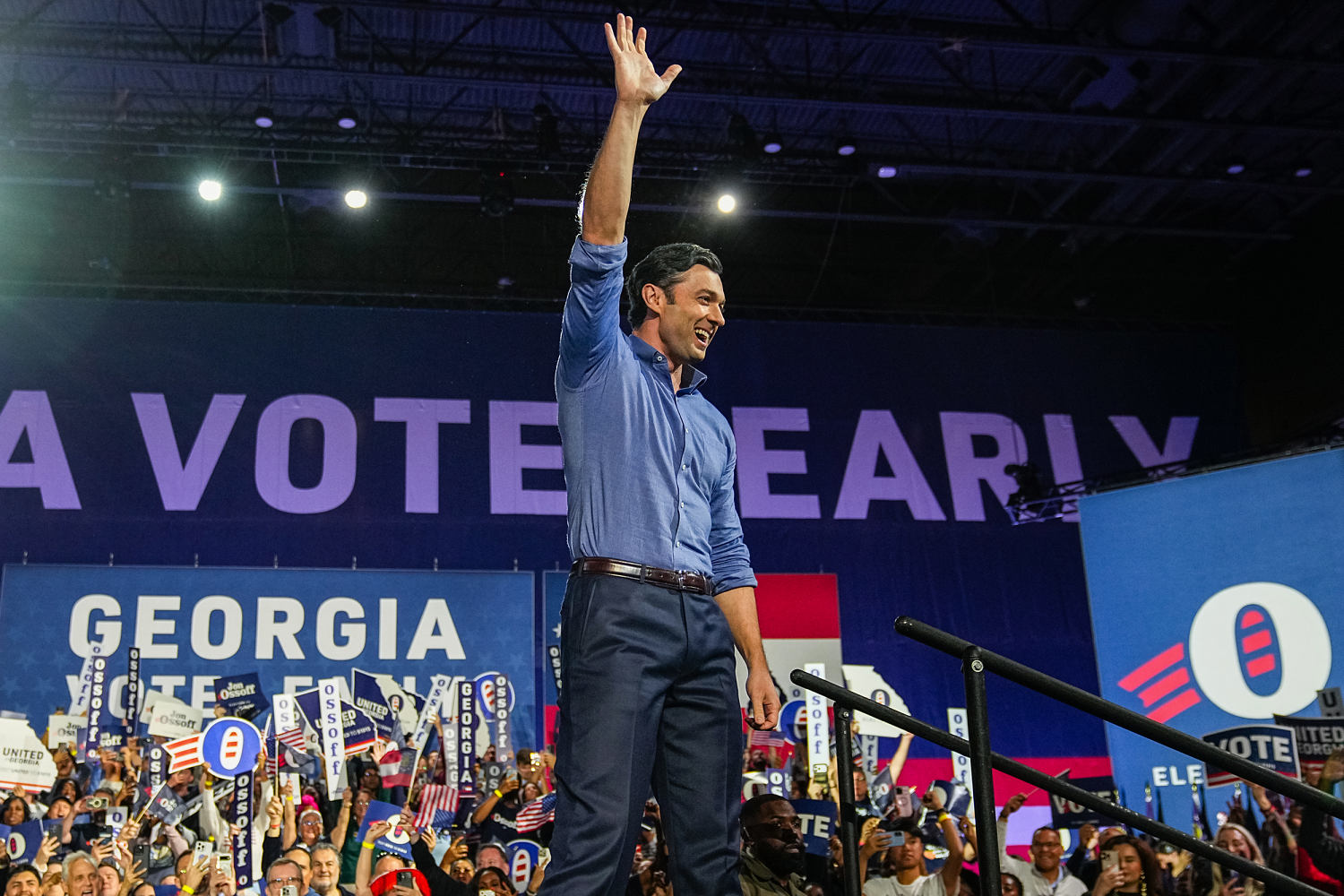
Then came the November 2026 midterm elections, and with them, a headline that looked deceptively simple on wire services across the country: Democratic Senator Jon Ossoff had won re-election in Georgia.
Cruised. That was the word many commentators reached for when the Associated Press and major television networks called the race. On a spreadsheet, a comfortable margin looks effortless, like a plane gliding down a runway with a tailwind. Yet standing inside a precinct gymnasium in DeKalb County at 6:45 a.m. on Election Day, watching fluorescent lights hum over rows of folding tables while rain tapped against the roof, nothing about Georgia politics felt effortless.
To understand what happened in Georgia in 2026—and why political analysts, party strategists, and everyday voters spent months dissecting every county line—you have to look past the box score. A Senate race in a battleground state is never merely a referendum on one person. It is a stress test on what millions of neighbors believe they owe one another when the cost of groceries climbs, when manufacturing plants rise out of old pine forests, and when national politics feels less like a conversation and more like a sirens-blaring traffic jam.
The Weight of a Second Act
Six years earlier, in January 2021, Jon Ossoff had won his first term in a runoff election decided by roughly 55,000 votes—a margin thinner than the capacity of Truist Park on a Friday night in July. Back then, at thirty-three years old, he entered the United States Senate as its youngest member since Joe Biden nearly half a century prior. Supporters saw a generational shift; critics dismissed him as a temporary beneficiary of national headwinds and historic turnout.
Incumbency changes the physics of a campaign. In 2021, Ossoff was running on promises. By 2026, he was running on receipts, and receipts are messy things in public life. Every vote cast on Capitol Hill leaves a paper trail that opponents can photocopy, enlarge, and mail to half a million households.
Consider a hypothetical voter—let’s call her Elena, a composite drawn from the demographic realities of Gwinnett County, just northeast of Atlanta. Ten years ago, Gwinnett was reliably Republican. Today, it is one of the most diverse counties in the American South, home to Korean bakeries, Mexican taquerias, sprawling logistics hubs, and subdivisions where cul-de-sacs echo with three or four languages at dusk. Elena manages inventory for a mid-sized medical supply distributor. She does not watch cable news. She tracks interest rates, diesel surcharges, and the monthly bill for her family’s health insurance.
When Elena walked into her polling place in November 2026, she was not thinking about Senate committee assignments or parliamentary procedure. She was weighing a quieter question: Is my life more stable than it was four years ago, and who seems focused on keeping it that way?
Political scientists call this retrospective voting. In plain terms, it means voters judge the person holding the steering wheel by whether the car stayed on the road. According to exit polling and post-election analyses published by outlets such as The Atlanta Journal-Constitution and national polling consortia, economic anxiety remained the single heaviest factor on Georgia ballots in 2026. Inflation had cooled from its post-pandemic peaks, yet the cumulative price of housing, childcare, and everyday staples still weighed on household budgets.
Republican challengers and conservative outside groups hammered that exact pressure point. Throughout the summer and fall of 2026, television airwaves from Columbus to Augusta saturated living rooms with advertisements tying Ossoff directly to the economic policies of the Biden-Harris era and Democratic spending packages. Their argument was straightforward and resonant to millions of Georgians: federal spending had fueled higher prices, border enforcement remained inadequate, and a vote for Ossoff was a vote to extend policies that strained working families.
Building an Unlikely Shield
How, then, did a Democrat in a state Donald Trump carried in 2016 and reclaimed in 2024 build enough insulation to win re-election decisively?
Part of the answer lies in an unglamorous, almost methodical approach to constituent service and targeted legislation that rarely makes national cable panels. Throughout his first term, Ossoff leaned heavily into committee work that produced tangible, localized headlines in Georgia’s regional newspapers—the kind of outlets people still read over biscuits at local diners.
He chaired the Senate Permanent Subcommittee on Investigations, using the gavel to probe conditions inside federal prisons—including high-profile scrutiny of the U.S. Penitentiary in Atlanta—as well as delays in Veterans Affairs medical care and supply chain bottlenecks affecting Georgia ports. For a veteran in Hinesville waiting eight months for a specialist appointment, or a correctional officer’s family worried about understaffing, those hearings were not abstract Washington theater. They were evidence that someone was paying attention to unglamorous failures.
At the same time, Georgia’s physical landscape was undergoing an industrial transformation. Driven in large part by federal clean-energy and semiconductor incentives passed during the 117th Congress—legislation Ossoff voted for and promoted relentlessly—billions of dollars in private manufacturing investment flowed into the state. Electric vehicle plants, battery factories, and solar panel facilities broke ground from Bryan County near Savannah to Bartow County northwest of Atlanta.
For Republican leaders, including Governor Brian Kemp, those projects were proof of Georgia’s business-friendly tax climate and workforce readiness. For Ossoff, they were proof that federal industrial policy could deliver blue-collar paychecks to rural and suburban counties that had spent decades watching textile mills close. Both narratives contained truth. Voters in those communities found themselves standing at the intersection of two competing credit claims, deciding which story matched what they saw rising along the highway.
Think of a contested battleground state like a suspension bridge anchored to two massive towers. One tower is the dense, rapidly growing metropolitan core of Atlanta and its inner suburbs, where Democratic margins have expanded steadily over the past decade. The other tower is rural and small-town Georgia, where conservative loyalty runs deep and cultural skepticism toward Washington remains fierce. The bridge only holds—or tips—depending on the tension across the cables in the middle: the outer suburbs, college towns like Athens, mid-sized cities like Savannah, Macon, and Columbus, and independent voters who refuse to wear either party’s jersey permanently.
In 2026, Ossoff did not need to win rural Georgia. No Democrat does. He needed to keep rural losses from becoming routs while running up strong margins in metro Atlanta and holding steady among suburban moderates.
The Anatomy of Turnout
Midterm elections usually punish the party in power, or at least suffer from a sharp drop-off in participation compared to presidential years. Organizers in Georgia knew that arithmetic well. When the excitement of a presidential race fades, precinct turnout can sag like an unstrung clothesline.
Both parties poured tens of millions of dollars into field operations designed to prevent that sag. In Democratic headquarters from Fulton County to Chatham County, staffers focused on a specific cohort: younger voters, Black voters in metro Atlanta and the Black Belt, and Asian American and Hispanic households whose numbers had surged since the 2020 census.
Yet raw spending never guarantees turnout. Anyone who has knocked on doors on a humid October afternoon in Georgia knows how quickly a scripted talking point evaporates on a front porch. Doors open a crack. Dogs bark. People are tired after double shifts. When voters did talk, organizers across both parties reported a similar refrain: exhaustion with performative outrage.
Ossoff’s campaign leaned into that exhaustion by projecting disciplined restraint. While national politics often rewards the loudest voice in the room, his public appearances tended toward measured, almost professorial cadence—focusing on infrastructure grants, maternal mortality rates in rural hospitals, and military base funding for Fort Moore and Robins Air Force Base. Supporters called it steady leadership. Detractors called it cautious triangulation, arguing he avoided taking bold stands on polarizing cultural debates to protect his flank with swing voters.
Meanwhile, the Republican effort in Georgia navigated its own internal currents. After years of bruising primary battles and debates over party direction between traditional business conservatives and populist nationalists, GOP strategists worked to unify their coalition around kitchen-table economics, public safety, and border security. In many northern counties and agricultural stretches of South Georgia, that message held firm. Turnout in reliable Republican strongholds remained disciplined, demonstrating that the conservative coalition in the state retained formidable organizational muscle.
Still, numbers tell an unforgiving story when the precincts close. As returns rolled in on election night in November 2026, early bellwethers in suburban counties like Cobb, Gwinnett, and Henry showed Ossoff matching or exceeding benchmarks needed to offset rural deficits. In Chatham County on the coast, margins held strong. By the time remaining ballots from metro Atlanta were tallied, the mathematical path for a Republican upset had narrowed to a thread.
What the Margin Actually Means
When a race is described afterward as a "cruise," there is a temptation to rewrite history—to assume the outcome was inevitable from the moment the filing deadline passed. That is almost always an illusion born of hindsight.
Nothing in Georgia’s political equilibrium is permanent. The same electorate that sent two Democrats to the U.S. Senate in 2021 and re-elected Raphael Warnock in 2022 also re-elected Republican Governor Brian Kemp by more than seven percentage points in 2022 and backed Donald Trump in 2024. Georgia voters have demonstrated a willingness to split their tickets, reward incumbents they perceive as pragmatic, and punish candidates who seem out of step with local priorities.
Consider another hypothetical scene, this time in a small hardware store outside Warner Robins, near Robins Air Force Base. Two neighbors stand near the register—one a retired Air Force master sergeant who votes reliably Republican, the other a public school teacher who leans Democratic. They disagree sharply on tax policy, federal regulations, and the direction of the country. Yet both care deeply about whether the base down the road keeps its aircraft maintenance missions, whether local roads can handle morning traffic, and whether their children can afford a house within thirty miles of home.
In 2026, Ossoff’s re-election rested on convincing enough people in that middle space—including voters who do not agree with him on every issue—that he was working inside the machinery of government rather than throwing wrenches into it. Critics on the right maintain that his voting record remains squarely aligned with national Democratic priorities and that rising federal debt will eventually catch up with the state’s booming economy. Critics on the left occasionally wish he pushed harder and louder on progressive structural reforms. Both critiques point to the narrow tightrope any statewide official in Georgia must walk.
Beyond the Headline
By Wednesday morning after the election, the yard signs were already coming down along Peachtree Street and country crossroads alike. Rain washed away the last chalk marks outside elementary school polling sites. In Washington, the arithmetic of the United States Senate absorbed Georgia’s result into the broader tally of committee ratios and legislative calendars.
Yet back on the ground in Georgia, the real story was never the margin of victory. It was the quiet maturation of a state that spent years being treated as a political anomaly and has settled into something far more consequential: a genuine, competitive bellwether where neither party owns the deed.
Out along the Ocmulgee River south of Macon, morning fog rises off the water before the interstate traffic begins to roar, blurring the line between old timberland and new concrete warehouses—two versions of the same state waking up side by side.