Cold.
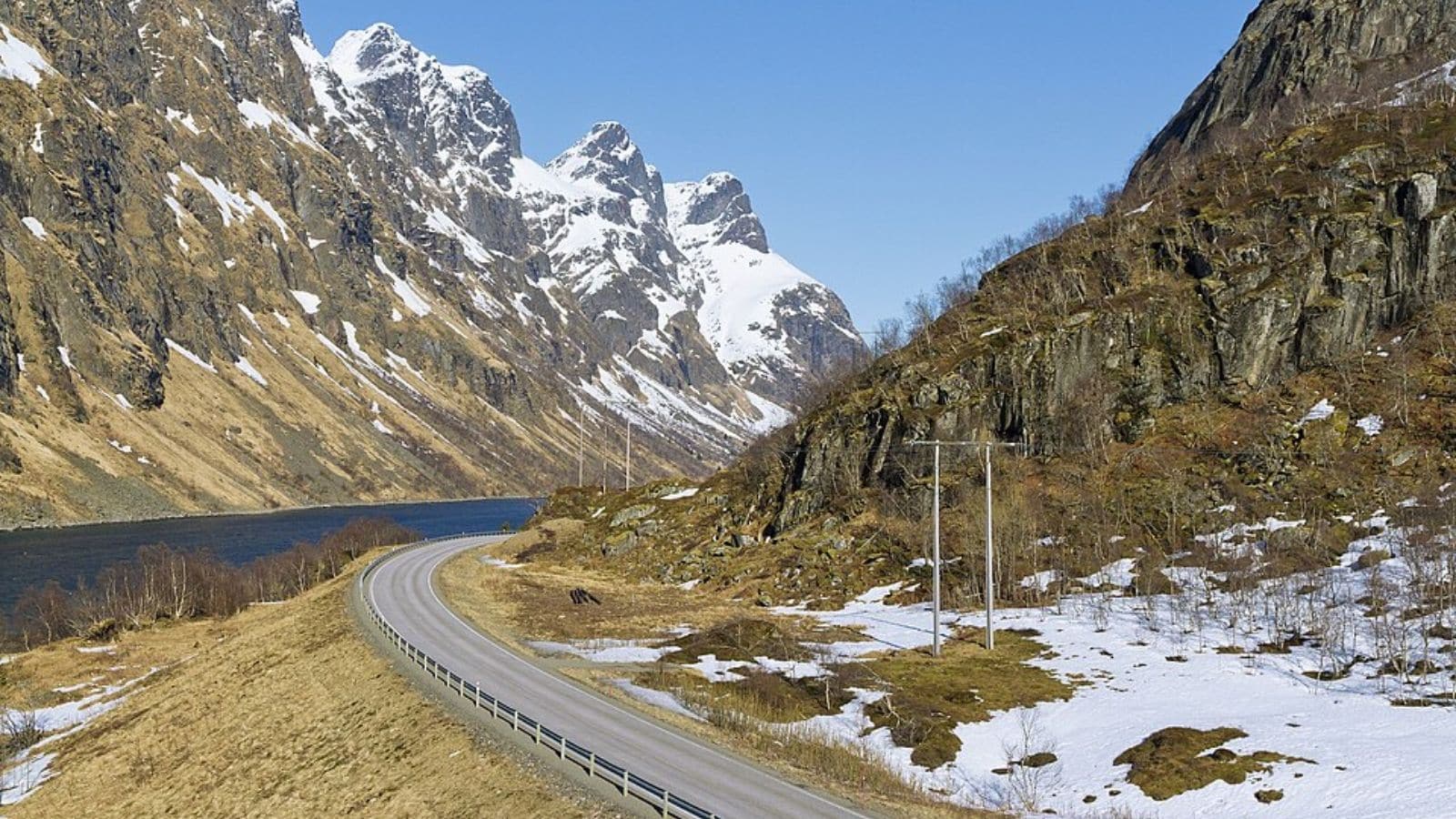
That is the first thing you notice when you step off the coastal ferry onto the edge of the Helgeland archipelago, right where the Norwegian Sea smashes its fists against granite cliffs that have stood there since the last ice age. The wind does not merely blow across northern Norway; it interrogates you, slipping through the zipper of a gore-tex shell to remind your bones how small you actually are.
Now picture a traveler—let us call him Arthur, a hypothetical accountant from Ohio who spent four thousand dollars to see the midnight sun and currently needs a bathroom.
Arthur is standing on a jagged peninsula called Ureddplassen, miles from the nearest coffee shop, miles from the nearest town, miles from anything resembling modern plumbing. In almost any other wilderness on earth, Arthur’s options would involve a pine tree, a shovel, or a plastic chemical box smelling faintly of blue disinfectant and regret. Instead, Arthur walks up to a concrete wave frozen in mid-curl, pushes open a frosted glass door, and steps inside a warm, softly lit architectural masterpiece overlooking a fjord where submarines once vanished into the deep.
He washes his hands. He looks out at the Arctic water. He takes a photo.
Years later, thousands of miles away, a former American president steps up to a microphone, angry about not winning the Nobel Peace Prize, and mocks Norway in front of a roaring crowd. He dismisses the country’s prestige, questions its relevance, and inadvertently hands a tiny Scandinavian nation the greatest marketing gift of the twenty-first century.
Norway did not issue a stern diplomatic rebuke. They did not summon an ambassador. They looked at the insult, smiled, and pointed directly at Arthur’s bathroom.
The Anatomy of a Geopolitical Eye-Roll
To understand why a nation of five and a half million people responded to superpower fury with photos of public toilets, you have to understand the particular quietness of Scandinavian confidence.
When Donald Trump repeatedly aired his grievances over being passed over for the Nobel Peace Prize—a prize awarded by an independent five-member committee appointed by the Norwegian Parliament, not by the Norwegian government itself—the political machinery in Washington treated the remarks like a diplomatic tremor. Pundits dissected the rhetoric. Cable news panels debated transatlantic alliances. Everyone braced for the usual, exhausting cycle of outrage, counter-outrage, and carefully worded press releases drafted by exhausted civil servants in windowless rooms.
Visit Norway, the nation’s official tourism board, chose a different path entirely.
They leaned into the punch with the deadpan timing of a seasoned stand-up comic. In a tongue-in-cheek social media campaign that immediately ricocheted across the internet, the tourism board acknowledged the criticism of their country’s international standing and gently pivoted to the things they actually take pride in—specifically, their world-famous, architect-designed roadside restrooms. "We might not give everyone the prize they want," the subtext whispered, "but come see our toilets. They have the best views on earth."
Brilliant.
It was a masterclass in asymmetric communication. Think of it like aikido, the Japanese martial art where you never meet force with force; you simply step aside, grab your opponent’s wrist, and let their own momentum carry them straight onto the mat. By refusing to argue about geopolitics—an argument nobody wins on social media—Norway changed the venue entirely. They moved the conversation from the toxic mud of partisan grievance to the crisp, clean air of Arctic fjords and Nordic design.
I remember the first time I stood inside one of those structures along the Aurlandsfjellet mountain road, shivering after a six-hour drive through blinding summer sleet. My fingers were numb. My patience was gone. When I walked onto the Stegastein viewpoint and realized the public restroom was a minimalist timber-and-concrete box cantilevered over a two-thousand-foot drop, I actually laughed out loud. The floor-to-ceiling window in front of the sink framed an unbroken expanse of mist, pine, and glacial water so vast it made every petty human argument feel entirely absurd. You walk out of a place like that feeling strangely dignified, as if someone decided your most basic human need deserved the same aesthetic respect as an opera house.
Why Concrete Boxes on Cliffs Actually Exist
Here is the secret that made the joke land so hard: Norway was not bluffing.
Those toilets are not a punchline invented by a clever copywriter in Oslo; they are the physical manifestation of a thirty-year, multi-billion-kroner public infrastructure project that treats ordinary travelers like royalty.
Back in the early 1990s, the Norwegian Public Roads Administration faced a deceptively simple problem. Tourists were flocking to the country’s dramatic coastline and mountain passes, drawn by the fjords, the northern lights, and the promise of untouched nature. There was just one catch. When thousands of motorists pull over on narrow mountain roads with no facilities, nature stops being untouched very quickly.
Most governments solve this problem the cheap way. They pour a slab of grey asphalt, drop a prefabricated concrete bunker next to a dumpster, bolt a steel mirror to the wall, and call it a day. The message to the traveler is unmistakable: Do your business, wash your hands if the soap dispenser works, and get back on the highway.
Norway decided to hire its best young architects instead.
Under the banner of the Norwegian Scenic Routes (Nasjonale turistveger), the state commissioned dozens of architectural firms to transform eighteen stretches of ordinary highway—spanning over two thousand kilometers from the southern tip of Jæren to the Russian border in Varanger—into an open-air museum of contemporary design. They built viewing platforms that jut out over waterfalls like diving boards. They poured sculptural picnic tables that mimic the curves of wind-carved snow. And, yes, they built restrooms that routinely win international design awards and appear on the covers of architecture magazines.
Consider what that actually requires in practice.
Building a rest stop on a flat suburban interstate in Ohio is a logistics exercise. Building one on a windswept granite shelf above the Arctic Circle—where winter temperatures plunge past minus twenty, where hurricane-force gales tear roofs off barns, and where concrete has to be barged across open water before being lifted into place by helicopter—is an act of stubborn devotion.
Take the Ureddplassen rest stop, the very one our hypothetical friend Arthur visited. Originally built as a memorial to the forty-two Norwegian sailors who perished when the Royal Norwegian Navy submarine HNoMS Uredd struck a German mine in 1943, the site was redesigned by the Oslo-based firm Haugen/Zohar Arkitekter. They created a wave-shaped concrete structure housing a single, frost-resistant restroom with glowing translucent glass walls that act as a soft beacon during the pitch-black polar winter. Outside, pink Norwegian marble benches step down toward the sea like an amphitheater facing the aurora borealis.
Nobody needed to use pink marble for a highway rest stop. Nobody needed to hire award-winning architects to design a place where truckers and camper-van tourists stop to relieve themselves between ferry crossings.
Yet they did. And when a foreign leader tried to belittle the nation, those pink marble benches and cantilevered glass boxes suddenly became the sharpest rhetorical weapons in Europe.
The Invisible Stakes of National Dignity
There is a deeper current running beneath the humor here, something we rarely pause to examine when we scroll past a viral tourism ad on our phones.
We live in an era where public discourse has become an arms race of volume. Every slight demands a louder counter-slight; every political jab triggers an avalanche of performative outrage. Brands, politicians, and entire nations fall into the trap of defending themselves on their critics' terms, mistaking noise for strength.
I have watched organizations tear themselves apart trying to win arguments they never needed to enter. Years ago, while advising a small regional cultural institute that had been unfairly lampooned in a national newspaper, I watched the board of directors spend three weeks drafting a twelve-hundred-word point-by-point rebuttal. They cited footnotes. They corrected minor factual errors. They demanded a retraction. When the newspaper finally buried a three-sentence clarification on page fourteen, nobody read it, the board looked defensive and humorless, and the original mockery remained the only thing anyone remembered.
Contrast that with what happened in Oslo.
By refusing to take the bait on the Nobel Peace Prize—an institution whose independence the Norwegian government legally cannot and will not compromise—the tourism board protected the integrity of the prize while elevating the country’s brand. If a government official had stepped up to a podium to lecture an American president on the bylaws of Alfred Nobel’s 1895 will, the story would have died in twenty-four hours as just another dry diplomatic squabble.
Instead, by pivoting to architecture and wilderness, Norway forced millions of readers around the world to pause and ask a completely different question: Wait—why does Norway actually have the most spectacular toilets in the world?
Curiosity replaced conflict. Search traffic spiked. People who had never thought about visiting northern Scandinavia suddenly found themselves staring at photographs of Bukkekjerka on the island of Andøya—a jagged, folded-steel rest stop shaped like a coastal mountain peak, equipped with one-way mirrored glass so you can look out at the roaring Norwegian Sea in complete privacy while nobody outside can see in.
Think about the psychology of that moment. You cannot stay angry while looking at a picture of a mirrored glass bathroom perched on the edge of the Arctic Ocean. The sheer absurdity of the contrast—grandiose political grievance on one side, quiet architectural perfection on the other—punctures the tension instantly.
The Hard Truth Behind the Punchline
Of course, it would be dishonest to pretend that Norway is a flawless utopia where every fjord sparkles and every public policy runs like a Swiss watch.
Spend enough time traveling through the country and the romance hits a few sharp edges. A simple lunch of fish soup and a glass of tap water in Bergen can easily cost thirty-five dollars. The weather along the western coast is famously indifferent to your vacation plans, capable of dumping sideways rain for eleven straight days in July while the tourism brochures show smiling hikers in sunglasses. Even the celebrated Scenic Routes project has faced domestic criticism over spiraling budgets, maintenance headaches in brutal sub-Arctic winters, and the environmental strain of funneling hundreds of thousands of camper vans onto fragile coastal ecosystems.
And the political reality beneath the joke is no laughing matter either. For a small Nordic nation sharing a border with Russia and relying heavily on transatlantic security alliances, navigating the unpredictable whims of American politics is a delicate, high-stakes balancing act. Diplomats in Oslo spend sleepless nights calculating trade tariffs, Arctic defense treaties, and energy security—problems that cannot be solved with a witty Instagram caption.
That is precisely why the tourism campaign felt so cathartic.
When you are a small country living next to giants, you cannot out-shout them. You cannot out-spend them. Your only real currency is who you are when nobody is watching. For thirty years, while no foreign president was paying attention, Norway poured concrete on lonely cliffs so that tired travelers—bikers, families, solo hikers, truck drivers—would have a clean, warm, dignified place to pause on a long road.
They built those rooms for the quiet moments, never imagining they would one day need them for a loud one.
Where the Road Ends
Imagine Arthur again, the accountant from Ohio, stepping back out through that frosted glass door at Ureddplassen.
The wind hits his face immediately, cold and sharp, carrying the salt spray of the Norwegian Sea. Behind him, the curved concrete roof glows softly against the twilight, humming quietly against the gale. Ahead of him, the pink marble steps descend toward the dark water, where the sky is just beginning to ripple with the first faint ribbons of green light.
Far across the ocean, microphones are still hot, crowds are still shouting, and pundits are still arguing about who deserves which medal and why.
Arthur zips up his jacket, walks down to the edge of the granite cliff, and breathes in the Arctic air. There is nothing left to argue about.