Cold coffee tastes like stale pennies at three in the morning.
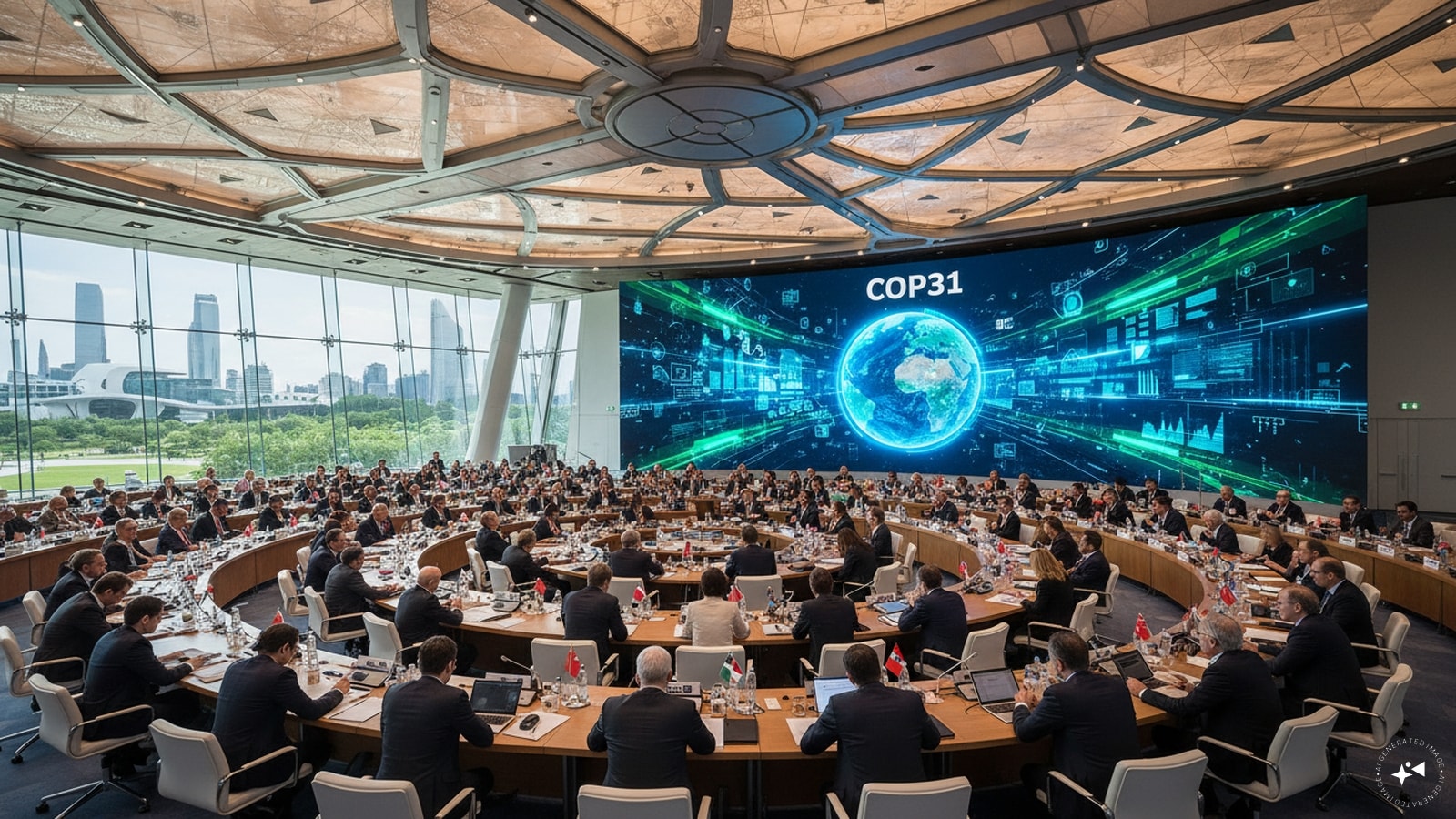
If you have ever sat inside a windowless convention hall while nearly two hundred nations argue over a single verb, you know that specific, metallic bitterness. Your eyes burn from fluorescent lights that never dim. Your shoes feel two sizes too small. Outside, the Mediterranean air of Antalya, Turkey, might be cool and fragrant with salt and pine, or maybe the rain is tapping softly against the glass pavilions—depending on which November night you step out for air—but inside the plenary zone, time does not move in hours. It moves in brackets. Meanwhile, you can find other events here: What Happens When Survivor Support Payments Stop and Your House Is on the Line.
Square brackets. [Shall] versus [should]. [Phase out] versus [transition away from].
Right now, as the COP31 climate talks inch toward a final agreement and the summit president announces that a deal is finally within reach, headlines across the globe are treating the moment like the final two minutes of a championship game. They love a countdown. They love the theater of a gavel poised over a wooden block, waiting to fall. To explore the full picture, check out the detailed report by NPR.
But if you look past the press releases and the triumphant podium statements, the real story of COP31 is not happening at the microphone. It is happening in the quiet, exhausted spaces between the words—and in the lives of people who will never step foot inside a diplomatic zone.
The Architecture of a Compromise
To understand why a "final deal" at a United Nations climate summit feels both monumental and maddeningly fragile, picture a hypothetical negotiator named Tariq. Let us be clear: Tariq is a composite character, an imagined figure built from the very real, documented experiences of delegates from small island developing states who attend these summits year after year.
Tariq represents a Pacific nation where high tide no longer stays on the beach. When he packs his suitcase for COP31, he does not pack theories. He packs photographs of his grandmother’s breadfruit trees dying from saltwater intrusion, and a spreadsheet showing that rebuilding a single coastal road after a Category 4 cyclone consumes twelve percent of his country’s annual gross domestic product.
Across the negotiating table from our hypothetical Tariq sits another composite character—let us call her Elena, an energy ministry official from a rapidly industrializing economy. Elena is not a cartoon villain twirling a mustache. She is a civil servant tasked with keeping the lights on for forty million people who still cook over open biomass fires, while simultaneously trying to satisfy investors, protect domestic manufacturing jobs, and honor international emissions pledges.
When the COP31 president says the talks are "close to a final deal," what that actually means is that people like Tariq and Elena have spent fourteen days trading commas for survival.
Think of a global climate agreement not as a single, binding contract signed in a boardroom, but as a massive, interlocking roof being built over two hundred houses at once, in the middle of a hurricane, by neighbors who do not speak the same language and do not fully trust each other’s measurements. Every beam has to bear weight. If one country refuses to pay for the timber, the beam sags. If another refuses to stop burning coal in the basement, the whole structure fills with smoke.
And here is the catch that rarely makes the evening news: under United Nations Framework Convention on Climate Change rules, decisions are made by consensus. Consensus does not mean everyone agrees wholeheartedly. It means nobody formally objects when the gavel drops. One single nation, out of nearly two hundred, can stall the entire apparatus if a paragraph threatens its economic lifeline—or its sovereignty.
Why COP31 Matters More Than the Headlines Admit
You might be wondering, understandably, whether any of this diplomatic choreography actually changes the temperature of the planet. It is a fair question. After thirty previous Conferences of the Parties—from Berlin in 1995 to Paris in 2015, Dubai in 2023, Baku in 2024, and Belém in 2025—skepticism is not cynicism. It is pattern recognition.
I remember standing outside a negotiating room years ago, watching a young activist weep silently against a concrete pillar because a phrase committing wealthy nations to concrete adaptation funding had been watered down to "encourages enhanced support." Watching that happen in real time strips away any romantic illusions about international diplomacy. You realize quickly that words in these rooms are not poetry; they are currency, and everyone is trying to spend as little as possible while demanding maximum insurance.
Yet dismissing the process misses the invisible machinery that COP agreements actually set in motion.
Consider what happened after the Paris Agreement in 2015. Before Paris, the world was on track for roughly 3.5 to 4 degrees Celsius of warming by the end of the century—a scenario that climate scientists associate with catastrophic systemic collapse. Since Paris, driven by national climate plans known as Nationally Determined Contributions (NDCs), clean energy deployment has accelerated faster than almost any agency predicted a decade ago. Solar power is now the cheapest source of new electricity in most of the world. Electric vehicle adoption has reshaped global automotive supply chains.
None of that happened because a UN gavel magically turned off an oil well. It happened because international agreements send an unmistakable market signal. When nearly two hundred governments put a direction of travel on paper, central banks, pension funds, sovereign wealth managers, and utility companies recalibrate trillions of dollars in long-term capital.
At COP31, the stakes revolve around three interlocking pressures that previous summits left unresolved:
- The Implementation Gap: Promises made in Belém and Dubai have to translate into actual grid upgrades, methane reductions, and fossil fuel phase-downs—not in 2050, but in the late 2020s and early 2030s.
- The Finance Bottleneck: Developing nations need trillions, not billions, to build clean energy infrastructure and fortify coasts against storms that are already locked into the climate system. Who pays, how much comes as grants rather than debt-trapping loans, and how quickly the money moves remain the sharpest fault lines in the room.
- Accountability Without a Police Force: There is no international climate police. There are no fines for missing a target. The only enforcement mechanism is radical transparency—forcing countries to show their math publicly every two years and face the geopolitical pressure of their peers.
The Invisible Stakes in the Corridor
Walk down the main concourse of any COP summit in the final forty-eight hours, and you can feel the atmosphere thicken. The suits get rumpled. The lanyards tangle. Journalists camp out on the carpeted floors beside power strips, refreshing draft text documents on their laptops like traders watching a crashing stock ticker.
In these final hours, the summit presidency plays a delicate psychological game. By announcing publicly that talks are "close to a final deal," the president is doing two things at once. First, they are signaling momentum to prevent exhausted delegations from walking away or reopening settled text. Second, they are applying quiet political heat: nobody wants to be the country blamed on the front page of tomorrow’s newspapers for blowing up a global climate accord.
But momentum can also be a trap.
When speed becomes the primary metric of success, ambition is usually the first casualty. To get a stubborn petro-state or a coal-dependent economy to drop its objection at 4:00 AM, negotiators often soften the verbs. A firm commitment to "phase out unabated fossil fuels" becomes a softer pledge to "accelerate efforts toward low-emission energy systems." A binding timeline for climate finance turns into a "dialogue" or a "work program" scheduled to report back at COP32.
For the diplomats in the room, that compromise feels like survival. They get to go home, hold a press conference, and declare that multilateralism works.
For our hypothetical negotiator Tariq, sitting in the back row with cold coffee in his cup, a softened verb has a very different weight. It means another three years before the seawall gets funded. It means another decade of record ocean temperatures bleaching the coral reefs that feed his village.
The Truth About Uncertainty
If I am being completely honest with you, watching these summits unfold induces a strange kind of vertigo. On one hand, the physics of the atmosphere are brutally simple and entirely indifferent to diplomatic schedules. Carbon dioxide traps heat. Every tenth of a degree of warming increases the frequency and intensity of extreme weather—heatwaves that buckle railway tracks, droughts that empty reservoirs, atmospheric rivers that drown entire valleys in forty-eight hours. The atmosphere does not negotiate. It does not grant extensions because an election is coming up in a swing state or because a ministry ran out of budget.
On the other hand, human societies do not change at the speed of physics. We move at the speed of politics, infrastructure, fear, and habit. Expecting two hundred nations with wildly different histories, wealth levels, and vulnerabilities to move in lockstep is like expecting an orchestra to play a symphony while half the musicians are still building their instruments and the other half are arguing over who owns the sheet music.
It is confusing. Sometimes it feels agonizingly slow. And anyone who tells you that a single COP deal will "save the planet" is selling you a fairy tale.
Yet anyone who tells you these talks are pointless is ignoring how human civilization has actually solved every transboundary crisis in modern history—from healing the ozone layer under the Montreal Protocol to eradicating smallpox. Progress never looks like a clean Hollywood ending. It looks like messy, imperfect, incremental scaffolding. You build one floor, argue furiously over the blueprints for the next, patch the cracks, and keep climbing because the alternative—abandoning the structure altogether—leaves everyone exposed to the storm.
What to Watch When the Gavel Falls
When the COP31 president finally steps up to the podium and brings the wooden gavel down, the applause will echo through the plenary hall. Exhausted delegates will hug. Cameras will flash. Within minutes, headlines will declare either a historic breakthrough or a watered-down failure.
Do not stop at the headline. Look closer at three specific details in the final text to know whether the deal actually has teeth:
- Look at the verbs, not the adjectives. Words like "historic," "unprecedented," and "ambitious" are diplomatic decoration. Look for verbs like shall, commits, and requires, paired with specific dates—2030, 2035—rather than vague horizons like "by mid-century."
- Follow the money. Check whether climate finance pledges specify new and additional public grants for adaptation, or whether they rely on creative accounting that relabels existing development aid and high-interest private loans.
- Check the fossil fuel language. Does the text explicitly address the production and consumption of coal, oil, and gas, or does it lean heavily on unproven, large-scale carbon capture technologies to justify business as usual?
History shows us that the real test of a COP agreement begins the morning after the closing gavel, when the banners come down, the convention hall empties out, and those two hundred delegations fly home to face their own parliaments, voters, and industries. That is where words either turn into wind turbines, grid batteries, and protected coastlines—or evaporate into paper.
Somewhere in a coastal town thousands of miles from the negotiating table, a fisherman is checking the tide tables before dawn, measuring the water line against the same stone seawall his father stood on forty years ago. He does not know the names of the delegates in Antalya, and he has never read a single bracketed paragraph of United Nations text. He only knows whether the water stops at the wall, or spills over his boots.