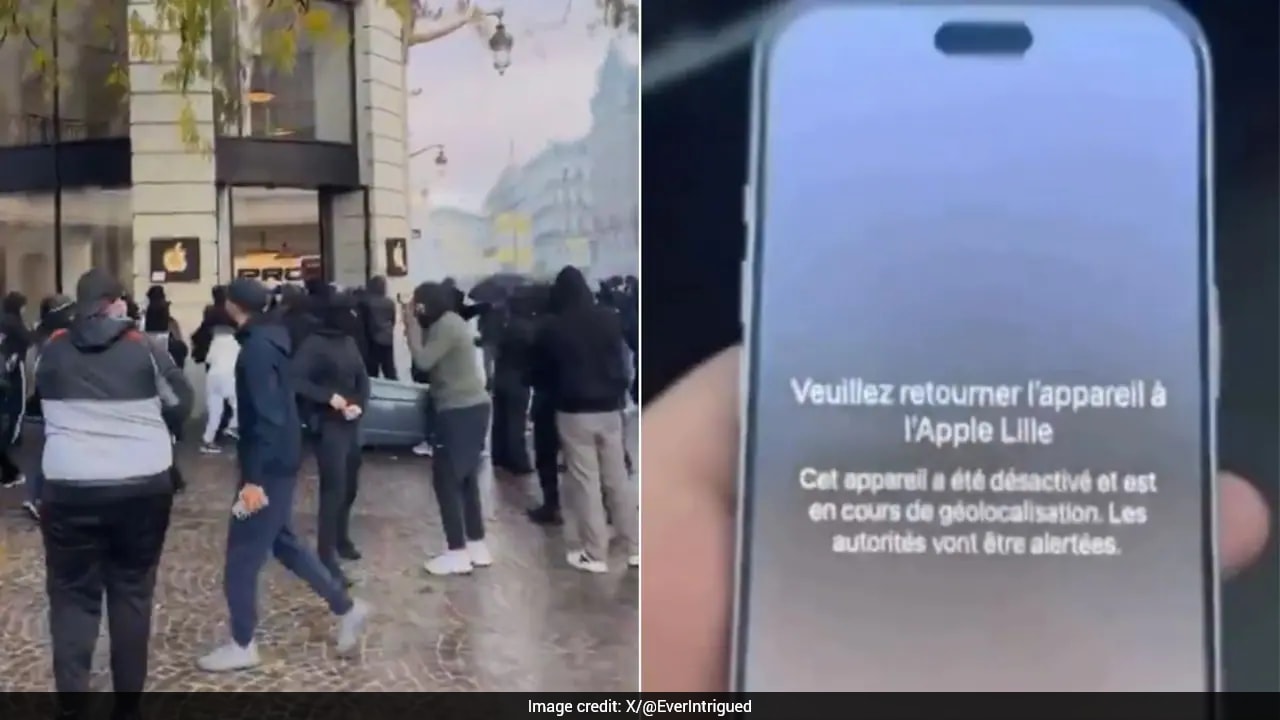
Glass shatters. Metal groans. For a few chaotic hours during civil unrest in France, a storefront window gives way, and dozens of gleaming rectangles of aluminum and tempered glass are swept off display tables into backpacks and hoodies. To the person running down the boulevard with a warm box tucked under an arm, that weight feels like liquid cash. A thousand euros. Eight hundred. Five hundred on a street corner before dusk.
Then the screen goes dark. Not the usual sleep mode where a swipe wakes the world back up. Something colder. A padlock appears on a blank face, accompanied by a message meant not for the person holding the glass, but for the rightful owner sitting somewhere else, perhaps nursing a cold coffee and watching security footage or inventory logs.
Locked.
To understand why that moment matters far beyond a single wave of street looting in France, you have to look at what a modern smartphone actually is when you strip away the marketing. It is not merely a phone. It is a vault holding family photographs from a trip to Brittany, two-factor codes for a bank account, saved train tickets, voice memos from someone you miss, and a digital key to your front door or your car. When someone steals it during unrest—or out of a coat pocket on the metro—they think they have stolen a luxury object. Often, they have only picked up a heavy, fragile paperweight wired to a remote kill switch.
I know the sickening hollowness in the stomach when a device vanishes. Years ago, in a crowded station far from home, I reached into my jacket and felt cold nylon where heavy glass had been ten minutes earlier. My heart hammered against my ribs. My first thought wasn't even about the money I had spent on the hardware. It was about the pictures I hadn't backed up yet and the stranger now holding an unlocked window into my daily life. Even when you use remote tools to lock a device down, there is a stretch of time—minutes, sometimes hours—where panic outruns certainty. You refresh a browser tab. You stare at a spinning wheel. You wonder if the person on the other end is guessing passcodes or pulling the SIM card out in a panic.
When Apple locks down stolen iPhones remotely—whether after organized sweeps during riots in France or individual thefts in quiet neighborhoods—the company is exercising a kind of digital gravity. The device might still sit in someone's palm. The battery might still read eighty percent. Yet the value that made it worth smashing a window for evaporates in seconds.
How a Pocket Computer Becomes a Ghost
To grasp how a remote lock turns a coveted gadget into dead weight, consider a simple metaphor. Imagine a luxury sports car built with a secret: the engine only runs if a tiny, unforgeable transponder in the owner's wallet is within range, and the manufacturer's central dispatch can permanently freeze the ignition from miles away the moment the car is reported stolen. You could hotwire the starter until the battery dies. You could swap the tires. You could paint the hood a different color. Without that cryptographic handshake, the car isn't a getaway vehicle. It is a sculpture sitting in the driveway.
Smartphones work on a similar principle, though the engineering is invisible to the eye. Modern iPhones rely on hardware-level security—like the Secure Enclave and Activation Lock tied to an Apple Account—alongside features such as Find My and Stolen Device Protection. When an owner marks a device as lost or when coordinated recovery efforts and remote lock protocols engage after mass thefts, the phone checks in with Apple's servers over cellular data or Wi-Fi.
Once that lock is active, wiping the phone through standard menus does not set it free. If a thief erases the device hoping for a fresh start, the screen still demands the original owner's Apple Account credentials before anyone can activate it and use it normally.
That detail frustrates thieves endlessly. And honestly, it confuses regular people too.
I have had friends ask me, half-skeptical, if remote locking actually stops crime or just creates a graveyard of locked screens in back rooms. "If they can't turn it on," a cousin asked me once over dinner, "why do they keep taking them?"
Fair question. Honest answer: criminals often act on impulse, desperation, or outdated assumptions. During fast-moving riots or chaotic street grabs, nobody is stopping to read whitepapers on cryptographic key exchange. A box on a shelf looks like money. Only later—when the adrenaline fades, when a buyer refuses to touch a locked screen, or when parts markets get flooded with unusable logic boards—does the reality sink in. A locked iPhone isn't cash in hand. It is a liability with a digital tracking beacon attached.
The Human Ledger Behind the Headlines
News reports about looted iPhones in France tend to read like a balance sheet. X number of stores hit. Y value in merchandise taken. Z devices remotely locked. Numbers are neat. Numbers keep headlines short.
Numbers miss the texture of the event.
Let's construct a hypothetical scenario—explicitly a composite illustration rather than a single real person—to see what sits behind those figures. Picture Claire, who runs a small independent electronics shop in a mid-sized French city. She spent ten years building a reputation for fair repairs, patient help for elderly customers setting up new phones, and honest trade-in prices. One night, disorder spills down her street. Shutters buckle. Glass rains onto the pavement. By morning, the display tables are bare, and the air smells of smoke and damp concrete.
Claire doesn't just lose inventory. She loses sleep. She loses the quiet pride of a shop she built piece by piece. When devices from her stock—or devices taken from citizens in the surrounding streets—are remotely locked, it doesn't magically sweep glass off the sidewalk or pay her insurance deductible overnight. Still, there is a fierce, stubborn satisfaction in knowing the people who broke her windows cannot easily turn her livelihood into easy profit.
Now picture a second hypothetical figure: Karim, a teenager swept up in the herd mentality of a crowd, grabbing a phone because everyone else is running and shouting. Later that night, sitting on a stairwell, he stares at a black screen with a padlock icon and a message from someone he doesn't know. There is no cash machine inside that glass. There is only a cold reminder that actions carry friction, even in the dark.
Neither Claire's shop nor Karim's stairwell makes the headline soundbite. Yet both sit inside the story. Remote locking is not a silver bullet for social unrest or street crime. Anyone who claims a software lock cures root causes in society is selling snake oil. What remote locking does do is change the economics of theft at the moment the prize is supposed to pay off.
Why Thieves Still Try—and Where the Weak Spots Hide
If remote locking makes a stolen iPhone practically useless as a normal phone, why do thefts keep happening?
Because human desperation and criminal adaptation are relentless. A thief who doesn't understand Activation Lock might still try to sell the phone to an unsuspecting buyer on a classified app or a street corner. That is where everyday buyers get burned. Someone pays three hundred euros for a shiny phone, gets home, connects to Wi-Fi, and hits a wall: iPhone Locked to Owner. Suddenly the buyer is out three hundred euros, holding a brick, with no recourse against a seller who already vanished.
Other bad actors try social engineering. They send fake texts pretending to be from support services or law enforcement, urging the victim to click a link and type in their account password to "track" or "recover" the stolen device. It is a classic trap. If the owner falls for it and enters their credentials on a phishing page, the thief gets the keys to turn off Find My and unlock the phone.
Then there is the hardware angle. Even when a whole phone cannot be activated as a clean device, parts scavengers sometimes strip screens, cameras, or housings—though newer generations of phones have increasingly paired components to specific logic boards so swapping parts triggers warnings or limits functionality. Every generation of hardware makes chop-shop economics a little harder, a little slower, a little less lucrative.
It is a cat-and-mouse game. No wall is ever a hundred percent unscalable forever. Still, raising the wall changes who bothers trying to climb it.
What You Should Do Before Anything Goes Missing
Reading about mass thefts and remote locks usually triggers a familiar thought: I should really check my settings. And then life gets busy, dinner burns, a notification pops up, and we forget until it's too late.
If you carry a smartphone—whether you live in Paris, Lyon, New York, or anywhere else—protection starts long before a crisis or a pickpocket arrives. Think of it like locking your deadbolt before you go to sleep rather than shopping for a stronger door after someone tries the handle.
First, make sure Find My is turned on and tied to an account you actually control with strong two-factor authentication. Do not share your primary account password casually, and keep your recovery phone number and trusted contacts up to date. If a phone ever disappears, speed matters, and having access to your account from another device or a web browser lets you mark it as lost immediately.
Second, turn on every layer of theft protection your device offers, including passcode rules and stolen device protections that require biometric authentication like Face ID or Touch ID before sensitive changes can be made. If someone grabs an unlocked phone out of your hand—a common trick on trains and sidewalks—biometrics plus delayed security timers can buy precious time before they can alter your account settings or lock you out of your own digital life.
Third, back up what matters. Photos, messages, notes, authenticator backups. Hardware can be replaced, even when it hurts the wallet. Memories and access to your financial life are much harder to rebuild from scratch.
The Bigger Question Behind a Locked Screen
When governments, retailers, and tech companies deal with stolen devices after riots or street sweeps in France, a broader tension comes into focus. How much power should a private technology company have over hardware sold to the public?
Most of us welcome remote locking when it protects our data and spoils a thief's payday. It feels protective. It feels smart. Yet it also reminds us how deeply our daily tools depend on remote servers, cloud accounts, and corporate infrastructure. A device that can be locked remotely to stop a thief is, by the same architectural coin, a device whose basic usability is mediated through network trust and account standing.
I don't think that makes remote locking bad. Quite the opposite: in an era where our phones hold our identities, locking a stolen device is one of the cleanest ways to strip theft of its reward without putting anyone in physical danger. Chasing a thief down a dark alley over a piece of glass is never worth your life. Letting silicon and cryptography turn a stolen trophy into cold glass from afar is a much better trade.
Still, it is worth pausing to appreciate the strange beauty of it. Somewhere, a window was broken. Somewhere, someone ran thinking they had scored something valuable. Somewhere, a few taps on a screen turned a prized haul into nothing at all.
The screen stays black. A tiny padlock sits quiet in the center of the glass. And a thief discovers that not everything taken by force can actually be kept.