Cold.
That is the first thing you notice when you step off an overnight train in western Ukraine at four in the morning—not the distant hum of generators, not the taped-over windows of the station hall, not even the exhaustion etched into the faces of men in mismatched fatigues waiting on the platform, but a damp, metallic cold that settles behind your ribs and refuses to leave.
I remember standing on a concrete loading dock outside Lviv two winters ago, watching a nineteen-year-old mechanic named Taras try to calibrate the optics on a donated European infantry fighting vehicle using a translated PDF on a cracked phone screen. His knuckles were split from freezing grease. Every twenty minutes, he had to blow on his fingers just to feel the torque wrench. Behind him sat three pallets of spare parts with manuals printed exclusively in German, stacked beside ammunition crates labeled in French and diagnostic tablets whose software licenses had expired somewhere between Brussels and the Polish border.
Taras did not need another press conference from a European capital promising solidarity "for as long as it takes." He needed someone who knew the machine to stand beside him in the mud and point at the right valve.
For years, Europe drew an invisible, trembling line in the dirt at the edge of Ukrainian territory. Weapons could cross it. Billions of euros could cross it. Intelligence, satellite imagery, and humanitarian convoys could cross it. European soldiers, however, stayed strictly on the safe side of the fence, training tens of thousands of Ukrainian recruits on quiet bases in Poland, Germany, and Spain while insisting that sending uniformed personnel onto Ukrainian soil would shatter an unspoken taboo.
Now, that line has quietly shifted.
When the European Union decided to deploy military advisers directly inside Ukraine, the headlines treated it like another bureaucratic milestone in a long, grinding conflict. A few paragraphs about mission mandates. A quote from a foreign policy chief in Brussels. A brief mention of training hubs and institutional reform. Dry ink on digital paper.
Yet if you have ever watched a logistics officer try to coordinate air-defense repairs across four time zones while air-raid sirens wail outside the window, you know there is nothing bureaucratic about boots crossing that border. Even unarmed boots. Even boots belonging to planners, engineers, and trainers who will never sit in a forward trench.
The Myth of the Safe Distance
To understand why this shift carries so much weight, strip away the diplomatic vocabulary and think about how you learn to fly an airplane.
You can spend six months in a simulator in Frankfurt. The cabin is climate-controlled. The turbulence is programmed by an algorithm. When a warning light flashes on the console, an instructor pauses the simulation, pours a cup of coffee, and walks you through the emergency checklist step by step. You leave feeling competent, prepared, and steady.
Then someone puts you in the cockpit during an actual ice storm over the Carpathian Mountains, with half your instruments flickering and static screaming through your headset. Suddenly, the textbook solutions feel three seconds too slow.
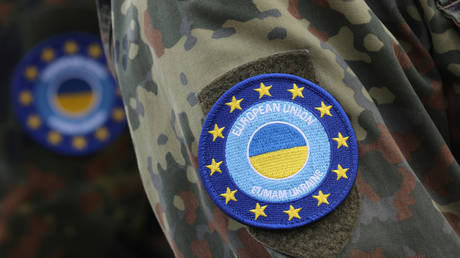
That gap—the chasm between simulated readiness and chaotic reality—is where Ukraine’s armed forces have been fighting since 2022. Under the European Union Military Assistance Mission, known in Brussels shorthand as EUMAM, European instructors have trained more than sixty thousand Ukrainian soldiers outside the country. Those programs taught recruits how to clear trenches, operate Leopard tanks, dismantle mines, and treat catastrophic trauma under fire. They saved lives.
Still, every commander returning from those courses ran into the same brutal friction the moment they crossed back into Ukraine.
Take a hypothetical brigade logistics officer—let us call her Olena, though she is a composite of a dozen quartermasters and engineers working out of converted warehouses near Kyiv and Dnipro. Olena manages a fleet of vehicles donated by nine different countries. When a transmission fails on a self-propelled howitzer, she cannot simply drive it down the highway to a regional depot in Bavaria. Putting a forty-ton armored vehicle onto a flatbed trailer, hauling it hundreds of kilometers west, waiting three days for border clearance into Poland, shipping it to a factory in central Europe, and hauling it back takes weeks. In a war measured in meters and hours, weeks are an eternity.
What Olena actually needs is a small team of European technical advisers standing right beside her mechanics in a reinforced hangar inside Ukraine, diagnosing faults in real time, certifying local workshops to perform complex repairs, and feeding battlefield lessons straight back to European defense manufacturers.
When you train an army outside its own borders, you are always teaching yesterday’s war. By the time a drone tactic observed near Pokrovsk is analyzed in Brussels, translated into a curriculum in Germany, and taught to a fresh battalion of recruits, Russian units on the front line have already adapted twice. Moving European military advisers inside Ukraine collapses that feedback loop from months to days.
What "Non-Combat" Really Means Under a Drone Sky
Brussels has been extraordinarily careful with its phrasing. These personnel are advisers, trainers, and planners—not combat troops. They are there to help reform Ukraine’s defense institutions, coordinate training pipelines, manage logistics, and assist with demining and cyber defense. They will be stationed away from the active front lines, operating under strict force-protection rules.
On paper, the distinction between an adviser in Lviv or Kyiv and an infantryman in Donbas is crystal clear.
On the ground, geography in modern warfare refuses to behave so neatly.
Anyone who has spent a week in central or western Ukraine knows that the front line no longer ends where the trenches stop. A cruise missile launched from a bomber over the Caspian Sea does not pause to check whether a barracks houses Ukrainian conscripts or European staff officers. A swarm of long-range attack drones buzzing low over the treetops at two in the morning makes no distinction between a combat brigade and a logistics advisory cell.
There is an uncomfortable truth that European leaders rarely say out loud at podiums, though every defense planner in Warsaw, Paris, and Tallinn loses sleep over it: the moment an EU military adviser steps off a train in Ukraine, deterrence stops being theoretical.
For more than three years, Moscow’s strategy relied heavily on psychological intimidation. Every time Western capitals debated sending anti-tank missiles, main battle tanks, air-defense batteries, or long-range strike systems, the Kremlin rattled its nuclear saber and warned of direct confrontation with NATO. Each time, Western leaders hesitated, debated for months, and eventually delivered the equipment—often after Ukrainian units had already paid for the delay in blood and lost ground.
By placing uniformed European advisers inside Ukraine, the EU is calling a bluff it spent years tiptoeing around.
Think about the psychology of a hostage negotiation or a neighborhood standoff. As long as one side announces every single thing it refuses to do—"We will never cross this street, we will never enter that building, we will never risk a single scratch"—the aggressor knows exactly where the boundaries are and pushes right up against them. Ambiguity, when backed by real capability, forces the aggressor to hesitate instead.
Yet honesty demands admitting the flip side of that coin. It is frightening. Nobody in Europe—certainly not the families of the officers packing their rucksacks for a rotation in Ukraine—wants a wider war. What happens if a Russian ballistic missile strikes a training facility where European advisers are working? Does Brussels treat it as a tragic occupational hazard in an active conflict zone, or does domestic political fury demand a military response?
There is no clean, risk-free formula for that scenario. Anyone claiming otherwise is selling comfort instead of candor. European leaders are betting that Moscow is far more cautious about killing uniformed personnel from EU member states than its television propagandists pretend—and that the strategic cost of letting Ukraine’s defense apparatus strain under logistical isolation is even more dangerous than the risk of presence.
The Invisible Exhaustion of Holding the Line
To grasp why Europe finally swallowed that risk, you have to look beyond maps and troop counts to the quiet, grinding exhaustion reshaping Ukraine’s military from the inside out.
Wars rarely collapse in a single cinematic moment. They erode. They wear down through missed maintenance schedules, overworked junior officers who have not slept four consecutive hours since last autumn, and raw recruits pushed into complex roles because the experienced sergeants who should have mentored them are either in hospital wards or buried beneath fresh wooden crosses.
Consider a hypothetical twenty-two-year-old platoon commander—call him Maksym—who was studying civil engineering in Kharkiv before the full-scale invasion. Today, Maksym is responsible for thirty men, three armored carriers, a reconnaissance drone team, and a sector of treeline that gets shelled every afternoon between three and five. He is brave, resourceful, and utterly exhausted. When headquarters assigns him twelve newly mobilized soldiers who have had five weeks of basic training, Maksym does not have the bandwidth to teach them radio discipline, electronic warfare counter-measures, and vehicle recovery from scratch while simultaneously keeping them alive.
When European advisers work directly alongside Ukrainian training centers inside the country, they relieve pressure on commanders like Maksym. They free up seasoned Ukrainian instructors to focus on the specialized, brutal realities of trench and drone warfare, while European specialists standardize foundational logistics, maintenance, medical evacuation protocols, and staff planning.
Just as importantly, they fix a problem that rarely makes the evening news: institutional translation.
Modern Western warfare runs on standardized procedures—how ammunition requests are logged, how intelligence is shared between units, how airspace is deconflicted so friendly drones are not shot down by friendly air defenses. Ukraine’s army was built on Soviet-era command habits, rapidly overlaid with heroic, improvised digital networks developed by tech-savvy volunteers in basements. Blending those two cultures while fighting the largest land war in Europe since 1945 is like trying to rebuild an engine while driving eighty miles an hour down a mountain road.
You cannot fix that over Zoom from Brussels. You fix it by sitting across a metal folding table in a cold concrete room, drinking instant coffee out of paper cups, and untangling the mess together.
History’s Echoes in Unmarked Uniforms
We have seen variations of this story before, though history never repeats itself without changing the uniforms and the hardware.
In the late 1930s, and again during the Cold War, major powers routinely deployed military advisers to allied nations long before—or instead of—committing regular combat divisions. Sometimes those missions prevented collapse by professionalizing local forces and stabilizing supply chains. Other times, mission creep quietly pulled advisers closer and closer to the firing line until the distinction between advising and fighting vanished entirely.
Europe’s memory of those historical traps is precisely why this deployment is wrapped in so many legal guardrails. Unlike past superpower interventions in distant jungles or deserts, the European Union is not trying to project imperial muscle halfway around the globe. Ukraine sits directly on the EU’s eastern border. The refugees fleeing missile strikes arrive in Polish and German train stations within hours. The grain that feeds global markets moves through Black Sea ports a stone’s throw from Romania and Bulgaria.
For Europe, this is not an expeditionary adventure. It is neighborhood fire prevention while sparks are already landing on the roof.
Still, look closely at the political fault lines inside the Union itself. Consensus in Brussels is never effortless. Twenty-seven member states carry twenty-seven different historical memories, economic anxieties, and domestic political pressures. Countries along the Baltic Sea and in Central Europe—nations that remember Soviet tanks rolling through their own capitals—have argued for years that hesitation only invites further aggression. Governments farther west or south, insulated by distance and worried about energy prices, inflation, and skeptical voters, have moved with far greater caution.
Getting those twenty-seven governments to agree on putting military advisers inside Ukraine required months of quiet horse-trading, carefully drafted mandates, and strict assurances that no member state would be forced to send personnel against its will. The result is a coalition of the willing wearing an EU badge—a subtle shift in how Europe organizes its own security at a moment when American political winds feel increasingly unpredictable.
What Changes When You Share the Same Sky
Walk back through that freezing rail yard outside Lviv in your mind.
Imagine Taras, the nineteen-year-old mechanic with split knuckles and an expired diagnostic tablet, standing beside that infantry fighting vehicle at four in the morning. Except this time, standing next to him in the pale beam of a hooded flashlight is a master sergeant from an armored brigade in Germany or the Netherlands.
The sergeant is wearing body armor and a helmet slung over his shoulder. He is shivering in the same damp Ukrainian wind. When the air-raid siren begins its low, rising wail across the city, he does not watch it unfold on a news ticker in Brussels or read about it in an intelligence brief three days later. He walks down the concrete stairs into the same basement shelter as Taras, sits on the same wooden crate, and listens to the distant thud of air-defense interceptors rattling the dust off the ceiling pipes.
That shared experience alters everything.
When European advisers live under the same sky as the people they are helping, complacency evaporates. Paperwork moves faster because the person signing the requisition order knows the face of the mechanic waiting for the part. Training manuals get rewritten overnight because the instructor saw firsthand why a standard procedure failed in freezing mud. And in Moscow, the calculation shifts subtly but unmistakably: Europe is no longer merely shipping crates to a neighbor’s porch and locking its own front door.
The trains heading east across the Polish-Ukrainian border tonight look no different from the ones that crossed last month—darkened carriages, drawn blinds, steel wheels clacking rhythmically over wet tracks in the pitch black. Yet inside a few of those compartments sit men and women carrying laptops, schematics, and quiet orders that mark the end of Europe’s comfortable distance, stepping across a border that will never quite be the same again.