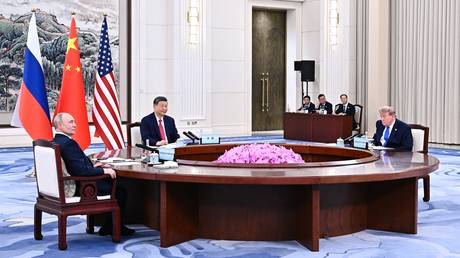
Every time Vladimir Putin steps up to a podium alongside Xi Jinping and Donald Trump and calls for a "partnership of equals," the mainstream press falls for the exact same head-fake.
Wire services treat the phrase as a diplomatic olive branch, a plea for multipolar harmony, or a return to great-power pragmatism. Foreign policy pundits spend hours debating whether Washington and Beijing will accept Moscow's terms for a new global architecture. They are asking the wrong question entirely.
In geopolitical reality, "equality" is never a principle sought by a country holding the weakest hand at the table. It is a pricing mechanism. When the leader of a heavily sanctioned, resource-dependent economy demands parity with the world's two largest economic and technological superpowers, he is not asking for fairness. He is asking for a massive, unbacked subsidy in diplomatic status.
To understand what actually happens when Putin, Xi, and Trump sit in the same room, you have to strip away the diplomatic pleasantries and look at the cold, hard balance sheets of power.
The Structural Reality Behind the Rhetoric
Diplomats use words like "equality" and "multipolarity" to mask asymmetrical dependencies. In international relations theory, specifically within the framework of structural realism—championed by scholars like Kenneth Waltz and John Mearsheimer—states do not operate on moral ideals or polite agreements. They operate on relative capabilities: gross domestic product, demographic trajectory, technological self-sufficiency, and power projection.
Look at the actual numbers sitting around that trilateral table:
- The United States commands an economy exceeding $28 trillion, controls the world's primary reserve currency, and leads in foundational artificial intelligence and semiconductor design.
- China operates an $18 trillion manufacturing and export juggernaut, dominates global supply chains for critical minerals and clean energy, and serves as the primary trading partner for over 120 countries.
- Russia maintains an economy roughly the size of Italy or Texas, heavily reliant on hydrocarbon exports, facing severe demographic contraction, and locked out of Western capital markets.
When Putin urges a "partnership of equals" with Xi and Trump, he is attempting to convert Russia's nuclear arsenal and regional spoiler capacity into full-spectrum parity with two economic titans. Mainstream coverage misses this distinction because it treats diplomatic rhetoric as a statement of intent rather than a negotiating tactic.
If you accept the premise that Moscow, Beijing, and Washington are equal pillars of a new global order, you automatically grant Russia veto power over European and Eurasian security arrangements that its economic weight could never justify on its own.
Why Beijing and Washington View "Equality" Differently
A genuine trilateral partnership requires aligned incentives. Here, the incentives are fundamentally incompatible, and both Xi and Trump know it.
Beijing's Calculus: The Junior Partner Reality
Chinese foreign policy analysts publicly echo Moscow's calls for a multipolar world and a "no-limits" partnership, largely because it serves Beijing's immediate interest in diluting American global influence. However, internal Chinese strategic thinking—often rooted in long-term economic statecraft—views Russia less as a peer and more as a strategic buffer and a discounted energy supplier.
Since Western sanctions cut Russia off from European markets, China has become Moscow's indispensable economic lifeline. Beijing buys Russian crude oil and natural gas at steep discounts, sells Russia dual-use industrial goods and consumer electronics in yuan, and dictates the terms of infrastructure projects across Central Asia—a region Moscow historically considered its exclusive sphere of influence.
Xi Jinping does not need a "partnership of equals" with Vladimir Putin because China already holds the structural leverage in their bilateral relationship. Endorsing Putin's rhetoric costs Xi nothing; granting him actual parity would mean surrendering Beijing's growing dominance in Eurasia.
Washington's Calculus: Transactional Leverage Over Institutional Parity
Donald Trump's approach to foreign policy rejects multilateralism and abstract diplomatic frameworks in favor of bilateral, transactional deal-making. In Trump's worldview, nations are not equal; they have varying degrees of leverage, trade deficits, and strategic utility.
When Trump engages with Putin or Xi, the objective is rarely to build a permanent, rules-based concert of powers. Instead, the focus is on immediate, tangible concessions: trade balances, energy market stability, ceasefire terms in regional conflicts, or decoupling Moscow from Beijing's orbit.
From Washington's perspective, elevating Russia to the status of an equal global partner offers zero strategic return unless Moscow is willing to break its alignment with China—a move Putin cannot afford to make without risking economic collapse.
Dismantling the Common Misconceptions
Public discourse around trilateral summits between the U.S., China, and Russia is riddled with flawed assumptions. Addressing the most persistent questions requires cutting through the noise.
Does a "multipolar world" actually reduce global conflict?
No. The popular belief that a three-way balance of power creates stability is one of the most dangerous myths in modern commentary. Historical evidence—from the collapse of the 19th-century Concert of Europe to the fractured alliances of the 1930s—demonstrates that multipolar systems are significantly more unstable than bipolar ones.
In a two-player system, like the Cold War between Washington and Moscow, deterrence is straightforward and red lines are clear. Introduce a third major actor, and the math changes exponentially. Every bilateral negotiation triggers paranoia in the third capital. Every concession looks like the formation of a two-against-one coalition. Far from stabilizing the international system, a formal trilateral framework institutionalizes mutual suspicion.
Is Trump trying to pull Russia away from China?
Strategists often refer to this concept as a "Reverse Nixon"—attempting to replicate Henry Kissinger and Richard Nixon's 1972 opening to China, which exploited the Sino-Soviet split to isolate Moscow.
The flaw in applying that playbook today is that the structural conditions are completely inverted. In 1972, China and the Soviet Union had already fought border skirmishes and viewed each other as existential ideological threats. Today, Putin and Xi share a deep, regime-level alignment against Western democratic norms and sanctions regimes. Russia's economy is now structurally integrated with China's industrial base. Washington cannot offer Moscow an economic package large enough or reliable enough to replace Beijing, especially when U.S. policy can shift every four years.
Why does Putin keep using the phrase if neither leader buys it?
Because the intended audience is not just sitting across the table. The phrase "partnership of equals" is a precision-engineered message aimed at the Global South—countries across Asia, Africa, and Latin America that resent Western lectures on governance and economic conditionality.
By framing his pitch around equality and sovereignty, Putin positions Moscow as the champion of nations tired of American hegemony, even while Russia pursues hard-power territorial expansion in its own neighborhood. It is a branding exercise designed to prevent diplomatic isolation outside the West.
The Historical Precedent Nobody Mentions
We have seen this exact diplomatic maneuver before. In the aftermath of the Napoleonic Wars, Russian Tsar Alexander I proposed the Holy Alliance—a grand, idealistic pact among Russia, Austria, and Prussia built on high-minded rhetoric about Christian brotherhood, mutual respect, and sovereign equality.
Austrian Foreign Minister Klemens von Metternich famously dismissed the document as a "loud-sounding nothing," while British Foreign Secretary Lord Castlereagh called it a "piece of sublime mysticism and nonsense." Yet Metternich quickly realized he could use the Tsar's lofty language as a practical tool to suppress nationalist uprisings across Europe while quietly advancing Austrian interests.
Modern diplomatic summits operate on the exact same mechanism. Great powers rarely reject idealistic framing outright; they simply hollow it out and fill it with their own strategic priorities.
The Downside of Cold Realism
Adopting a strictly transactional, capability-based view of these summits carries its own set of risks. If Washington and Beijing treat Moscow purely as a declining power unworthy of equal status, they risk backing a nuclear-armed state into a corner where asymmetric escalation becomes its only remaining tool.
History shows that powers experiencing relative decline are often the most dangerous actors in the international system. When conventional economic and diplomatic channels fail to secure the status a leader demands, the temptation to disrupt the board through cyber warfare, proxy conflicts, or nuclear brinkmanship increases dramatically. Dismissing Putin's rhetoric entirely without offering face-saving off-ramps on specific, verifiable security issues can accelerate the very instability that realists seek to avoid.
How to Read the Next Summit
Stop reading the official joint communiqués. They are written by career diplomats whose primary job is to obscure disagreement behind words like "constructive," "candid," and "equal."
If you want to know who actually won the room when Putin, Xi, and Trump meet, ignore the handshakes and track three concrete indicators over the following ninety days:
- Currency Settlement Ratios: Watch whether bilateral trade between Moscow and Beijing continues to shift exclusively into the Chinese yuan, and whether Washington enforces secondary sanctions on financial institutions facilitating those flows.
- Energy Infrastructure Commitments: Look for signed, financed contracts—not non-binding memorandums of understanding—on pipelines like Power of Siberia 2. Delays mean Beijing is still dictating the price.
- Defense Technology Transfers: Monitor whether Moscow receives high-end microelectronics and machine tools from China, or whether Washington successfully trades tariff relief to Beijing in exchange for tighter export controls on Russian supply chains.
Power does not negotiate on equal terms. It negotiates on leverage. Until the underlying economic and military balance shifts, a "partnership of equals" remains nothing more than a polite fiction spoken into a live microphone.