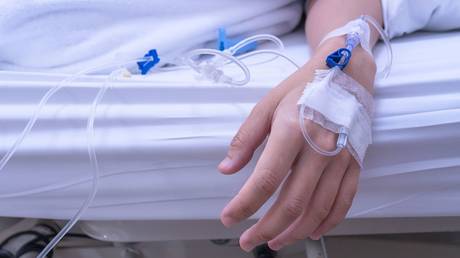
The waiting room of St. Jude’s Memorial smelled of burnt coffee and floor wax. It was 3:14 AM on a Tuesday. The fluorescent lights hummed a flat B-flat, a sound that drills into your temples when you have been awake for twenty-four hours.
Laura Vance sat in a vinyl chair that squeaked every time she shifted her weight. Her mother, Margaret, was slumped beside her. Margaret’s skin was the color of skim milk. Her breathing sounded like someone dragging a heavy rake through dry leaves. Meanwhile, you can read related stories here: Sundar Pichai and the Monastic Batchmate Who Chose Peace Over Silicon Valley.
"Just a little longer, Mom," Laura whispered. She had been saying that since midnight.
In the old days, a seasoned triage nurse would have looked at Margaret, seen the subtle bluish tint beneath her fingernails, noted the asymmetrical rise of her chest, and bypassed the waiting room entirely. Instinct, honed by decades of watching people live and die, would have overridden the queue. To see the bigger picture, check out the recent report by Wired.
But St. Jude’s no longer relied solely on human instinct. They had upgraded. They had automated. They had implemented CarePulse—a state-of-the-art predictive triage algorithm designed to streamline patient flow and eliminate human bias from emergency medicine.
It was supposed to save lives. Instead, it became a silent wall.
The Math of Suffering
To understand how Margaret Vance spent her final conscious hours in a plastic chair, you have to look at how a machine learns to see a crisis.
When Margaret was admitted, the intake clerk fed four data points into CarePulse: age (67), heart rate (92 beats per minute), blood pressure (138/85), and chief complaint (shortness of breath). The algorithm processed these numbers against millions of historical patient records. It calculated a risk score. It assigned a priority tier.
On paper, Margaret looked stable. Her vitals were elevated but not catastrophic. The algorithm, programmed to optimize bed occupancy and prioritize acute trauma, flagged her as a Tier 3: non-urgent.
What the machine did not see was the human context. It did not know that Margaret was a stoic woman who never complained, meaning that her admitting to "shortness of breath" was the equivalent of anyone else screaming in agony. It did not see that her pupils were slightly dilated, a classic sign of escalating panic as her brain began to starve for oxygen.
Machines excel at reading numbers. They are blind to nuance.
Consider a simple analogy. Imagine you are driving a car down a mountain pass, and the brake pedal feels mushy. A sensor in the dashboard might show the brake fluid level is within normal parameters. The sensor says you are fine. But your foot, feeling the lack of resistance, knows the truth: the brakes are failing. You trust the feeling, not the sensor.
In modern medicine, we are increasingly telling doctors to take their feet off the pedals and trust the dashboard.
The Ghost in the Triage Booth
Dr. Aris Vance—no relation to Laura, though the shared surname felt like a cruel joke later—was the attending physician on duty that night. He spent most of his shift staring at a dual-monitor workstation.
The left screen showed the patients. The right screen showed the metrics.
"The algorithm acts like an invisible colleague," Aris told me months after the incident, his voice dropping an octave. "But it's a colleague you can't argue with. If I override a CarePulse recommendation and the patient has a negative outcome, the hospital’s legal team wants to know why I deviated from protocol. If I follow the algorithm and the patient has a negative outcome, it’s a tragic system error. Which choice do you think the system encourages us to make?"
This is the psychological trap of predictive technology. It creates a shield of plausible deniability. It shifts responsibility from the individual to the code.
By 4:00 AM, Margaret’s condition shifted. The rake-like sound in her chest stopped. It was replaced by a terrifying silence. She was no longer moving enough air to make noise.
Laura stood up, knocking her purse to the floor. "Help! Someone look at her!"
A nurse hurried over, glanced at the monitor that displayed CarePulse’s live queue, and noticed Margaret’s name was still glowing yellow—stable. The nurse hesitated for a fraction of a second, caught between the digital directive and the frantic daughter. That fraction of a second was the gap where a life slipped through.
When they finally wheeled Margaret into a resuscitation bay, her oxygen saturation was sixty-two percent. Normal is ninety-five. Her heart stopped three minutes later.
The Data That Deceives
The post-mortem analysis of the incident did not find a software bug. The code executed perfectly. The servers did not crash. The network did not drop a single packet.
The failure was deeper, embedded in the very philosophy of how we train machines to care for us.
Algorithms are backward-looking prophets. They predict the future based entirely on the past. If the data used to train an emergency room algorithm comes from hospitals that historically underserved certain populations, or if the data reflects administrative pressures to clear beds quickly, the algorithm absorbs those patterns as gospel. It learns that efficiency is the highest virtue.
But efficiency is not empathy.
In our drive to modernize, we have confused processing power with wisdom. We treat software as an objective oracle, forgetting that every line of code was written by a human being with deadlines, budgets, and biases. We have built systems that can calculate the probability of a cardiac event to the fourth decimal point, yet cannot recognize the look of terror in an old woman’s eyes.
The investigation into St. Jude’s revealed that CarePulse had been calibrated to reduce "false positives"—meaning it was intentionally designed to be conservative about upgrading patients to critical status to avoid overwhelming the staff. It worked beautifully for the hospital's quarterly performance metrics. The average wait time for minor injuries dropped by twelve percent.
The cost of that twelve percent was paid in full by Margaret Vance.
The Weight of the Silence
Six months after her mother’s death, Laura sat in her own living room, looking at a framed photograph on the mantelpiece. The house was quiet, save for the rhythmic ticking of a grandfather clock.
"I don't hate the technology," Laura said, her fingers tracing the edge of her coffee mug. "I hate that nobody looked at her. Really looked at her. They looked at the screen. They trusted the screen more than they trusted the person dying right in front of them."
The hospital has since updated the software. There is a new patch, version 4.2, which allegedly factors in respiratory depth and patient age with greater sensitivity. The administrators call it a triumph of iterative development. They talk about closing the loop and optimizing the care pathway.
But lines of code cannot weep, and updates cannot apologize.
As dawn broke over the city, the grandfather clock struck the hour. A solitary, metallic chime echoed through the empty room, a precise and automated marker of time passing, completely indifferent to who was left to hear it.