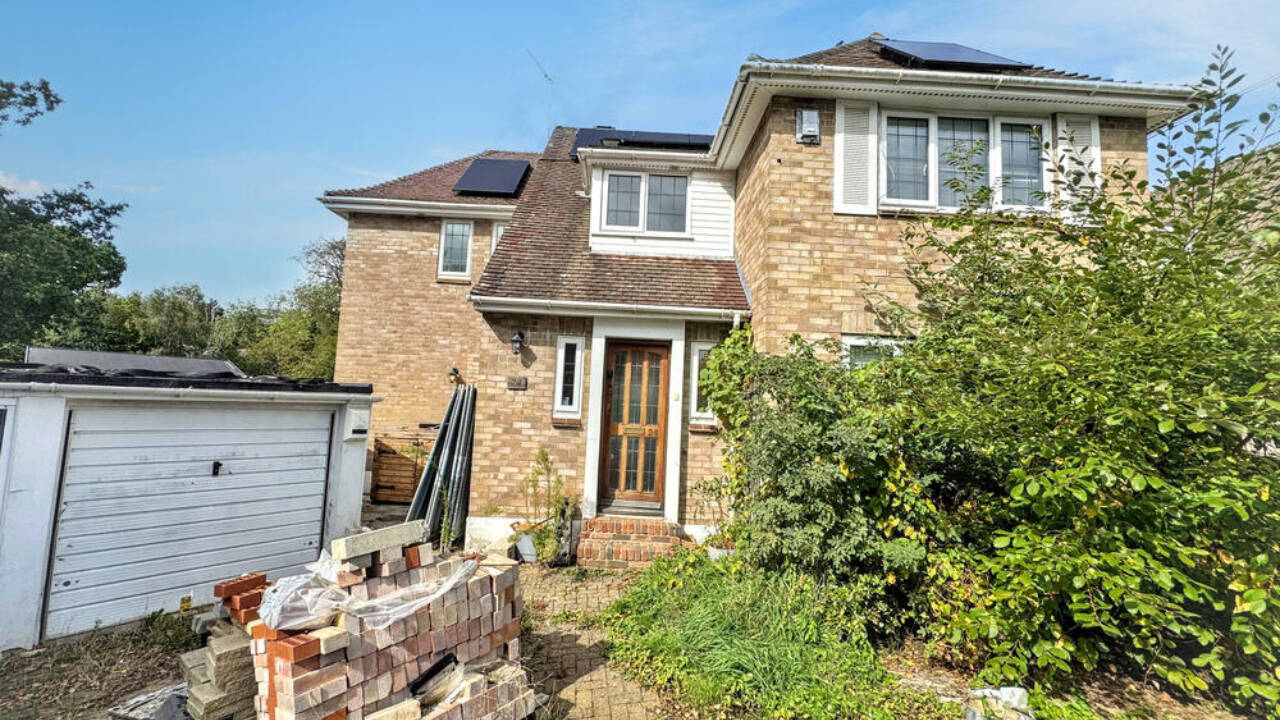
A property valued at £465,000 listing at a £1 auction reserve after landslip and an occupancy prohibition exposes a hard truth about residential real estate: when structural stability fails and legal habitability is revoked, market value does not discount linearly; it collapses toward net present liabilities. This analysis breaks down the economic mechanics behind extreme distress pricing, separates confirmed facts from structural hypotheses regarding the reference case, and establishes an evaluation framework for distressed asset buyers. Because no external source text or case file beyond the headline was supplied in the prompt, exact figures on remediation bids, mortgage balances, and local council enforcement notices are unavailable; where specific numbers are absent, this piece models the underlying cost and risk mechanisms rather than inventing figures.
The Mechanics of Extreme Distress Valuation
Standard residential valuation relies on comparable sales, replacement cost, and rental yield. All three assumptions break down when ground movement compromises a structure and a local authority prohibits occupancy. A home that cannot legally be lived in generates zero residential rent under normal terms, cannot be financed through standard retail mortgages, and carries open-ended remediation exposure.
In auction environments, a £1 guide or reserve price functions as a price-discovery mechanism rather than an appraisal of intrinsic worth. Sellers and insolvency or enforcement agents use nominal starting points when conventional valuation bands fail to attract serious bids, shifting the burden of risk assessment entirely onto the buyer.
The Net Present Liability Function
For a structurally compromised, unoccupiable home, raw market value gives way to a liability equation. A rational buyer bids based on expected exit value minus all costs required to reach a saleable, insurable, and legally occupiable state, discounted for time and risk.
$$V_{\text{bid}} = \frac{V_{\text{remediated}} - (C_{\text{stabilization}} + C_{\text{repair}} + C_{\text{holding}} + C_{\text{legal}})}{(1 + r)^t} - R_{\text{tail}}$$
In this formulation:
- $V_{\text{remediated}}$ represents the projected post-repair market value once ground movement is arrested and occupancy restrictions are lifted.
- $C_{\text{stabilization}}$ captures geotechnical engineering, piling, underpinning, drainage, or retaining work required to halt further slope or foundation movement.
- $C_{\text{repair}}$ covers superstructure, utility, roofing, and interior reinstatement needed to meet building regulations and habitability standards.
- $C_{\text{holding}}$ accounts for council tax (where applicable), security, site insurance, and debt service while the asset sits dormant.
- $C_{\text{legal}}$ includes planning permissions, structural sign-offs, conveyancing, and auction or enforcement fees.
- $r$ reflects a high risk-adjusted discount rate suited to illiquid, non-standard engineering projects.
- $t$ represents the timeline in years from acquisition to legal re-occupancy or resale, which frequently stretches across seasons due to ground investigation and permitting.
- $R_{\text{tail}}$ represents unquantified residual risk, such as ongoing ground shift or neighboring boundary disputes.
When estimated stabilization and repair costs approach or exceed the post-repair ceiling—or when $t$ is long and uncertain—the calculated bid drops sharply. A £1 entry price signals that the asset may sit near zero or negative net equity before factoring in buyer-side engineering contingency.
Known Facts Versus Structural Hypotheses
Given only the headline reference—£465,000 English home heads to auction for £1 after landslip, with occupancy ban in place—strict analytical discipline requires separating what is stated from what is inferred.
Known facts from the headline:
- The property previously carried a £465,000 reference value (either a prior valuation, asking price, or benchmark figure).
- The asset is located in England and is scheduled for auction with a £1 figure.
- Landslip has affected the property or its site.
- An occupancy ban is currently in place.
Educated hypotheses based on English property and regulatory mechanics:
- The £465,000 figure likely reflects a pre-incident or unimpaired valuation rather than current realizable value under an active ban.
- The occupancy ban likely stems from statutory powers exercised by a local authority or building control body due to imminent structural danger or unsafe living conditions.
- Standard buildings insurance and high-street residential mortgages are almost certainly unavailable while active ground movement and a prohibition on occupation persist.
- The £1 figure may represent a nominal guide price or reserve set to stimulate competitive bidding among cash buyers, developers, or specialist contractors.
Cause-and-Effect Chains Missable in Headline Coverage
Headline reporting focuses on the dramatic gap between £465,000 and £1. That spread grabs attention, yet it obscures the causal sequence that turns a physical earth movement into an illiquid financial trap.
Ground Movement to Regulatory Freeze
A landslip begins as a physical and geotechnical event: pore water pressure rises, slope shear strength drops below gravitational stress, or subsurface soil shifts under load. Once cracking, subsidence, or tilt threatens structural integrity or life safety, regulatory intervention follows. In England, local authorities hold statutory powers to restrict use or require immediate evacuation when a building poses a danger to occupants or the public.
An occupancy ban immediately severs cash flow and primary residential utility. An owner-occupier cannot live there; a landlord cannot lawfully collect residential rent. Even if the roof is intact and the kitchen is modern, legal non-habitability strips away standard consumer demand.
Uninsurability and the Financing Lockout
Lenders protect collateral through enforceable charges and mandatory buildings insurance. When ground instability is documented and a prohibition notice is active, commercial insurers typically withdraw standard cover or exclude subsidence and landslip altogether. Without acceptable insurance, mainstream mortgage lenders refuse to advance funds or may call in existing facilities upon breach of covenants.
This creates a liquidity bottleneck. Ordinary homebuyers who rely on mortgage finance are locked out of the bidding pool. Only cash buyers, specialist bridging lenders, or experienced contractors can participate, shrinking demand at the exact moment execution risk peaks.
Information Asymmetry and Adverse Selection
Geotechnical risk is notoriously uneven. Surface cracks tell a buyer very little about slip-plane depth, groundwater tables, or whether neighboring plots share the same unstable slope. Without intrusive site investigation—such as boreholes, trial pits, and structural monitoring—the true cost of stabilization remains hidden.
In markets marked by severe information asymmetry, informed sellers and distressed disposers face adverse selection. Cautious buyers price in worst-case engineering outcomes or walk away entirely. A £1 starting price lowers the barrier to entry for inspection and bidding, yet it does not remove the underlying cost of fixing the ground.
Four Pillars of Distressed Ground-Risk Evaluation
Evaluating an unoccupiable property affected by landslip requires structured triage across four operational dimensions. Skipping any pillar turns a bargain entry price into a sunk-cost trap.
1. Geotechnical and Structural Viability
The first question is physical: can the land be stabilized, and can the structure be made safe at a credible cost? Surface stabilization alone fails if deep-seated rotational or translational movement continues beneath the foundations. Retaining walls, deep bored piles, ground anchors, or subsurface drainage systems carry vastly different engineering complexity and cost profiles depending on soil type, gradient, and water table behavior.
Buyers must treat any pre-purchase walk-through as visual reconnaissance only. Without formal geotechnical and structural engineering input, cost estimates are guesses.
2. Legal, Statutory, and Title Constraints
An occupancy ban sits inside a wider legal web. A prospective buyer needs clarity on the exact statutory basis of the prohibition, the conditions required to lift it, and whether enforcement notices or repair obligations attach to the land. Title deeds, restrictive covenants, rights of drainage, and boundary responsibilities also matter when slope stability involves shared embankments or adjacent parcels.
In England, local land charges searches and direct dialogue with local authority building control or environmental health teams help clarify what formal sign-off is required before anyone can legally step back inside.
3. Capital Stack and Holding Economics
Buying at £1 does not mean acquiring the asset for £1. Auction buyer premiums, legal fees, stamp duty land tax rules, site security, uninsurable or specialist premiums, and extended holding costs accumulate from day one. Furthermore, lenders financing distressed groundworks typically demand substantial equity buffers and charge elevated interest rates.
If ground investigation and planning permissions take 12 to 24 months before physical stabilization even starts, holding costs and time-value erosion can quietly consume the margin that looked attractive on paper.
4. Exit Pathway Realism
Every distressed acquisition needs a credible exit:
- Full remediation and resale: Stabilizing the site, lifting the ban, completing repairs, and selling into the open market once confidence returns.
- Specialist hold or alternative use: Retaining the asset if permitted uses allow non-residential or land-based utility, though occupancy bans heavily constrain options.
- Land assembly or demolition: Clearing an unsaveable structure if demolition and land stabilization yield a viable plot, provided demolition itself does not trigger further slope instability.
If the post-remediation ceiling in the local micro-market cannot support the combined weight of stabilization, rebuild, finance, and developer profit, there is no viable exit regardless of how low the auction guide price starts.
Tactical Due Diligence Sequence for Distressed Buyers
Approaching a £1 auction lot with an occupancy ban requires disciplined execution rather than speed. The following step-by-step sequence structures buyer decision-making before committing capital.
- Audit the auction legal pack immediately. Review special conditions of sale, buyer's premium obligations, completion deadlines (often 28 days or fewer), title registers, search results, and any copies of prohibition or enforcement notices.
- Verify the exact nature of the occupancy restriction. Contact the relevant local authority department to understand what triggered the ban, what documentation or engineering certification is required to revoke it, and whether any prior works were attempted without approval.
- Assess site access and physical boundaries. Inspect the property from safe public vantage points or authorized access routes. Note slope gradient, surface water runoff, retaining structures, nearby trees, and proximity to neighboring buildings or infrastructure.
- Commission targeted geotechnical and structural scoping. Engage a chartered structural engineer and a geotechnical specialist to review available reports, define necessary ground investigations (such as boreholes or monitoring), and establish a range of stabilization scenarios rather than a single point estimate.
- Model worst-case timelines alongside base-case budgets. Build a cash-flow model assuming permitting delays, wet-weather construction slowdowns, and cost overruns. Stress-test what happens if remediation costs double or exit values face a local stigma discount even after repairs finish.
- Set a hard walk-away ceiling before bidding. Lock in a maximum total all-in cost before entering the auction room. Never treat a £1 guide price as an anchor for rational bidding; anchor strictly to net recoverable value after all risks.
Strategic Limitations and Market Realities
Even disciplined analysis cannot eliminate every hazard in landslip-affected real estate. Buyers and analysts should account for four structural limitations.
First, ground behavior can surprise specialists. Subsurface conditions vary over short distances, and heavy rainfall or altered drainage can change slope stability after initial assessments. No engineering report offers an absolute guarantee against future movement.
Second, stigma lingers after physical repair. Even when structural engineers certify a property as safe and authorities lift an occupancy ban, future buyers and lenders may apply a permanent discount to homes with a known landslip history. Comparing post-repair value to an undamaged peak price can overstate recovery potential.
Third, auction mechanics compress diligence windows. Standard auction timelines often leave too little time for intrusive ground testing before exchange of contracts. Bidding without sufficient technical visibility forces buyers to either price in massive contingency—losing to less cautious bidders—or accept unquantified downside.
Fourth, local market fundamentals cap upside. Expensive engineering fixes rarely pay for themselves in lower-value housing markets, and even in higher-value areas, the cost of deep stabilization can exceed the land value itself.
Final Strategic Play
Treat a £1 auction reserve on a landslip-hit, unoccupiable home as a high-risk engineering and regulatory turnaround rather than a discounted house purchase. Before placing a bid, secure full legal pack clarity on the occupancy ban, obtain specialist geotechnical and structural scoping to bound stabilization costs, and underwrite the deal using a conservative post-remediation resale value plus a substantial contingency buffer. If the numbers only work under optimistic repair timelines, zero cost overruns, and full price recovery, step aside and deploy capital where downside risk is bounded and financeable.