The Number on the Screen
The screen glowed in the dim basement of an intelligence outpost outside Washington. It was 3:00 AM. A young analyst, let’s call her Sarah—a woman who survived on stale coffee and the quiet terror of what-if scenarios—stared at a string of Arabic characters translating in real-time.
Ten million dollars.
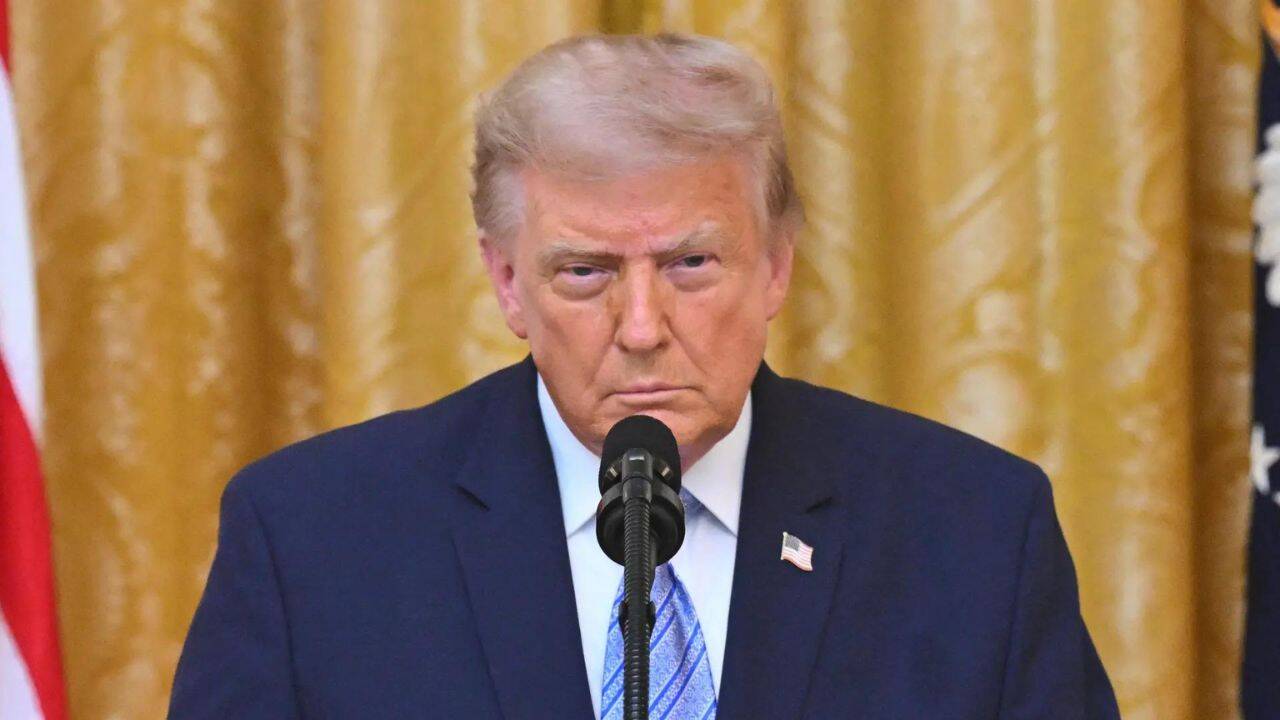
It is a number that is easy to write but hard to comprehend. In Baghdad, that sum can buy neighborhoods. In the shadow economy of global terror, it is an siren song. The bounty, issued by an Iran-backed Iraqi militia group, was not a secret whisper passed in a dark alley. It was a public decree, broadcasted across encrypted channels and splashed across social media networks. The target was the President of the United States.
We often view geopolitical chess moves through the cold lens of press releases and official statements. State departments issue "condemnations." Militias post "declarations." But behind the sterile language of international relations lies a raw, deeply human reality. This is the story of how a single number, broadcast from a dusty office in Iraq, ripples through the lives of secret service agents, ordinary Iraqi citizens caught in the crossfire, and the fragile psychology of global security.
The Geography of a Threat
To understand how we arrived at a ten-million-dollar bounty, we have to look at the dirt. Specifically, the dirt of the road leading to Baghdad International Airport.
Years ago, a precision airstrike vaporized a convoy. In an instant, Qasem Soleimani, the architect of Iran’s regional influence, and Abu Mahdi al-Muhandis, the leader of Iraq’s Popular Mobilization Forces, were gone. For the West, it was a tactical triumph. For the network of militias operating under Iran’s umbrella, it was a wound that never stopped bleeding.
In the Middle East, blood demands blood. It is an ancient, unyielding arithmetic.
But modern asymmetrical warfare does not always rely on armies marching across borders. Instead, it uses the internet. The militia group behind this bounty, Harakat Hezbollah al-Nujaba, understands that psychological warfare is incredibly cheap to produce and devastatingly effective. By putting a massive financial price on the head of a US President, they accomplished several goals simultaneously without firing a single bullet:
- They signaled to their base that they are still potent, active, and defiant.
- They forced American intelligence agencies to redirect massive, expensive resources to counter a threat that might only exist on paper.
- They injected a toxic dose of instability directly into the American political bloodstream.
Consider the sheer mechanics of this threat. A ten-million-dollar bounty is not designed for a professional army. It is designed for the desperate, the radicalized, or the highly skilled mercenary. It turns the entire globe into a potential firing range.
The Invisible Shield
Imagine standing in the center of a crowded room, knowing that anyone who looks at you might be calculating the value of your life against a lottery-sized payout.
For the Secret Service agents tasked with protecting a president, the bounty changes the math of daily survival. Security is no longer about checking bags and scanning crowds. It becomes an agonizing exercise in anticipating the unpredictable.
Every window is a threat. Every drone in the sky is a potential delivery system. Every piece of intelligence—no matter how absurd or far-fetched—must be chased down to its origin.
In the intelligence community, they speak of the "security bubble." It is a physical and digital barrier designed to keep the president isolated from danger. But bubbles are fragile things. They are made of tension. When a hostile foreign entity places a bounty of this scale, that bubble must harden. It grows heavier, more restrictive, and infinitely more expensive to maintain. Taxpayer dollars flow by the millions into counter-surveillance, cybersecurity, and physical reinforcement.
The militia does not even need to succeed to win. They merely have to make the target live in a state of permanent, stifling siege.
Baghdad's Quiet Dread
But what about the people who live in the birthplace of these threats?
Let us look at Ahmed, a fictionalized but highly representative thirty-something schoolteacher living in Karrada, a bustling district of Baghdad. Ahmed does not care about American political parties. He does not care about the grand ideological struggle between Washington and Tehran. He cares about electricity. He cares about whether his daughter can walk to school without encountering a vehicle checkpoint manned by nervous men with Kalashnikovs.
When news of the bounty broke, Ahmed felt a familiar, cold knot tighten in his stomach.
"Every time they poke the bear," he might say, looking at his daughter sleeping under a sputtering fan, "we are the ones who get bit."
For ordinary Iraqis, these high-profile provocations are terrifying. They know that a serious attempt on an American president's life would bring down a devastating, swift military response. The sky above Baghdad would once again fill with the low, terrifying rumble of coalition jets. The fragile stability they have clawed back over the last decade could vanish in an afternoon.
The militia leaders who issue these threats do so from secure, heavily fortified compounds, often shielded by political immunity. But the people who pay the price for their bravado are the shopkeepers, the students, and the families who just want a normal life. The bounty is not just an attack on a foreign leader; it is a hostage-taking of Iraq’s future.
The Illusion of Distance
It is easy for someone sitting in a comfortable home in Ohio or Oregon to read about an Iraqi militia's bounty and dismiss it as foreign noise. A crazy threat from a distant land.
That is a dangerous illusion.
We live in a hyper-connected world where a spark in Baghdad can set off a firestorm in Washington. The internet has flattened distance. The same digital networks that carry the militia's propaganda also fuel domestic extremism within our own borders. Loners, conspiracy theorists, and radicalized individuals do not need to travel to the Middle East to receive their marching orders. The bounty is a beacon, flashing across dark corners of the web, waiting for a vulnerable mind to catch its signal.
This is the true danger of modern asymmetric threats. They bypass our physical borders entirely. They enter our homes through our screens, whispering promises of wealth, glory, or divine retribution.
The Cost of Staying Human
How do we respond to a threat that refuses to play by the rules of civilized nations?
If we retreat into total paranoia, the militia wins. If we shut down our open society, close our borders, and view every outsider with suspicion, we destroy the very things we are trying to protect. Security cannot become a prison.
The response to a ten-million-dollar bounty cannot just be more concrete barriers and heavier armor. It must be an unyielding commitment to the truth, to international law, and to the quiet work of diplomacy. We must support the moderate voices within Iraq who are fighting to reclaim their country from extremist proxies. We must show the world that a nation's strength is not measured by the height of its walls, but by the resilience of its values.
Sarah, the analyst, finally shuts off her screen as the sun begins to rise over Virginia. The world outside her window is quiet, waking up to a normal day. People are jogging, driving to work, buying coffee. They do not know about the ten-million-dollar number hovering in the ether.
She takes a deep breath and steps out into the morning air. The threat is real, heavy, and constant. But so is the determination of those who stand in its way, quietly holding the line so the rest of the world can keep spinning.