The wind off the Taiwan Strait carries a specific, metallic tang. It smells of salt, heavy humidity, and the faint, unmistakable scent of industrial progress. If you stand on the coast of Hsinchu, the city known as Taiwan’s Silicon Valley, you can look out across the gray-blue waters toward a mainland that feels both impossibly close and terrifyingly distant.
Beneath your feet, the ground hums. It is not an earthquake, though Taiwan knows those well. It is the vibration of millions of microchips being etched with nanoscale precision, mere miles from an ocean highway where warships regularly carve lines through the waves.
For decades, the world has viewed this island through a lens of cold, geopolitical calculus. We talk about percentages of global semiconductor supply. We analyze troop movements. We debate the strategic ambiguity of Washington and the national rejuvenation rhetoric of Beijing.
But when the evening light hits the glass facades of the fabrication plants, the spreadsheets disappear. What remains is a community of twenty-three million people who are tired of being treated like chips on a casino table.
The Ledger of Human Lives
Imagine a woman named Lin. She is thirty-four, a software engineer, and she spends her mornings fighting Taipei traffic on a scooter to drop her son at kindergarten before heading to work. She represents a generation that has never known anything other than a vibrant, chaotic, noisy democracy. To Lin, the cross-strait tension is not an intellectual puzzle to be solved over espresso in a European think tank. It is the background radiation of her entire life.
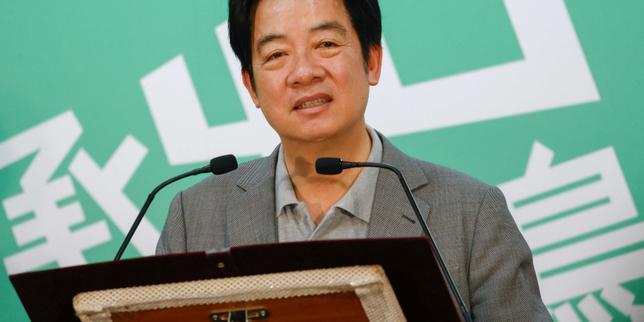
Recently, Taiwan's President, Lai Ching-te, stood before a microphone and spoke to this exact reality. He made a statement that didn't just ripple through diplomatic cables; it struck a chord in living rooms across the island. He insisted that Taiwan’s security cannot be a bargaining chip. It cannot be bartered away in some grand compromise between two superpowers looking to smooth over their trade deficits or patch up their bilateral relations.
The word he challenged was marchandage. Bargaining. Higgling.
It is a dirty word when applied to human existence. Consider the mechanics of a transaction. In any market, you give up something of value to secure something else you want more. But what happens when the item up for auction is the right of a population to vote, to speak freely, to exist without the shadow of subjugation?
When Washington and Beijing sit down at massive mahogany tables in neutral cities, the temptation to treat smaller nations as leverage is historically hard to resist. We saw it at Yalta. We saw it in the closing days of the Cold War. The danger today is that Taiwan becomes a currency—a token used to buy a temporary, fragile truce in a much larger economic knife fight.
But peace bought with someone else's freedom is just a lease on subjugation.
The Illusion of the Silicon Shield
There is a comfortable myth that circulates in Western capitals. It is the concept of the "Silicon Shield." The theory goes like this: because Taiwan produces over ninety percent of the world's most advanced microchips, neither side dares touch it. A war would instantly vaporize the global economy, plunging the world into a digital dark age. Therefore, the chips guarantee safety.
It is a beautiful, logical theory. It is also dangerously naive.
History is littered with the ruins of cities that thought their economic utility made them indispensable. Dependability is not a deterrent to a regime driven by historical destiny and ideological conviction. To believe that a dictatorship will halt its century-long territorial ambitions just because of a disruption to smartphone supply chains is to completely misread the nature of power.
Look inside one of those cleanrooms. The machines that print these chips use extreme ultraviolet lithography. They are the most complex instruments ever created by human ingenuity. They require a global web of lasers, mirrors, and chemical engineering to function. They are miracles of cooperation.
Yet, they are incredibly fragile. A single artillery shell, a prolonged power outage, or the flight of key engineers would render these multi-billion-dollar facilities useless. You cannot run a semiconductor fab at gunpoint. You cannot force a scientist to innovate with a bayonet at their back.
The shield is made of glass. It can shatter in an instant.
The View from the Other Side of the Atlantic
Across the ocean, the American political landscape shifts like sand dunes in a storm. One administration pledges "rock-solid" support; the next questions whether a distant island is worth the risk of a third world war. For the people living in Taipei or Kaohsiung, watching American cable news is an exercise in rising blood pressure.
They hear pundits talk about Taiwan as an "unsinkable aircraft carrier" or a "strategic choke point."
Notice how rarely those commentators talk about the night markets. They don't mention the smell of stinky tofu, the laughter of teenagers outside a temple, or the quiet pride of a society that became the first in Asia to legalize same-sex marriage. When a society is reduced to a military asset, its humanity is stripped away. It becomes easier to abandon when the cost of maintaining that asset gets too high.
But the real problem lies elsewhere. The anxiety in Taiwan isn’t just about a sudden, catastrophic invasion. It is about the slow, grinding erosion of certainty.
Every time a Western politician suggests that perhaps Taiwan should pay for its own protection like an insurance policy, or that maybe a deal could be struck to split differences with Beijing, a tremor goes through the island’s economy. Capital considers moving. Young families look at immigration visas. The psychological warfare is effective long before a single shot is fired.
The Cost of Staying Quiet
It is easy to look at this situation and feel a paralyzing sense of powerlessness. The numbers are too big. The military disparities are too vast. China’s defense budget eclipses Taiwan’s by orders of magnitude.
But strength is not purely an exercise in arithmetic.
Think about the concept of home. If someone breaks into your house, you do not calculate the economic value of your living room before deciding whether to defend it. You defend it because it is yours. Because your memories live there. Because your children sleep there.
Taiwan's resistance is built on this stubborn, unquantifiable sentiment. It is an understanding that identity cannot be traded for market access. President Lai's refusal to allow Taiwan to become a commodity is a declaration of adulthood. It is the island telling the world: We are a protagonist in our own story, not a footnote in yours.
The world faces a choice that extends far beyond the shipping lanes of the Western Pacific. If we accept the premise that small democracies can be bartered away to appease authoritarian neighbors, we validate a ruleset where might dictates reality. We return to an era where the strong do what they can and the weak suffer what they must.
Yesterday, a friend in Taipei sent a picture of a park near her apartment. The azaleas were in full bloom, a brilliant explosion of pink against the gray concrete of the city. In the background, older residents were practicing Tai Chi, their movements slow and deliberate, perfectly synchronized.
Life goes on. It must. But it goes on with a profound, quiet courage that the rest of the world frequently misunderstands as indifference. They are not indifferent. They are simply refusing to live their lives in a state of permanent apology for existing.
The wafers of silicon will continue to spin in their vacuums. The ships will continue to navigate the strait. But the true value of the island is not found in the technology that powers our pockets. It is found in the stubborn, beautiful insistence that freedom is not a luxury item to be discounted when the market gets rough.