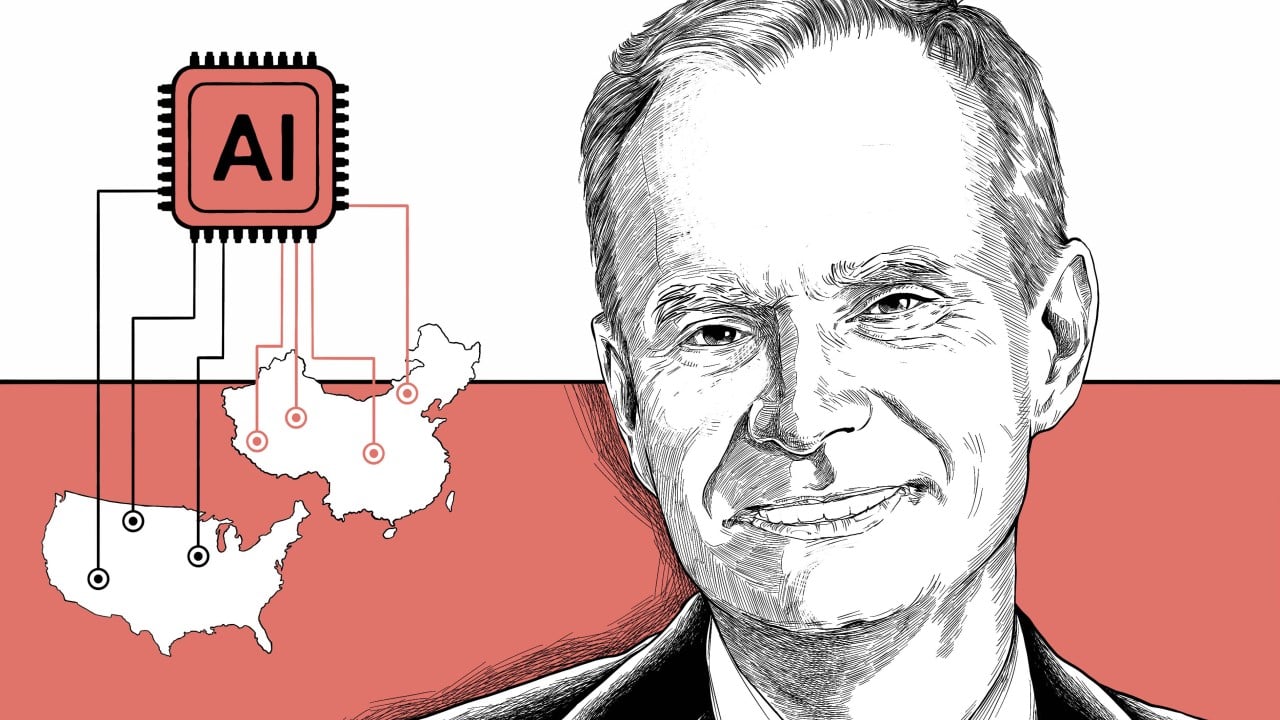
A quiet hall in Stockholm can feel like the furthest place on earth from the smog of a megacity or the silent server farms powering our digital age. Yet, when an elder statesman of economic thought stands before a microphone, the distance collapses instantly.
He speaks with the steady cadence of someone who has spent decades parsing numbers to understand human choices. He does not wave his hands or shout. He simply points to a map, a dataset, and an uncomfortable reality. If you liked this post, you might want to check out: this related article.
We are pulling apart the world we spent three-quarters of a century building.
The Friction in the Machine
Think of global trade like a vast, delicate clockwork mechanism. For decades, the gear wheels turned with remarkable smoothness. A microchip etched in Taiwan was placed in a device assembled in Shenzhen, running software written in California, powered by raw materials extracted in Australia. For another angle on this development, refer to the recent coverage from BBC News.
It was messy. It was imperfect. But it worked, driving down costs and pulling billions out of severe poverty.
Now, grit is being intentionally thrown into the gears.
In lecture halls and government cabinets across the West, a new doctrine has taken root. The argument sounds reasonable on the surface: protect national security, secure supply chains, keep critical technologies at home. But trace that logic down to its human root, and the picture shifts dramatically.
When a country decides to restrict the export of advanced computing hardware or erect steep tariffs against a trading partner, the impact does not stop at corporate balance sheets. It trickles down to a small laboratory in Guangzhou where researchers are trying to model early-stage cancer cells. It lands on a family business in Ohio forced to pay double for raw components.
Politicians sell economic separation as a shield. In reality, it acts as a blindfold.
Science does not care about borders. When you isolate an adversary, you do not just stop them from acquiring your discoveries; you cut yourself off from theirs. China now produces a massive volume of high-impact scientific research. To act as if that knowledge can be ignored or fenced off is a gamble driven by pride rather than prudence.
Suspicion is cheap. Isolation is extraordinarily expensive.
The Great Unraveling of Truth
There is a deeper, quieter crisis unfolding alongside these geopolitical economic rifts. It is a slow decay in how societies view empirical reality itself.
When public health recommendations become partisan battle lines, when environmental data is dismissed as a political conspiracy, the fundamental social contract begins to fray. Science is not a set of dogmatic beliefs. It is a rigorous, often tedious method of asking questions, testing hypotheses, and adjusting our view when proven wrong.
Yet, we see an increasing appetite for easy lies over uncomfortable truths.
When political leadership actively discredits institutional expertise, the damage is not easily repaired. Trust takes generations to build and mere months to dismantle. Once a populace learns to distrust the measuring tape, every measurement becomes an argument.
Consider the consequences for the next global emergency. If a society cannot agree on basic statistical facts, how can it coordinate a response to a new pandemic, a failing power grid, or a changing climate?
Panic replaces planning. Noise drowns out signal.
A Double-Edged Intelligence
Into this atmosphere of geopolitical tension and institutional skepticism steps artificial intelligence.
It arrives not with a bang, but as an ever-present digital layer settling over daily life. The promises are dizzying: automated medical diagnoses, hyper-efficient logistics, tailored education for every child on earth.
The risks, however, are not confined to sci-fi tropes of rogue machines. The real danger is much more immediate, grounded, and human.
The first hazard is economic disruption on a scale we are ill-prepared to manage. Previous industrial shifts replaced manual labor, eventually creating new categories of service and knowledge work. Advanced algorithms target the middle of the intellectual workforce—translators, analysts, coders, writers, administrative managers.
If millions of knowledge workers find their skills obsolete overnight, the social safety nets in most nations will not bend; they will snap.
The second hazard is political. In an era where trust in facts is already fragile, generative tools act as a powerful accelerator for falsehood. When anyone can generate convincing video, audio, and text at zero marginal cost, the public sphere becomes polluted beyond recognition.
Truth becomes a luxury item.
Who controls these tools? A handful of mega-corporations concentrated in a single nation. This brings us back to the geopolitical chessboard. If the development of transformational technology remains locked inside a corporate oligopoly protected by nationalistic trade barriers, the rest of the world is left with a stark choice: submit to digital dependence or build dangerous, unregulated alternatives.
Reclaiming the Commons
The path forward requires a jarring shift in perspective.
Global cooperation is not a soft, idealistic favor we grant to our rivals. It is a cold, hard necessity for our own survival. The problems facing the coming generation—unregulated artificial systems, economic inequality, global health threats—do not respect national borders. They cannot be solved by tariffs or export bans.
To navigate this era, we must rebuild two distinct bridges.
First, the bridge of trade and scientific exchange. Competition between nations is natural and can even drive progress. But competition without rules, or competition aimed at the total containment of a rival, ultimately impoverishes everyone involved. Keeping lines of communication and commerce open is a form of risk management.
Second, the bridge of public trust. Restoring faith in expertise requires experts to speak clearly, admit uncertainty, and engage with the public's real fears rather than dismissing them. It requires political leaders to stop using scientific institutions as political footballs.
The choices made in boardroom meetings and legislative chambers today will echo for decades. We can continue down the path of fragmentation, building higher walls around smaller fiefdoms while the shared threats of our world grow unchecked. Or we can remember a basic truth that every era of human progress has demonstrated: we learn more together than we ever could alone.
The world does not grow safer when we close the windows and lock the doors. It just grows dark.


