The Mediterranean at dusk does not look like a graveyard. It looks like spilled ink, vast and heavy, swallowing the final orange fractures of the sun. If you stand on the southern shores of Europe, the water murmurs against the stone with a rhythm that feels ancient and calm. But twenty miles out, where the dark water deepens and the safety of the shoreline vanishes, that same rhythm sounds like a throat clearing.
It is a Monday. In a small coastal town, a woman named Elena sits near the docks, watching the horizon. She is not waiting for a cruise liner or a fishing boat. Elena works with an rescue organization, and she knows that right now, hidden by the swell of the waves, there is a rubber dinghy. It was built for ten people. It currently holds sixty-five.
Among them is a hypothetical boy we will call Samuel. He is twelve. He does not know how to swim. His sneakers, fake leather and two sizes too big, are already soaked through with a mixture of saltwater and spilled diesel fuel from the outboard motor. The skin on his ankles is beginning to blister from the chemical burn. Samuel’s mother paid three thousand dollars—the collective savings of an extended family across three generations—to a man in a linen suit who promised a clean cabin on a safe ship. Instead, Samuel was shoved into the dark at 3:00 AM, told to keep quiet at gunpoint, and cast adrift.
This is the human geometry of human trafficking. It is a mathematical equation where desperate hope is divided by calculated cruelty, and the remainder is almost always terror.
The Geography of the Trap
We often talk about migration as if it is a choice made in a vacuum. A simple matter of moving from point A to point B. It is not. It is a flight from an unlivable present toward an unimaginable future.
Consider how the mechanism works. A smuggler does not market themselves as a criminal. They market themselves as a travel agent for the hopeless. They operate in the shadows of broken states, exploiting the fact that legal pathways to safety have been systematically choked off. When a border closes, a premium is placed on the smuggler’s services. The higher the walls, the higher the fee. The higher the fee, the more brutal the methods required to protect the profit margin.
The business model relies entirely on the asymmetric value of life. To the trafficker, Samuel is not a child with a future, a voice, or a soul. He is a metric. He is three thousand dollars of upfront revenue. If the boat capsizes five miles off the coast of Libya, the transaction is already complete. The money has been laundered through three different accounts before the water even enters the boy’s lungs.
This is the reality that standard news bulletins struggle to capture. They give us numbers. They tell us that thousands have died this year alone in the Mediterranean corridor. But numbers are an anesthetic. They numb the brain. They allow us to nod gravely, turn the page, and eat our breakfast. They shield us from the smell of the diesel, the sound of sixty people praying in four different languages simultaneously, and the cold reality of a child's hand slipping beneath the surface.
A Voice from the Balcony
Every now and then, someone attempts to pierce that numbness.
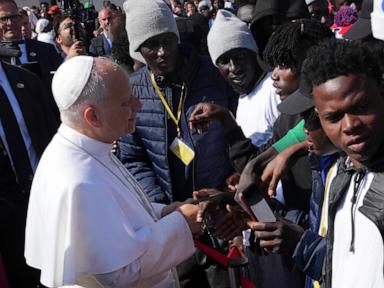
Recently, the sun beat down on St. Peter’s Square in Rome. The air was thick with the scent of hot asphalt and cheap wax from tourist candles. An old man dressed in white stepped out onto a balcony. Pope Francis looked down at the crowd, but his mind was clearly miles away, out on the ink-black water where the dinghies drift.
He did not offer a polite diplomatic statement. He did not call for a committee or a study group. He spoke with the raw, vibrating anger of someone who sees an ancient horror recurring in the modern world.
He called them out directly: the traffickers. The men in linen suits. The syndicates operating out of makeshift offices in Tripoli, Izmir, and the underbelly of European cities. He did not merely accuse them of breaking international law. He accused them of violating something far older and more dangerous to cross.
"Stop," he said. His voice carried across the cobblestones, flat and heavy. "Repent."
He warned them that they would face the wrath of God.
To a secular world, such words might sound like anachronisms. We are used to statements from the United Nations, policy papers, and economic sanctions. We understand the language of asset freezes and border enforcement. But the language of divine wrath operates on a different plane. It strips away the corporate veneer of human smuggling. It takes a crime that hides behind logistical euphemisms—"facilitated transport," "network coordination"—and calls it what it is. A sin that cries out to heaven.
The Illusion of Distance
It is easy to sit in a comfortable room, miles away from the coast, and view this as a tragedy of geography. A Mediterranean problem. A European problem. A border problem.
That is an illusion. The supply chains of human misery are deeply interconnected with our daily lives. The money washed from the pockets of desperate families finds its way into global banking systems. The demand for cheap, undocumented labor underpins industries we rely on every day, from agriculture to hospitality. The instability that drives a family to put their child on a sinking boat is fueled by global conflicts, climate realities, and economic policies that we are all complicit in.
The real problem lies elsewhere. It is not a lack of boats for rescue operations, nor is it a lack of radar technology along the coastlines. It is a lack of imagination. We cannot imagine our own children in Samuel’s oversized sneakers. We cannot imagine our own mothers selling their wedding bands to buy a ticket on a death trap.
We have created a hierarchy of grief. We mourn the losses we can understand, and we categorize the losses we cannot understand as statistics.
The Anatomy of Repentance
What does it mean to tell a human trafficker to repent?
It is not a call for a superficial apology. True repentance requires looking at the damage done and dismantling the system that allowed it. For the syndicates, that means walking away from millions in blood money. For governments, it means acknowledging that militarized borders without safe, legal alternatives simply create a highly lucrative market for criminals. For the rest of us, it means refusing to look away.
Elena still sits by the docks. The sun has gone completely now. The water is a flat, featureless void. Her radio crackles with static—a faint, garbled transmission from a search plane checking coordinates.
Somewhere out there, the dinghy’s engine has died. The passengers are using their bare hands to bail out the water that is slowly rising past their ankles. Samuel is holding his mother's sleeve. He is looking at the horizon, searching for a light, any light, to prove that the world hasn't forgotten they are out here in the dark.
The old man in Rome spoke of a ledger that will be settled long after the earthly courts are done. But until that day comes, the water keeps moving, the boats keep leaving the shore, and the silence of the sea remains the loudest accusation of all.