The kitchen clock ticks in the quiet house, but Arthur doesn’t hear it anymore. He sits by the window, hands tracing the grain of the wooden table. His wife, Martha, is in the other room. She is a stranger who happens to know where the kettle is kept.
Care is not a logistical problem to be solved with spreadsheets or debate chambers. It is a slow, grinding attrition. It is the sound of a heavy door locking behind you, sealing away the life you expected to lead, replacing it with a quiet, expensive desperation.
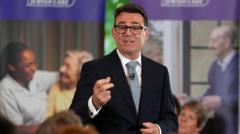
Andy Burnham, the Mayor of Greater Manchester, stands in a brightly lit room miles away, speaking about fiscal responsibility and the grim arithmetic of local governance. He talks about tax rises. He speaks of the "impossible choices" required to keep the machinery of social care from grinding to a halt. To the detached observer, these are figures on a page. To Arthur, these are the only words that matter.
We have spent decades treating the sunset of our lives as a private tragedy, a storm that individual families must weather alone. We talk about tax thresholds and funding formulas, yet we miss the visceral truth: we are currently building a society where the final chapter of human life is treated as an optional luxury.
Consider the hypothetical, yet painfully common, scenario of a family like Arthur’s. They have saved for thirty years. They paid their dues. They assumed that when the body failed or the mind drifted, the state would be a partner in their care. Instead, they find themselves in a labyrinth of means-testing, where the very act of having been responsible—of owning a home, of tucking away modest savings—is used as a justification for denying support.
Burnham’s refusal to rule out tax increases is not just a political stance. It is a brutal acknowledgment of a crumbling foundation. The current system is a leaky dam, and we have been trying to plug the holes with pebbles. When a politician mentions raising taxes, the immediate reaction is typically a visceral protest—a fear of another bite taken from a shrinking paycheck. But we rarely count the cost of not doing it.
The cost is there, invisible and heavy. It is found in the emergency rooms crowded with elderly people who have nowhere else to go. It is found in the exhausted social workers who have fifteen minutes to complete a task that requires an hour. It is found in the lonely, deteriorating health of the primary caregiver—the spouse or the child who is slowly breaking under the weight of a duty they were never trained for.
There is a strange, cold comfort in the precision of the numbers. Experts often point to the "social care funding gap," a dry statistic suggesting that billions more are needed annually just to keep the service at its current, inadequate level. Think of that gap as a canyon. We have been trying to jump it for years, and we are falling short. Tax rises, as unpalatable as they are, are simply the attempt to build a bridge.
Yet, money is only part of the friction. The deeper issue is our collective denial. We prefer to look away from the inevitability of infirmity. We treat the aging process as a medical failure rather than a biological certainty. By separating health care, which we view as a public right, from social care, which we treat as a private burden, we have created a fractured reality.
I remember the day my own father stopped recognizing the garden he had planted with such care. The loss wasn’t dramatic. It was quiet. It was the slow, steady erosion of his autonomy. We were left to navigate a system that seemed designed to frustrate, a series of forms and assessments that felt like interrogations. Every interaction felt like we were begging for scraps from a table that was already bare.
This is the reality Burnham and other leaders are tiptoeing around. To fix social care isn’t just about collecting more revenue. It is about a fundamental shift in how we value the elderly. It requires an admission that the current model—where the most vulnerable are forced to exhaust their life’s savings before receiving help—is a moral error.
Some argue that local authorities should be given more autonomy to raise their own taxes to bridge the divide. This is the argument of the localist, the belief that the people closest to the problem are best equipped to find the solution. But there is a danger here. It risks creating a postcode lottery where the quality of one’s care depends entirely on the wealth of the neighborhood they live in. If we treat care as a human right, the solution cannot be geographically biased. It must be anchored in something sturdier than municipal tax bases.
The political courage required to tax citizens for a service that many believe they will never need is immense. It is easier to promise lower taxes and kick the can down the road. But the road is ending. The demographics are shifting, the population is aging, and the demand for care is outstripping the supply of compassion.
When we debate these policies, we aren't talking about abstract economics. We are talking about the quality of the light in a room when a person is dying. We are talking about whether a person is treated as an object to be stored or a human to be honored.
Arthur still sits by the window. He has stopped worrying about the tax rate. He has stopped trying to solve the riddle of the funding gaps. He is just trying to make sure Martha is comfortable for one more hour. He is living the reality that the politicians are debating.
There is a moment in every life where the structures of society either hold you or let you fall. We are currently allowing far too many to fall, watching them disappear into the silence of a system that has run out of ways to say it cares. The tax debate is a tedious, technical, and often infuriating exercise, yet beneath the jargon lies the most important question a society can ever ask itself.
It is not about whether we can afford to pay more. It is about whether we can afford to remain the kind of people who would choose to pay less.
The sun begins to dip below the horizon, casting long, sharp shadows across the floor. Arthur reaches out and takes Martha’s hand. She looks at him, eyes wide and searching, and for a fleeting, beautiful second, she remembers exactly who he is.
That second is all there is. It is fragile, it is fleeting, and it is worth everything.


