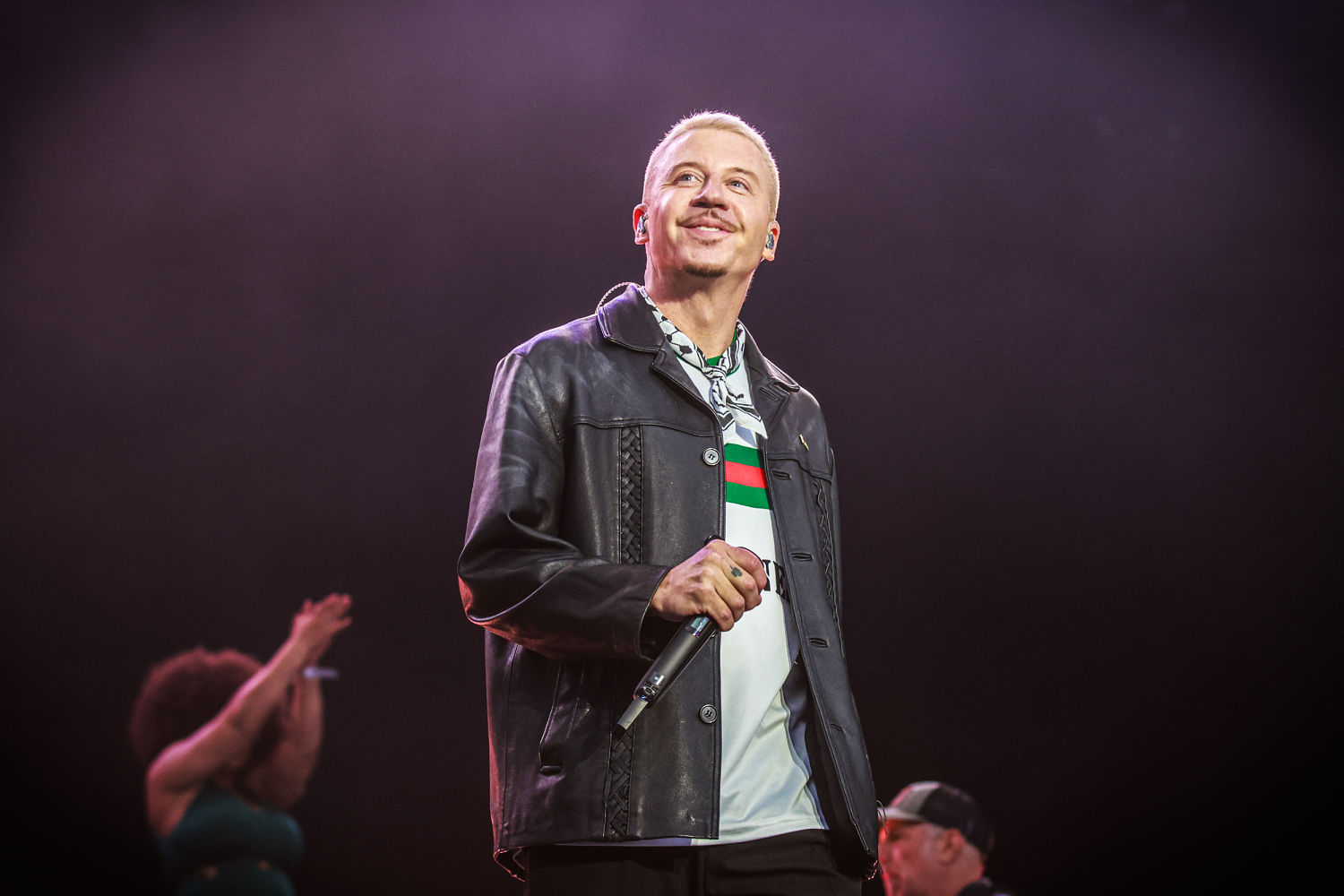
Backstage smells like ironed cotton, damp concrete, and the stale vinegar of leftover catering. If you have ever stood in the wings while forty thousand people roar in the dark, you know the sound is less like a wave and more like a jet engine pressed directly against your skull. It vibrates your teeth. It makes you feel, for three minutes, like an architect of the cosmos.
Then the house lights come up. The roadies roll the cable trunks. And reality reclaims the room.
For Ben Haggerty—known to the planet as Macklemore—that reality arrived not with a roar, but with a quiet, polite cancellation notice.
Drop. Removed. Gone.
The official explanations given to the press were bureaucratic ghosts: scheduling anomalies, shifting European itineraries, standard logistical friction. But music has always operated on two frequencies. There is the frequency of the chord progression, the three-minute pop hymn that sounds good bouncing off the back row of a stadium. And there is the frequency of the unwritten contract. That subterranean ledger where money, politics, and cultural compliance are weighed against one another in smoke-filled rooms far away from the stage.
To understand why a stadium tour can evaporate overnight, you have to look past the marquee names. You have to look at the machinery of access.
Stadiums do not run on enthusiasm. They run on concrete, insurance policies, municipal permits, and corporate underwriting. When Ed Sheeran rolls into town, he is not merely a guy with an acoustic guitar and a loop pedal; he is a multinational logistical enterprise. Hundreds of people depend on that tour truck rolling into the next city on Tuesday morning. Venues are owned by conglomerates, sports franchises, and billionaires whose names sit bronze-plated on executive suites.
Enter Robert Kraft.
You know the name from Sunday afternoons. Owner of the New England Patriots, fixture of Foxborough, billionaire patriarch of corporate sports empires. When a figure of that magnitude moves through an industry, the floorboards dip.
Reports surfaced—and were later acknowledged by Macklemore himself during candid moments on stage and in interviews—that an intended slot supporting Sheeran vanished because Kraft had organized or influenced a pushback against the rapper. The catalyst was not musical. It was lyrical. It was political. It was about an onstage declaration, an unfiltered cry for Palestinian freedom delivered into a microphone during a festival appearance.
Words have weight. In the ecosystem of high-end entertainment, however, words have invoices.
Imagine sitting in a mahogany-lined office overlooking a harbor. The air conditioning hums at a crisp sixty-eight degrees. On the desk sits a ledger of risks. A pop star singing about peace in a conflict zone is not categorized as art by the risk assessors; they categorize him as liability. Will luxury suite holders complain? Will stadium sponsors issue cautious memos? Will the frictionless glide of corporate hospitality experience a single micron of turbulence?
That is where the invisible boycott lives. It does not need a signed decree. It does not require a press conference. It operates through the subtle art of the chilled phone call. A mutual acquaintance nudges a promoter. A sponsor subtly reminds a booking agent of their multi-million-dollar partnership. The gears shift. The schedule clears. And suddenly, an artist finds themselves looking at an empty block of dates on the calendar, wondering how the air grew so thin so fast.
It is a curious thing, this modern exile. We like to pretend that culture is a wide-open prairie where the best voice wins the room. We tell ourselves that art exists outside the petty calculations of capital. But walk into any major arena dressing room and look at the rider taped to the mirror. Notice who pays for the security detail. Notice who owns the parking garages.
Macklemore is no stranger to swimming against the current. This is the artist who independent-hustled his way to Grammy dominance with The Heist, bypassing the traditional major-label gatekeepers entirely back in 2012. He built a career on saying the quiet part out loud, whether it was critiquing consumerism in thrift shops or lambasting homophobia in hip-hop with the anthem "Same Love." He knows the rules of the game. You can critique the system, provided you do it with enough abstraction that the corporate sponsors can still buy a luxury box. You can be edgy, as long as your edginess doesn't threaten the balance sheet of a stadium owner who sits on boards with defense contractors and international conglomerates.
Step across the line into real-world geopolitics, though, and the invisible boundary reveals its barbed wire.
When Macklemore dropped the phrase "Free Palestine" at a crowded festival, he was operating as a troubadour in the ancient tradition of musicians sticking their fingers into the gears of statecraft. But modern stadium tours are not medieval town squares. They are corporate temples. And temples have strict rules about who gets to question the high priests.
The backlash was swift, silent, and systemic. Ed Sheeran’s camp found themselves caught in the crossfire of corporate gravity. You do not invite an artist who brings cultural lightning storms onto a tour sponsored by multinational brands without calculating the cost of the thunder. And so, the decision was made. The door was closed.
What happens to an artist when the door closes like that?
To the public, it looks like a blip. A headline read over morning coffee, a momentary scandal scrolled past on a phone screen, forgotten by evening. But for the artist, it alters the temperature of the room. It creates a chilling effect that extends far beyond one cancelled tour. Every other promoter, every festival booker, every corporate brand manager watching from the sidelines takes quiet note. Is he worth the headache? Does my brand want to absorb that shrapnel?
That is the true power of the modern boycott. It isn't just about punishing a single voice; it is about sending a signal flare to every other artist on the roster. Sing about love, sing about heartbreak, sing about whatever demographic-friendly emotional struggle fits neatly into a thirty-second TikTok clip. But step off the reservation into the raw, bleeding fractures of global politics, and watch how fast the stage disappears beneath your feet.
We live in an era that claims to celebrate authenticity. Every pop star is urged to share their mental health struggles, their childhood traumas, their emotional breakthroughs. Vulnerability is marketed as the ultimate virtue. But it is a managed vulnerability. It is safe vulnerability. It is the kind of vulnerability that sells merchandise and streams on Spotify playlists curated by algorithms designed to maximize neutral engagement.
Real conviction, however, is inconvenient. It refuses to stay in its lane.
When Robert Kraft and his peers exerted their gravity to push Macklemore off that tour, they were protecting an ecosystem. Not an ecosystem of art, but an ecosystem of frictionless commerce. They were demonstrating that while artists may write the songs, the people who own the real estate still write the bottom line.
Consider what happens next time an emerging rapper, an indie-rock band, or a pop icon looks at a microphone and feels the urge to speak about something larger than their own bank account. They will feel a phantom chill at the back of their neck. They will remember the empty dates on Macklemore's calendar. They will remember how fast a stadium tour can turn into a living room conversation.
And that is the quiet tragedy of modern culture. The censorship doesn't require a censorious government locking doors. It works much better when the doors lock themselves, oiled by the silent, collective terror of lost revenue.
Yet, there is a stubborn resilience to the troubadour spirit. You can cancel a tour. You can reroute a truck. You can whisper through corporate networks until an opening act vanishes into thin air. But you cannot un-ring a bell that has already echoed across forty thousand minds.
Macklemore is still standing. The stadiums are still lit. And somewhere out there, in the damp concrete wings of a venue far away, another artist is gripping a microphone, weighing the cost of a chorus against the price of silence.
The lights go down. The crowd holds its collective breath.
And the music starts anyway.


