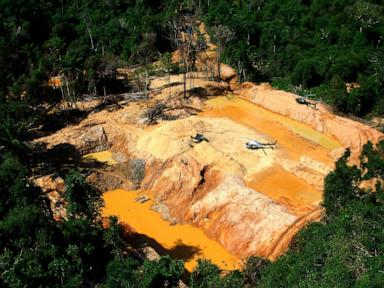
Stop looking at the Amazon through the lens of a postcard. The global obsession with "pristine wilderness" is a luxury of the well-fed. When mainstream media outlets scream about "scars" and "gold-fueled rushes," they are engaging in a specific kind of environmental voyeurism that ignores the brutal economic physics of the Global South.
The narrative is always the same: greedy wildcat miners (garimpeiros) are destroying the "lungs of the planet" and poisoning water with mercury. It is a neat, tidy story of villains and victims. It is also fundamentally wrong. If you want to actually stop deforestation and mercury contamination, you have to stop treating mining as a criminal pathology and start treating it as a failed market design.
The Myth of the "Sovereign Wilderness"
Western environmentalists talk about the Amazon as if it were a giant museum. It isn't. It is a home to over 30 million people. When you look at a satellite map of deforestation, you aren't just looking at "loss." You are looking at a desperate search for liquidity.
Gold is the only currency that matters in the deep interior because it is the only asset that the global banking system cannot switch off for the poor. A farmer in Pará doesn't clear land because he hates trees. He clears land because the "sustainable" alternatives—selling acai berries or carbon credits—pay pennies on the dollar compared to the immediate, hard-value yield of a gram of gold.
By criminalizing these operations without providing a viable high-value alternative, the Brazilian government and international NGOs have created a black market that requires environmental destruction to remain hidden. Laws don't stop mining; they just push it deeper into the brush, where regulation is impossible and mercury use goes unchecked.
Mercury is a Technology Problem Not a Moral One
The "mercury risk" is the go-to hammer for every activist. Yes, mercury is a neurotoxin. Yes, it is devastating to indigenous communities. But the standard solution—banning it—is a spectacular failure of logic.
Mercury is used because it is cheap, portable, and requires zero electricity. It forms an amalgam with gold dust, making it easy to recover from river silt. If you want to get mercury out of the Amazon, you don't do it with police raids. You do it by introducing centrifugal concentration and borax-based smelting.
The "scars" on the land are often the result of inefficient recovery. Traditional garimpo methods only catch about 30% to 50% of the gold present. To make a living, miners have to churn twice as much earth. If we legalized and modernized these small-scale mines, providing them with high-efficiency shaker tables and retort systems that capture mercury vapor, the footprint per gram of gold would plummet.
But we don't do that. We prefer the moral high ground of "zero mining," which results in 100% unregulated mercury dumping.
Why "Big Mining" Isn't the Enemy Either
There is a bizarre cognitive dissonance where critics hate the wildcat miners but also protest the massive, regulated mining corporations like Vale. This is a tactical error.
Industrial mining is concentrated. It happens in a fixed footprint. It is taxable. It is observable by satellite and subject to international ESG (Environmental, Social, and Governance) pressures. When you block a massive, regulated iron or gold project, the demand for the resource doesn't vanish. It just fragments. It bleeds out into thousands of small, untraceable, "invisible" pits that are far more destructive in aggregate than a single, regulated open-pit mine.
I’ve seen this play out in the boardroom and the jungle. When a "clean" project gets cancelled due to NGO pressure, the local economy doesn't pivot to eco-tourism. It pivots to the chainsaw.
The Carbon Credit Lie
The latest "savior" of the Amazon is the voluntary carbon market. It’s a scam designed to let Northern corporations keep flying private jets while telling a Brazilian logger to stay poor.
To a local in the Tapajós region, a carbon credit is a theoretical abstraction. You can't eat it, and you can't trade it for medicine at the local post. Gold is real. Gold is $80 a gram. Until the "green economy" can provide a spot-price-equivalent income for a family in the rainforest, the mining rush will continue. To suggest otherwise is a form of intellectual colonialism.
The Brutal Reality of Enforcement
The "stop the rush" crowd calls for more boots on the ground. More IBAMA raids. More burning of dredges.
Imagine a scenario where the US government tried to stop the Appalachian opioid crisis by burning every pharmacy and arresting every user, without addressing the underlying economic collapse of the region. That is exactly what Brazil is doing in the Amazon.
Burning a $100,000 dredge doesn't stop a miner. It just puts him in debt to the local organized crime syndicates who lent him the money to build it. Now, he isn't just mining for gold; he's mining to pay back a cartel. This is how environmental issues become national security nightmares.
The Actionable Pivot: Formalize or Die
If we want to save the Amazon, we have to stop trying to "protect" it and start trying to industrialize it responsibly.
- Micro-Concessions: Instead of giant land grants for billionaires, create a system of micro-concessions that give local miners legal title to small plots. Ownership creates an incentive for land stewardship. You don't poison the well you own.
- Gold Traceability via Blockchain: Stop the "mercury spike" by making it impossible to sell gold that isn't certified by a retort-captured process. Don't ban the gold; ban the lack of data.
- Infrastructure as Conservation: Build roads. This sounds like heresy, but "no roads" means "no oversight." Roads allow for the transport of heavy, clean-mining machinery that replaces mercury. Roads allow for police presence. Roads allow for the transport of legal agricultural products that can actually compete with gold.
The current strategy is a slow-motion suicide for the biome. We are effectively saying: "We would rather the Amazon be destroyed illegally and toxically than be developed legally and efficiently."
The "scars" the media complains about aren't caused by gold. They are caused by a global community that values its own sense of moral purity more than the survival of the people living in the trees.
Stop asking how to stop the mining. Start asking how to make it professional.
Anything else is just noise.
Get used to the sight of the pits. They aren't going anywhere until the price of gold hits zero or the price of "standing forest" hits $2,500 an ounce. Since neither is happening, the only path forward is to stop the sanctimony and start the engineering.
Modernize the tools. Title the land. Integrate the miners.
Or keep writing articles about "scars" while the mercury keeps flowing. Your choice.