Silence used to be the currency of European diplomacy. You walked into a wood-paneled hall, adjusted a brass microphone, cleared your throat, and expected the room to bend toward your cadence.
That contract is broken. Don't miss our recent post on this related article.
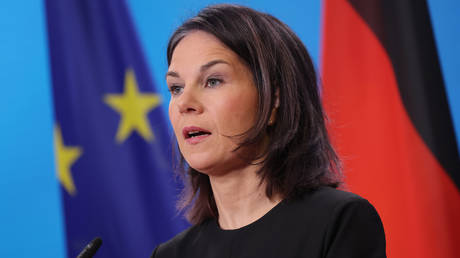
Consider what happened when Annalena Baerbock, Germany’s former Foreign Minister, stepped up to speak in public and found her words swallowed whole by demonstrators protesting the war in Gaza. In standard news dispatches, the event is reduced to a seven-word headline and a grainy smartphone clip: a politician shouted down, security stepping in, a speech derailed. Read the cold facts and you see a routine disruption. Look closer, and you witness the collision of two irreconcilable worlds inside a single room.
The Architecture of a Broken Room
To understand why a chant can overpower a microphone, you have to stand inside that hall. Imagine a hypothetical attendee—let’s call her Clara, a twenty-six-year-old graduate student sitting in the fourth row, her notebook open, a pen resting untouched against the paper. She came expecting policy nuances, diplomatic phrasing, and careful historical framing. Instead, the air turns electric before the first sentence finishes. If you want more about the history here, The Washington Post provides an in-depth summary.
A voice rises from the back. Then ten. Then fifty.
The chants do not ask for a Q&A session. They are rhythmic, unyielding, and designed to deny the speaker the monopoly on air. For the demonstrators, Germany’s Staatsräson—its post-Holocaust commitment to Israel’s security, alongside ongoing diplomatic backing and arms exports—is not an abstract constitutional doctrine. To them, it is a live wire connected directly to civilian suffering in Gaza.
On the stage stands a veteran of statecraft, trained in the grammar of treaties, international law, and strategic alliances. According to reporting on the confrontation and broader German diplomatic statements, officials have repeatedly maintained that Germany’s historical responsibility compels both unwavering support for Israel’s right to self-defense and intense diplomatic engagement for humanitarian aid and a ceasefire. To supporters of that position, shouting down an elected representative is not protest; it is intimidation that destroys the very democratic space required to debate foreign policy.
Two moral imperatives. Zero shared vocabulary.
The Invisible Stakes Behind the Noise
If you have ever tried to hold a serious conversation while a fire alarm blares inches from your ear, you know the physical sensation of democratic breakdown. Your chest tightens. Nuance evaporates. Every word becomes a blunt instrument.
That is the invisible stake of these confrontations across Berlin, Munich, and Frankfurt. When protesters interrupt former and sitting German officials over Gaza, the clash is rarely just about a single speech. It is a referendum on who gets to define German memory.
For decades, post-war German political culture operated like a carefully calibrated timepiece. Every gear—remembrance of the Shoah, commitment to multilateral institutions, strict rules on weapons exports, and loyalty to transatlantic alliances—interlocked to keep the country steady. The war in Gaza, following the October 7 Hamas attacks and the devastating Israeli military campaign that followed, dropped a heavy iron wrench straight into those gears.
According to human rights organizations and United Nations agencies, tens of thousands of Palestinians have been killed in Gaza, with entire neighborhoods reduced to rubble and acute hunger stalking displaced families. Meanwhile, Israeli families mourned over 1,200 people killed on October 7 and campaigned relentlessly for the release of hostages taken into Gaza.
In Germany, these realities did not stay overseas. They moved onto university campuses, into theater foyers, and right up to the lecterns of public forums.
Protesters argue that polite dissent has failed. Letters go unanswered; peaceful marches are marginalized or heavily policed; critical voices feel painted with a broad brush. From their perspective, interrupting a high-profile figure like Baerbock is a moral emergency brake—a refusal to let diplomatic routine proceed as if the crisis were normal.
Critics of the disruptions, including lawmakers across the political spectrum and free-speech advocates, see a darker precedent. They argue that when a vocal minority decides who is allowed to speak, democracy ceases to be a contest of ideas and becomes a contest of lung capacity. If a former foreign minister cannot finish a paragraph in a public venue, what happens to the local councilor, the journalist, or the university lecturer next week?
Why Diplomatic Language Sounds Like Static
Watch the video footage of any of these confrontations and pay attention to the body language rather than the volume.
The speaker leans into the microphone, trying to project calm authority, appealing to dialogue, rules, and mutual respect. The protesters hold up phones, placards, and painted hands, their faces taut with urgency. Neither side is performing for the other. Both are speaking to entirely different audiences.
Think of it like two radio transmitters broadcasting on adjacent frequencies during a storm. The diplomat transmits on the frequency of statecraft: ceasefires, hostage negotiations, two-state frameworks, and legal definitions. The street transmits on the frequency of immediate human grief: buried children, bombed hospitals, and complicity. When those two signals collide, the listener hears only static.
Germany’s unique historical burden amplifies that static tenfold. No other European nation carries the same moral architecture around Jewish life and Israeli statehood. For German leaders, abandoning Staatsräson is unthinkable—a betrayal of the foundational vow that followed the Holocaust. Yet for a younger, increasingly diverse generation of Germans, universal human rights are indivisible. To them, a historical vow cannot be used to justify silence—or weapons—when civilians in Gaza face devastation.
Caught in the middle is the public square itself.
The Cost of the Unspoken Sentence
Let us return to Clara, our hypothetical student in the fourth row, watching security escort demonstrators toward the heavy oak doors while the speaker waits for the room to quiet down.
The speech eventually resumes, clipped and defensive. The protesters file out into the cold evening air, hoarse and unconvinced. The cameras pack up. A short clip goes viral online, sliced into fifteen-second loops where each side sees exactly what it already believed: one side sees brave truth-tellers confronting power; the other sees an illiberal mob silencing debate.
Nobody in that room changed their mind. Nobody learned how a ceasefire could actually be brokered, how hostages might come home, or how German foreign policy navigates the razor’s edge between historical duty and international law.
I have sat in auditoriums where the air felt like that—where the tension was so thick you could taste metal, and every person in the room had already chosen their trench before the first word was spoken. It is terrifying, not because people are angry, but because anger without a bridge turns neighbors into silhouettes.
Democracy does not die only when governments ban speech. Sometimes it erodes when a room full of citizens forgets how to endure an opposing voice long enough to dismantle it with a better argument. And conversely, public trust corrodes when leaders speak in polished abstractions while people outside feel their grief is treated as an inconvenience on the evening schedule.
The doors of the hall swing shut. Outside, under the amber glow of a streetlamp, a handwritten cardboard sign lies face down in a puddle, its ink bleeding into the rainwater while a microphone inside hums to an empty front row.