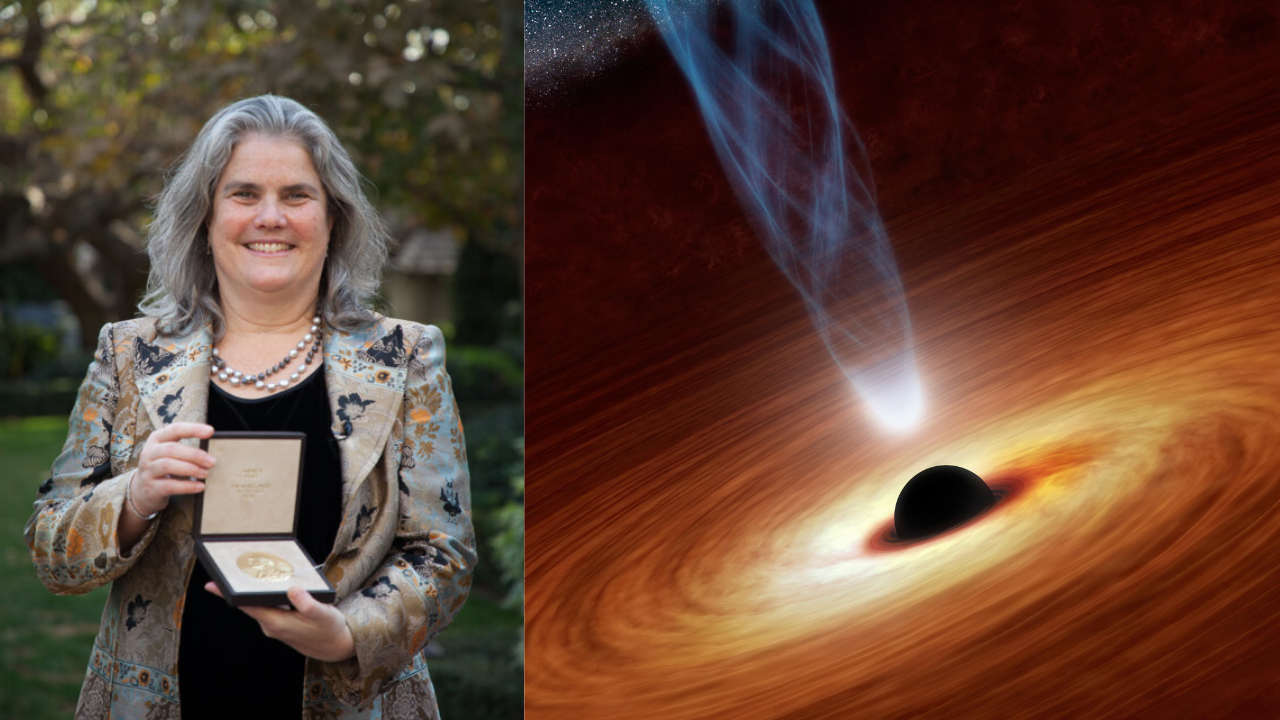
The identification of a supermassive compact object at the center of the Milky Way requires resolving a fundamental contradiction in observational astrophysics: demonstrating the existence of a body whose defining characteristic is the total absence of electromagnetic emission. Conventional narratives frame this as a personal narrative of curiosity and problem-solving. A rigorous analysis reveals it as a multi-decade operational optimization problem. By treating the Earth's atmosphere as a dynamic distorting filter, designing an empirical observation framework, and systematically tracking stellar kinematics over a 25-year epoch, Andrea Ghez and her team established the constraints required to mathematically lock the mass density of Sagittarius A* (Sgr A*) beyond the theoretical threshold of a black hole.
To isolate an invisible mass of 4.1 million solar masses within a radius smaller than our solar system requires bypassing specific observational bottlenecks. The systematic methodology developed at the W. M. Keck Observatory serves as a blueprint for high-contrast, high-resolution imaging under extreme physical constraints.
The Atmospheric Distortion Function and Technological Deficits
Ground-based optical and infrared astronomy operate under a severe penalty function imposed by the Earth's atmosphere. Temperature fluctuations and wind vectors induce rapid variations in the refractive index of air, a phenomenon quantified as atmospheric turbulence.
This turbulence breaks incoming planar wavefronts from stars into patchworks of coherence characterized by Fried’s parameter ($r_0$). At near-infrared wavelengths (2.2 microns), $r_0$ is typically 10 to 20 centimeters. When a telescope’s aperture ($D$) is much larger than $r_0$, the angular resolution is limited not by the diffraction limit of the instrument ($\theta \approx \lambda / D$), but by the seeing limit ($\theta \approx \lambda / r_0$). For a 10-meter telescope like Keck, this degrades the theoretical resolution from 0.05 arcseconds to roughly 0.5 arcseconds—a factor of 10 degradation that obliterates the faint stars moving closest to the galactic center.
To overcome this, Ghez’s empirical strategy progressed through two distinct technological phases designed to minimize or correct this distortion function.
Phase 1: Speckle Imaging and Image Reconstruction
Initial observations relied on speckle imaging, a high-speed operational methodology. By taking thousands of extremely short exposures (under 100 milliseconds), the telescope effectively "freezes" the atmospheric turbulence before it can shift. Each short exposure captures a pattern of interference fringes, or "speckles," which retain high-spatial-frequency information.
The limitation of speckle imaging is data efficiency. The signal-to-noise ratio drops rapidly for faint objects because light is distributed across numerous speckles, and the read noise of the detector accumulates over thousands of frames. This restricted early tracking to only the brightest stars (such as S2, or S0-2) and introduced significant positional uncertainty.
Phase 2: Adaptive Optics and Wavefront Correction
The bottleneck of speckle imaging led to the integration of Adaptive Optics (AO). Instead of filtering out atmospheric distortion after data collection, AO corrects the distorted wavefront in real-time.
The mechanics of this closed-loop control system rely on three primary components:
- Wavefront Sensor: Measures the deviations of the incoming light from a flat plane at a frequency of approximately 1 to 2 kilohertz. Because the galactic center is heavily obscured by interstellar dust (extinction of roughly 30 magnitudes in the optical spectrum), a natural guide star is unavailable. The system uses a sodium laser fired into the mesosphere (at an altitude of roughly 90 kilometers) to create an artificial laser guide star near the target area.
- Deformable Mirror: A mirror driven by hundreds of piezoelectric actuators that physically changes shape to match and counteract the measured phase errors of the atmosphere.
- Real-time Computer: Calculates the inverse phase matrix and commands the actuators within fractions of a millisecond, keeping the total correction loop delay below the coherence time of the atmosphere.
By deploying AO, the Keck telescope achieved its theoretical diffraction limit at 2.2 microns, bringing the angular resolution down to roughly 0.05 arcseconds. This precision allowed the detection of stars up to 10 times fainter than what speckle imaging could resolve, altering the tracking data density.
Kinetic Reconstruction of Keplerian Orbits
The core mathematical proof of Sgr A*'s nature lies in the orbital mechanics of the S-stars—a cluster of high-velocity young B-type stars orbiting within light-days of the galactic center. Tracking these objects converts their positions over time into an explicit measurement of the central gravitational potential.
The position of a star in a bound orbit is governed by Kepler's laws of planetary motion, modified by relativistic corrections. Because we observe a two-dimensional projection on the sky of a three-dimensional orbit, the tracking framework must solve for seven independent orbital parameters:
- Semi-major axis ($a$)
- Eccentricity ($e$)
- Inclination ($i$) relative to the plane of the sky
- Longitude of the ascending node ($\Omega$)
- Argument of periastron ($\omega$)
- Time of periastron passage ($T_0$)
- Orbital period ($P$)
By combining high-precision astrometry (2D positions on the sky) with radial velocity measurements obtained via infrared spectroscopy (the Doppler shift of stellar absorption lines, like Br-gamma), Ghez's team constructed complete three-dimensional kinematic profiles.
The critical target was the star S0-2 (or S2), which possesses an orbital period of roughly 16 years. By capturing the complete pericenter passage of S0-2—where it closed to within 17 light-hours (roughly 120 astronomical units) of the central object while traveling at over 2% of the speed of light ($7,000\text{ km/s}$)—the team isolated the central mass profile.
Evaluating the mass ($M$) within the periastron radius ($r_{\text{per}}$) follows Kepler's Third Law:
$$M = \frac{4\pi^2 a^3}{G P^2}$$
The long-term dataset forced the mass measurement to a precise value: $4.1 \pm 0.1 \times 10^6$ solar masses.
Establishing the Black Hole Threshold
The definitive scientific contribution of this work is not simply finding a large mass, but limiting the physical volume that mass occupies. To confirm that a central mass is a supermassive black hole, researchers must systematically eliminate alternative astrophysical configurations.
Alternative hypotheses for large dark masses include:
- A dense cluster of dark stellar remnants (neutron stars, stellar-mass black holes, white dwarfs).
- A concentrated ball of degenerate dark matter fermions.
- A single giant diffuse star or nebula.
The minimum density ($\rho$) required to rule out these configurations is achieved by dividing the enclosed mass by the volume defined by the closest approach (periastron) of the tracked stars:
$$\rho = \frac{M}{\frac{4}{3}\pi r_{\text{per}}^3}$$
As the tracking baseline grew from 1995 onward, the measured periastron distance dropped. The maximum possible physical radius of the central object was forced below 100 astronomical units. If the central mass were a cluster of distinct stellar remnants or dark matter particles confined to such a small volume, the lifetime of the cluster against gravitational collapse or kinetic scattering would be shorter than the age of the galaxy. The objects would collide, merge, or collapse into a single entity on an astrophysically brief timescale.
Therefore, confining 4.1 million solar masses within this volume leaves a supermassive black hole as the only stable physical state allowed by General Relativity.
Scientific Limitations and Next-Generation Requirements
While the orbital tracking methodology provides robust constraints on mass and position, it encounters fundamental limits when probing the event horizon itself. Astrometric tracking of S-stars measures the integrated spacetime metric at distances of hundreds to thousands of Schwarzschild radii ($R_s$). At these distances, Newtonian gravity with minor post-Newtonian corrections is sufficient.
To test General Relativity in the strong-field limit—such as measuring black hole spin or observing the shadow of the event horizon—requires a shift in observational strategy. This limit drove the development of the Event Horizon Telescope (EHT), which uses Very Long Baseline Interferometry (VLBI) at millimeter wavelengths to bypass atmospheric effects entirely and image the emission ring surrounding Sgr A* directly.
Ghez’s kinematic framework remains the baseline anchor. Without the precise mass and distance parameters calculated from the 25-year stellar orbit dataset, the EHT models would lack the strict boundary conditions required to interpret their interferometric data accurately. Future optimization of this field requires linking these micro-arcsecond astrometric models with extremely large ground telescopes (such as the Thirty Meter Telescope) to observe fainter stars even closer to the event horizon, directly testing the precession of orbits induced by black hole spin.