Zoom in.
That is the reflex of the modern scroll, a tiny pinch of two fingers on a glass screen that turns a polished, sunlit photograph into a forensic crime scene. We do it without thinking now, hunting for the extra finger curled around a coffee mug, the warped doorframe bending impossibly behind a smiling face, or the background text that dissolves into alien hieroglyphics upon closer inspection.
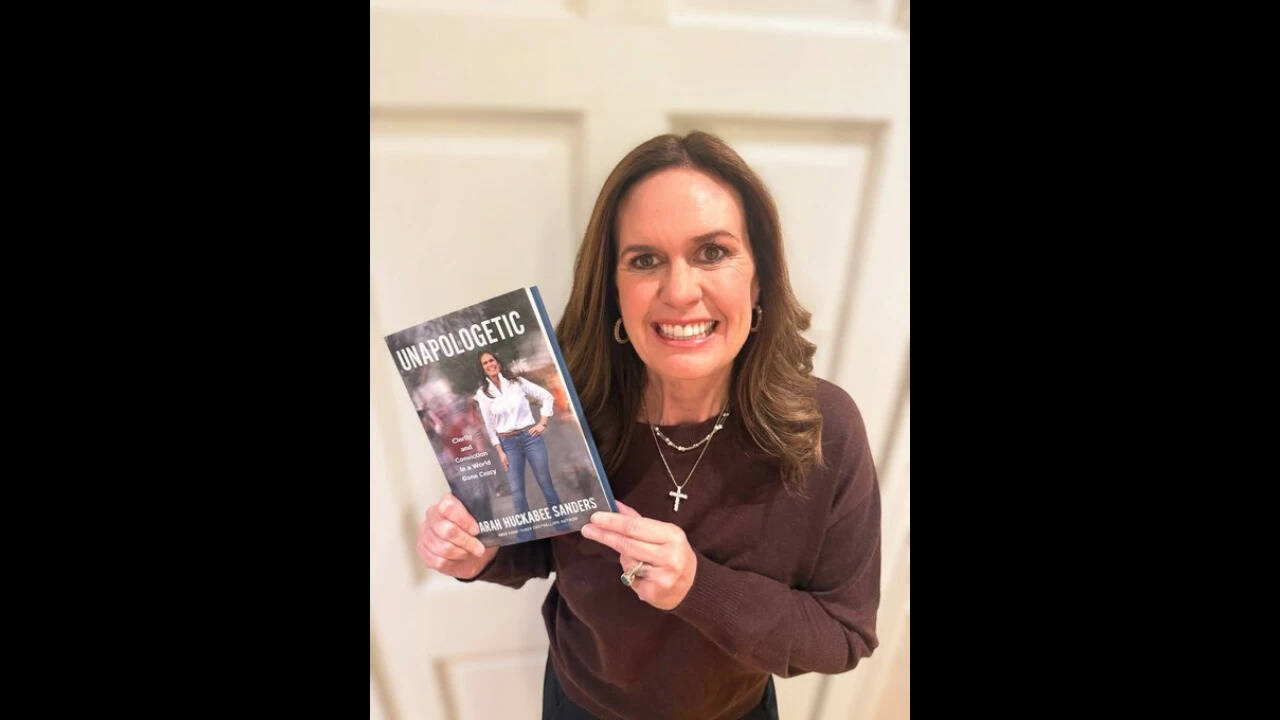
When Arkansas Governor Sarah Huckabee Sanders posted a promotional image on social media for her book, the internet did what it always does. It zoomed in. According to widespread commentary across X and various media reports covering the online reaction, users quickly pointed out anomalies in the background of the photo—specifically, the spines of the books lining the shelves behind her. Critics and casual observers alike mocked the image as a suspected AI-generated creation, with social media users highlighting that the lettering on the background volumes appeared garbled and illegible, prompting viral remarks that those weren't even real words.
On the surface, it is just another fleeting moment of digital schadenfreude, a twenty-four-hour news cycle snack destined to be forgotten by Friday. A politician posts a promo shot; the internet spots a flaw; jokes are made; everyone moves on.
Look closer, though. The real story isn't about one book promotion or one governor's social media team. It is about what happens to human connection when the visual proof of our lives becomes synthetic, and why a shelf full of gibberish strikes a nerve so much deeper than a simple typo ever could.
The Architecture of a Lie
I remember the first time I got fooled by a synthetic image. It wasn't a dramatic deepfake of a world leader declaring war, nor was it a fantastical rendering of a neon cyberpunk city. It was a photograph of a wooden cabin in the woods, shared in a renovation forum I used to frequent. The light hit the cedar planks at just the right late-afternoon angle, casting long, lazy shadows across a porch where a pair of worn leather boots sat waiting by the door. I felt a sudden, sharp ache of envy for whoever lived there, for the quiet mornings they must have spent drinking coffee on those steps. Then someone in the comments pointed out the porch railing. The balusters didn't meet the floor; they simply faded into the wood grain like ghosts. The boots had no laces, only smooth, melted ridges of brown leather.
That feeling—the abrupt whiplash from genuine human warmth to cold, algorithmic emptiness—is the defining emotional tax of our current era.
Think about a bookshelf. Historically, a bookshelf in the background of a portrait was never just wallpaper. It was an autobiography written in cardboard and ink. During the pandemic, when news anchors, politicians, and celebrities broadcast from their living rooms, an entire subculture emerged dedicated to reading the spines behind the speakers. People paused their televisions to squint at the titles, judging a person's intellect, vanity, or secret hobbies by the worn paperbacks wedged between hardcover histories. A real bookshelf is messy. It has dust. It has a weird paperback thriller you bought at an airport in 2014 sitting right next to a solemn biography of Abraham Lincoln. It carries the weight of actual human time.
When an image replaces those real books with algorithmic approximations—shapes that mimic the idea of a spine without containing a single legible word—it breaks an unspoken contract with the viewer.
Media observers and social media critics who analyzed the Sanders promotional photo noted that the backlash wasn't merely partisan nitpicking; it tapped into a broader, growing fatigue with artificial polish. In a political culture already saturated with carefully staged photo-ops, fake grass-roots campaigns, and focus-grouped slogans, the suspected use of generative AI to fabricate the very room a public figure is standing in feels like a bridge too far. If the background isn't real, the viewer subconsciously asks, what about the person in the foreground? What about the words inside the book being sold?
The Uncanny Valley of Everyday Life
To understand why people react so viscerally to garbled text in an AI image, it helps to look at how the human brain processes visual trust. For tens of thousands of years, our survival depended on a simple rule: if you can see it, it is there. Light bounces off an object, enters the eye, and forms a reliable map of reality. Even after the invention of photography and the arrival of Photoshop, altering an image required human labor, intention, and skill. Someone had to deliberately cut, paste, airbrush, and blend.
Generative artificial intelligence shattered that equation. It doesn't copy reality; it predicts pixels based on statistical probability.
Imagine a hypothetical communications staffer—let's call him Marcus—sitting at a desk at 4:30 PM on a Tuesday. His boss needs a promotional graphic for a book release, and the deadline was ten minutes ago. They don't have a high-resolution photo of her in a cozy, well-lit study, and booking a photographer would take three days and two thousand dollars. So Marcus opens an image generator, types in a prompt for a warm, inviting library backdrop, composites the subject into the frame, glances at it on his laptop screen for four seconds, and hits publish.
To Marcus, looking at a thumbnail-sized preview, the job is done. The lighting looks warm. The colors pop. The books look like books.
He didn't intend to deceive anyone about the titles on the shelves. He wasn't trying to rewrite history. He simply took the path of least resistance offered by modern software. Yet the moment that image hits millions of high-definition smartphone screens, the illusion collapses. Because human eyes are extraordinarily sensitive to language—our brains are wired to automatically decode letters the instant we see them—garbled, non-existent words jump off the screen like a wrong note played at full volume in a quiet concert hall.
Psychologists have long studied the "uncanny valley," that unsettling revulsion we feel when a robot or digital avatar looks almost human, yet misses the mark by a fraction of a millimeter. We are now living inside the uncanny valley of environments. The lighting is almost right. The textures are almost believable. Until you look at the hands, or the teeth, or the spines of the books, and realize you are staring at a hallucination.
Why Small Fakes Matter More Than Big Ones
There is a comforting myth that we only need to worry about artificial intelligence when it is used for malicious disinformation—fake videos of crimes, fabricated audio of scandals, or synthetic propaganda designed to swing elections. Those threats are real and documented by cybersecurity researchers worldwide.
Consider what happens next, however, when low-stakes synthetic media becomes the default aesthetic of public life.
When politicians, brands, and everyday influencers routinely use AI to generate cozy living rooms, bustling crowds, or candid moments that never happened, they aren't telling a grand, sinister lie. They are doing something far more corrosive. They are training the public to stop believing their own eyes.
Digital literacy experts and journalists covering online misinformation have repeatedly warned about the "liar's dividend"—a phenomenon where the mere abundance of fake imagery makes it easier for bad actors to dismiss real, incriminating evidence as "just AI." Every time a public figure posts a synthetic photo and shrugs off the ridicule, the baseline of public skepticism ticks upward. Authenticity stops being the default assumption and becomes something that has to be proven, verified, and cross-examined.
Look at the broader pattern across digital culture right now. Major corporations have faced customer boycotts after releasing holiday advertisements filled with slightly distorted, AI-generated families. Publishing houses have been forced to apologize after artists discovered their book covers were stitched together by algorithms rather than human illustrators. In almost every instance, the backlash follows the exact same arc: initial confusion, followed by forensic zooming, followed by a wave of collective disgust.
People hate feeling like they are being sold a shortcut disguised as sincerity. A book, by its very nature, is supposed to be an intimate artifact—one human mind speaking directly to another across time and space. Promoting a book with a backdrop of unreadable, non-existent books creates an irony so sharp it practically writes its own punchline. It suggests that the aesthetic of reading matters more than the words themselves.
Reclaiming the Imperfect Frame
So how do we navigate a visual landscape where the background can dissolve into gibberish at a moment's notice? We cannot unplug the servers, nor can we expect millions of overworked social media managers to suddenly abandon tools that save them hours of labor.
The answer lies in a radical shift in what we value—both as creators and as consumers of information.
First, for anyone communicating in public—whether you are a governor, a small business owner, or a writer trying to sell a memoir—imperfection has suddenly become the ultimate currency of trust. A slightly grainy smartphone photo taken in a real room with bad fluorescent lighting now carries more emotional authority than a pristine, studio-lit portrait that smells faintly of an algorithm. Real life has creased shirts, stray hairs, and crooked picture frames. Leaving those flaws in the frame is no longer sloppy; it is proof of life.
Second, as readers and viewers, we have to resist the urge to let our skepticism curdle into total cynicism. When we spot the telltale signs of synthetic imagery—the melted text, the impossible shadows, the sterile symmetry—the goal isn't merely to mock the person who posted it and move on to the next target. The goal is to pause and recognize what is missing from the frame.
Real human stories are built on friction. They require someone to actually sit in the chair, pull a real book off a real shelf, turn the pages, and wrestle with the ideas inside. No algorithm can replicate the weight of a lived experience, no matter how convincingly it renders the dust motes floating in the afternoon sun.
The next time an image crosses your screen and something feels slightly off, take a second to zoom in. Look at the edges. Read the spines on the shelves. Check if the words actually mean anything at all—because in a world drowning in effortless illusions, the things that are genuinely real will always have legible print.