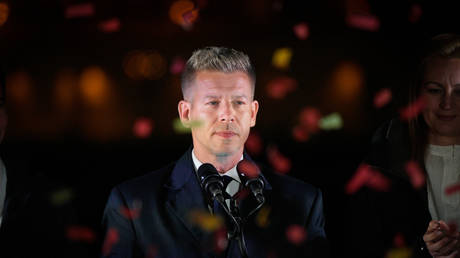
The international press is currently obsessed with a phantom. They see Péter Magyar—the defector-turned-messiah of the Hungarian opposition—and they see the beginning of the end for Viktor Orbán. They are wrong. They are chasing a narrative of democratic "awakening" while ignoring the brutal structural reality of the Hungarian state. Magyar isn't the antidote to the System of National Cooperation (NER); he is its most sophisticated byproduct.
If you think a few massive rallies in Budapest signal a shift in the tectonic plates of Central European power, you haven't been paying attention for the last fourteen years. The consensus view suggests that Magyar is "uniting" a fractured country. In reality, he is merely reorganizing the deck chairs on a ship that has already been turned into a fortress. You might also find this similar coverage interesting: The Germany Withdrawal Myth and the Cost of Coming Home.
The Insider Trading of Political Capital
The most dangerous misconception is that Magyar represents a "clean break" from the past. Let’s get real. Magyar didn't spend a decade in the inner sanctum of the Fidesz machine because he was a secret democrat waiting for his moment. He was a creature of the system, a beneficiary of the very patronage networks he now claims to despise.
When an insider flips, we usually call it a "whistleblower" moment. In Magyar’s case, it looks more like a hostile takeover attempt. I have watched political machines across Eastern Europe for two decades, and the pattern is always the same: when the pie stops growing, the elites start eating each other. Magyar isn't attacking the corruption because it’s morally wrong; he’s attacking it because he’s been locked out of the kitchen. As highlighted in recent reports by TIME, the results are significant.
[Image of the Hungarian Parliament Building in Budapest]
The "TISZA" party’s meteoric rise in the polls isn't a sign of a new ideology. It is a sign of brand fatigue. The old opposition—the fragmented mess of socialists, greens, and liberals—was a known quantity that Orbán could defeat in his sleep. Magyar is a fresh face with the same DNA as the incumbent. He speaks the language of the right, uses the symbols of the right, and shares the nationalist sentiment of the right. He isn't offering a path to Brussels; he’s offering Fidesz-lite.
The Economic Fortress is Not for Sale
Commentators love to talk about "rule of law" and "democratic backsliding." They ignore the balance sheets. The NER is not just a political party; it is a massive holding company that owns the country’s infrastructure, media, energy, and banking sectors.
Even if Péter Magyar were to win an election—a mathematical improbability given the gerrymandered districts and the state-controlled media apparatus—he would inherit a hollowed-out state.
- The Deep State of Foundations: Billions in state assets have been transferred to "public interest" foundations managed by Orbán loyalists. These are legally untouchable by a simple change in government.
- The Oligarchic Grid: The companies that pave the roads and provide the internet are owned by a handful of men whose loyalty is not to the office of the Prime Minister, but to the man currently occupying it.
- The Debt Trap: Hungary’s reliance on non-EU capital, specifically from Beijing and Moscow, creates a geopolitical tether that a newcomer cannot simply cut without crashing the national currency, the Forint.
Imagine a scenario where Magyar takes the Prime Ministry. On day one, he finds that the prosecutors, the judges, the constitutional court, and the heads of every major state agency are Fidesz appointees with nine-year terms. He would be a general without an army, presiding over a bureaucracy designed to sabotage him.
The Myth of the Rural Awakening
The "People Also Ask" sections of Google are filled with variations of: "Will the Hungarian countryside turn against Orbán?"
The answer is a flat no.
Magyar’s rallies are impressive, but they are concentrated in Budapest and a few urban hubs. The "countryside" is not a monolith, but it is a region where the information flow is strictly regulated by the KESMA (Central European Press and Media Foundation) conglomerate. To the voter in a small village near the Ukrainian border, Magyar is not a savior; he is a traitorous urbanite who might take away their utility subsidies and invite "Brussels interference."
Orbán doesn't need to win the hearts of the youth in Budapest. He only needs to maintain his grip on the three million voters who see the world through the state-funded lens of "sovereignty" and "traditional values." Magyar’s rhetoric tries to pivot toward these voters, but in doing so, he risks alienating the very liberal urbanites who are currently fueling his momentum. You cannot be the champion of the EU and a hardline nationalist at the same time without eventually snapping.
The "Third Way" is a Dead End
The standard analysis suggests Magyar is building a "third way" between the corrupt government and the incompetent opposition. This is a classic political fallacy. In a polarized, two-pole system like Hungary's, the center is not a place of strength; it is a kill zone.
Magyar’s strategy relies on "TENT" politics: trying to bring everyone under one roof. But a tent that holds both disillusioned Fidesz voters and hard-left activists is a tent that will blow over at the first sign of a real policy debate.
- Foreign Policy: Will he support Ukraine? If yes, he loses the Fidesz defectors. If no, he loses the youth.
- The Euro: Will he push for adoption? If yes, he cedes sovereignty to the ECB. If no, he remains a pariah in the eyes of the European investment community.
- The Oligarchs: Will he prosecute his former friends? If he does, he triggers a capital flight that wrecks the economy. If he doesn't, his "anti-corruption" platform is revealed as a sham.
Stop Asking if He Can Win
The question isn't whether Magyar can win. The question is what his presence does to the existing power structure. He isn't a threat to the system; he is the system’s new stress test.
Orbán is a master of "vibrant" politics. He thrives on having an enemy. For years, that enemy was George Soros or the "Gender Lobby." Now, he has a tangible, domestic villain to focus his propaganda machine on. This allows the government to consolidate its base, purge the remaining lukewarm loyalists, and justify even harsher crackdowns on "foreign-funded" interference.
Magyar is providing the illusion of competition in a state that has effectively moved beyond it. He is the safety valve that lets off steam so the boiler doesn't explode. By participating in a rigged game, he lends it a veneer of legitimacy that it hasn't enjoyed for years.
The Brutal Truth
The West wants a hero. They want a "Hungarian Spring." They want a simple story of a man with a megaphone taking down a strongman.
But power in the 21st century doesn't work that way. It isn't found in the streets; it's found in the ownership of the fiber-optic cables, the boardrooms of the state-adjacent banks, and the fine print of constitutional amendments written in the middle of the night.
Péter Magyar is a symptom of a restless elite, not a revolutionary leader. He is using the tools of the NER to fight the NER, which means that even if he "wins," the NER survives in a different skin. The machine is designed to outlast the man.
Stop looking for the exit. Hungary isn't going anywhere. It is exactly where it was designed to be: a private fiefdom disguised as a republic, now featuring a new, charismatic lead actor to keep the audience from leaving their seats.
The show goes on. The script remains the same.