Most headlines about Iranian President Masoud Pezeshkian's September 23, 2026 speech at the 81st United Nations General Assembly focused on the theatrical insult. Calling Donald Trump a "bully" from the green marble podium in Midtown Manhattan makes for easy clickbait. It also completely misses what was actually happening behind closed doors a few hours later.
If you read the mainstream coverage, you probably walked away thinking Tehran and Washington were on the brink of another round of nonstop bombing. They were—and still are, considering the November strikes on Qeshm Island and ongoing friction in the Strait of Hormuz. Yet on that exact same afternoon in New York, while TV pundits replayed clips of Pezeshkian accusing the U.S. of terrorism, Trump's envoys Steve Witkoff and Jared Kushner were sitting down for roughly three hours of indirect talks with Iranian officials through Qatari mediators.
That contradiction isn't an accident. It's the entire playbook.
The Split Screen at the 81st UN General Assembly
To understand why Pezeshkian sounded like a street fighter at the podium while his diplomats were trading notes with Trump's inner circle, you have to look at the sequence of events in New York.
On Tuesday, September 22, Donald Trump took the General Assembly stage and laid down a blunt ultimatum. He boasted that Iran had once been the "bully of the Middle East" but was "the bully no more," defending the joint U.S.-Israeli military campaign that had battered Iranian infrastructure and killed Supreme Leader Ayatollah Ali Khamenei at the start of the war. Trump framed the choice for Tehran in stark, binary terms. Either Iran strikes a deal that lets the country rebuild, or Washington moves to "annihilate the Islamic Republic". Members of the Iranian delegation walked out mid-speech.
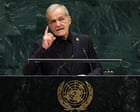
Twenty-four hours later, Pezeshkian walked up to the same lectern. It was the first time the leader of a nation actively at war with the United States had addressed the UNGA in New York.
He didn't hold back. Pezeshkian flipped Trump's phrasing directly back at him, telling "Mr. Trump and those who seek to bully us" that Washington didn't understand Iran if it thought bombs and sanctions could force submission. He accused the U.S. and Israel of breaking international law by hitting schools, hospitals, and universities, and he pointed to a double standard that resonates deeply across the Global South. "The nuclear weapon is in Israel, but the inspectors are in Iran," Pezeshkian told the room. "Israel kills, but Iran is subject to sanction".
Then came the pivot that got buried under the fiery soundbites. Right near the end of his remarks, Pezeshkian stated plainly that Iran was "ready for dialogue and diplomacy and negotiations without accepting the language of force".
Why Pezeshkian Had to Talk Tough to Survive at Home
Here is what Western commentary consistently gets wrong about Iranian politics. People treat Tehran like a monolith where the president speaks for the whole system. In reality, Pezeshkian traveled to New York on a razor-thin leash.
Before he even boarded his flight—navigating complicated airspace restrictions after neighboring countries like Oman and Iraq faced pressure over Iranian civilian flights—Iranian generals and hardline factions spent a full week warning him not to smile for the cameras in Manhattan. In previous years, Iranian state media always broadcast footage of the president meeting with the Supreme Leader right before a UN trip. That visual served as a public stamp of authorization. Following Khamenei's assassination earlier in the conflict, that clear chain of public authority was conspicuously absent.
Pezeshkian knew that if he went to New York and sounded conciliatory, the Islamic Revolutionary Guard Corps (IRGC) and domestic hardliners would tear him apart before his plane touched back down in Tehran. So he gave them the exact speech they wanted to hear.
Look at how quickly the military brass fell in line afterward:
- Top military commanders publicly praised Pezeshkian for standing firm against the "bullying enemy".
- Army commander Amir Hatami thanked him for showing "unity and coordination".
- State media framed the speech as a verbal slap across Trump's face in front of the entire world.
Every single one of those endorsements praised what Pezeshkian refused to do. Not a single general mentioned the backchannel talks happening on the sidelines. By delivering maximum rhetorical heat from the podium, Pezeshkian bought himself the political cover required to let his negotiators stay in the room.
Even the small details of diplomatic choreography became political landmines back home. When a member of Iran's UN mission, Nasser Asadi, remained in his seat during Trump's Tuesday speech instead of walking out with the rest of the delegation, hardliners in Tehran erupted. Foreign Ministry spokesman Esmail Baghaei had to publicly defend the move, calling Iran's seat at the General Assembly a "trench" that diplomats shouldn't abandon just because an adversary hurls insults.
Fact-Checking the Podium Claims
When leaders speak during an active war, truth is usually the first casualty on both sides. If you want to read the diplomatic signals accurately, you have to separate Pezeshkian's valid grievances from his flat-out falsehoods.
Where Pezeshkian's Argument Landed
His critique of Western double standards hit a nerve for a reason. Iran has been subjected to crippling economic sanctions and International Atomic Energy Agency (IAEA) inspections for years, while Israel's undeclared nuclear arsenal operates entirely outside the Non-Proliferation Treaty. For diplomats from Asia, Africa, and Latin America sitting in that hall, Pezeshkian's claim that "those that are unable to defend themselves will be trampled upon" sounded less like radical ideology and more like a blunt description of 2026 geopolitics.
Where the Rhetoric Fell Apart
On the other hand, Pezeshkian made a statement from the podium that was measurably false. "We responded, but we did not hit civilian populations," he insisted.
That simply doesn't hold up against the documented reality of the conflict. Since the war began, Iranian retaliatory strikes across the region and disruptions to commercial shipping lanes have killed merchant mariners and foreign migrant workers who had nothing to do with military operations. Claiming zero civilian impact might play well on state television in Tehran, but it damages Iranian credibility with the exact neutral nations Pezeshkian was trying to court.
Meanwhile, Iranian social media didn't exactly buy the tough-guy act either. Plenty of ordinary Iranians watching the broadcast pointed out the irony of a government calling Donald Trump a "bully" on the world stage while crushing dissent and enforcing strict social controls inside its own borders. Critics online mocked his delivery, noting his trembling voice and stumbles over the text, calling the regime a "bully at home, victim abroad".
What Happened Behind Closed Doors in New York
While the U.S. delegation walked out during Pezeshkian's speech—standard diplomatic theater—the real work was happening away from the cameras.
Trump himself confirmed to reporters later that day that his chief envoys, Steve Witkoff and Jared Kushner, had spent around three hours engaging with Iranian counterparts on the sidelines of the General Assembly. Qatari mediators acted as the go-betweens, ferrying messages back and forth so neither side had to suffer the domestic political cost of a formal, televised handshake.
Both sides immediately tried to downplay the significance of the meeting to protect their flanks:
- Iranian Foreign Ministry spokesman Esmail Baghaei dismissed the indirect contacts as "not anything new" and denied that Tehran had dropped any of its core preconditions.
- Hardline figures aligned with the Revolutionary Guards insisted there was "no negotiation," claiming Iran had simply handed a list of seven strict conditions directly to Trump's envoy.
- Trump offered few specifics on the substance of the three-hour session, keeping his options open between cutting a deal and ordering fresh strikes.
Don't let the spin fool you. You don't spend three hours passing detailed terms through Qatari intermediaries during an active war unless both capitals are desperately looking for an off-ramp.
Why This Matters Right Now
The UN speech in September wasn't the end of the story—it was the blueprint for the messy, stop-and-start brinkmanship we're watching play out today.
Since that General Assembly showdown, the pattern has repeated itself almost weekly. At the end of October, Vice President JD Vance sent a letter seen by many observers as a last-ditch diplomatic opening to prevent wider escalation. Days later, on November 3, U.S. forces struck Iran's Qeshm Island even as Vance publicly voiced optimism about reaching an agreement. Tehran responded by unveiling provocative "We will kill Trump" banners and targeting U.S. military radar installations in Bahrain, while reportedly securing a deal with Russia for 90 helicopter missile launchers.
Every time the rhetoric spikes or a missile flies, markets panic about the Strait of Hormuz—the narrow waterway through which roughly a fifth of the world's petroleum passes.
If you want to track where this conflict actually goes next without getting whiplash from daily headlines, stop listening to what leaders say at microphones. Watch three concrete indicators instead:
- Qatari and Omani shuttle diplomacy. Whenever Doha or Muscat suddenly goes quiet or hosts unannounced ministerial visits, real bargaining is happening regardless of what Trump posts online or what Pezeshkian says at a podium.
- Commercial shipping insurance rates in the Strait of Hormuz. Insurers price risk based on hard intelligence, not political speeches. When marine war-risk premiums spike, military action is imminent; when they dip, a quiet de-escalation agreement is holding.
- IRGC public messaging vs. Foreign Ministry statements. When Pezeshkian's diplomats talk about "equal rights" and "diplomacy without force" while the Revolutionary Guards stay unusually silent on the specific terms, Tehran is preparing its domestic base for a compromise.
Pezeshkian calling Trump a bully at the UN wasn't a rejection of talks. It was the price of admission to have them.
For a closer look at how the U.S. delegation reacted in the room and the immediate diplomatic fallout from the address, watch CNN's coverage of Pezeshkian's UN General Assembly speech. This clip highlights the sharp contrast between Pezeshkian's fiery accusations on the floor and the high-stakes diplomatic maneuvering happening around the summit.