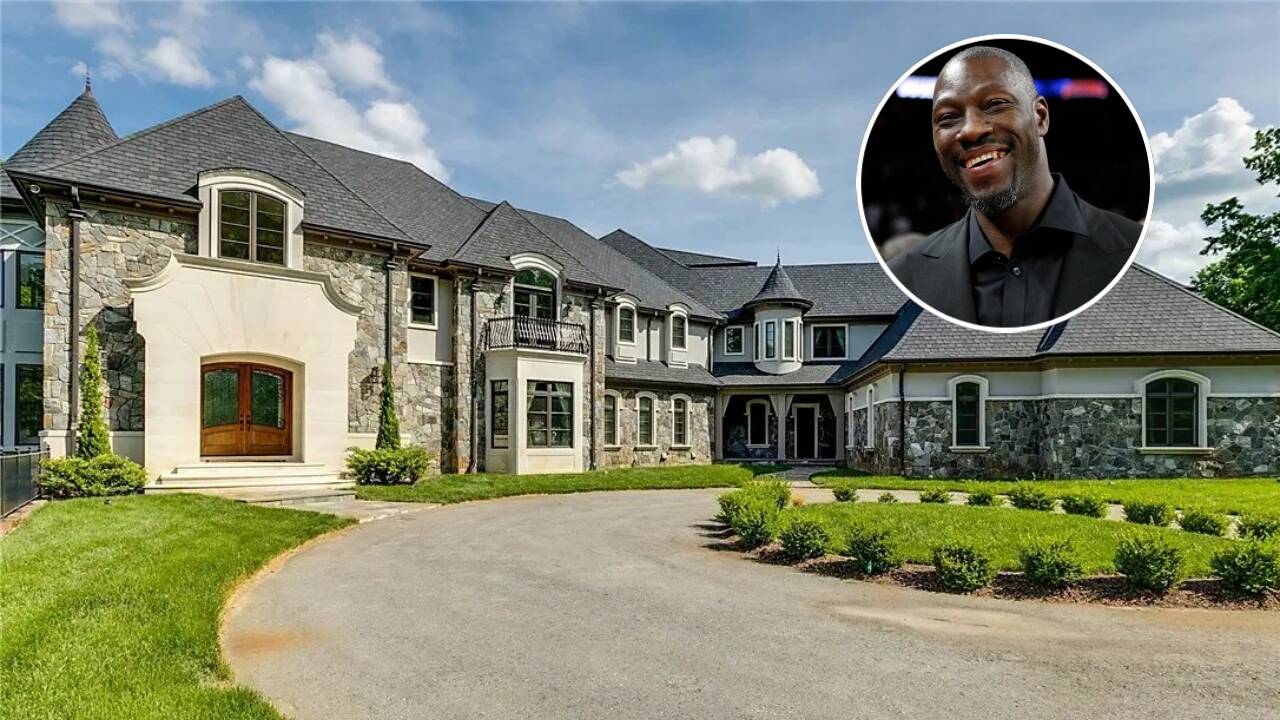
Most celebrity real estate stories treat a $6.9 million listing like a simple tour of shiny countertops and oversized garages. That completely misses the actual story behind NBA Hall of Famer Ben Wallace putting his sprawling Goochland County compound on the market.
On paper, the headline is straightforward. Ben Wallace listed his custom-built, 22,308-square-foot estate at 785 Oak Spring Lane in Manakin-Sabot, Virginia for $6.9 million. Look closer at the county tax records, the surrounding land filings, and his commercial property sales in Richmond, and a much sharper picture emerges.
Wallace wasn't just offloading a big house. He was executing a calculated exit from Central Virginia's luxury market at the exact moment the neighborhood around him started changing.
Why Ben Wallace Priced His Virginia Mansion Below Tax Assessment
Here is the number that makes real estate analysts pause: $8,176,900.
That is Goochland County's tax-assessed value for Wallace's 35.33-acre estate across three parcels. The 18-acre main parcel holding the residence alone carried an assessment north of $7.1 million. Yet when Wallace and his wife, Chanda, put the property on the Central Virginia Regional Multiple Listing Service in late May 2026, they priced the entire compound at $6.9 million.
That is roughly $1.27 million below what the local government says the property is worth.
In standard suburban real estate, listing below tax assessment looks like distress. In ultra-luxury rural estates, it's survival. Custom homes exceeding 20,000 square feet suffer from a brutal economic reality—there is almost no comparable inventory, and the buyer pool shrinks to a handful of families.
If you overprice a 22,308-square-foot European-style estate in a market where the county median home sale hovers around $655,000, the house rots on the market for three years. Annual property taxes alone on 785 Oak Spring Lane run $43,337. Add commercial-grade climate control, pond maintenance, and groundskeeping for 35 acres, and holding costs burn through six figures every twelve months.
Listing agent Sharon Ligon of Sotheby's International Realty understood that pricing below assessment creates immediate urgency. It worked. The property went under contract on August 20, 2026—less than three months after hitting the market—and officially closed on November 13, 2026 for $6,500,000, or $291 per square foot.
That $6.5 million sale stands as the second-priciest residential transaction of 2026 in the entire Richmond metro area, trailing only the Hill Crest mansion on Cary Street Road, which cleared $9 million in August.
Inside the 22,308-Square-Foot Manakin-Sabot Compound
Wallace's connection to Richmond isn't random. Before becoming a four-time NBA Defensive Player of the Year, a 2004 NBA Champion with the Detroit Pistons, and a 2021 Naismith Memorial Basketball Hall of Fame inductee, Wallace played college ball at Virginia Union University right down the road in Richmond.
After going undrafted out of VUU in 1996, he built a 16-season career across Washington, Orlando, Detroit, Chicago, and Cleveland. When it came time to plant roots, he bought 35 acres of raw land in Goochland County for $790,000 and spent years constructing a private sanctuary completed in 2015.
Unlike flashy athlete mansions built purely for status, this estate was engineered around durability, privacy, and serious athletic training.
The Athletic Wing Built for a Hall of Famer
Most celebrity "basketball courts" are glorified concrete slabs in the driveway or cramped half-courts tucked into a basement corner. Wallace built an indoor court facility complete with an integrated climbing wall and a second-level viewing balcony.
Right next to it sits a dedicated weight room designed for heavy strength training rather than light cardio. For a player who famously bench-pressed over 400 pounds during his playing days, a standard home gym wouldn't cut it.
Living Spaces and Architectural Scale
The main four-story residence spans 15,082 finished square feet above ground and another 7,226 finished square feet in the heated walk-out lower level.
- Bedrooms and Baths: Six bedrooms, six full bathrooms, and seven half-bathrooms.
- Grand Entry: A two-story foyer anchored by curved staircases and a floating catwalk overlooking the main living areas.
- Materials and Finishes: Travertine stone, cherry hardwood flooring, custom millwork, five gas fireplaces, and massive window walls framing the surrounding woods.
- Primary Suite: Effectively an apartment within the house, featuring a private lounge with a curved wall of windows, a drop-down television, both wet and dry bars, a steam shower, and a soaking tub.
- Utility and Accessibility: A full commercial-style residential elevator servicing all levels, double laundry rooms, and an oversized mudroom.
Infrastructure That Keeps a Mega-Mansion Running
Anyone who has ever managed high-acreage luxury real estate knows that systems matter more than marble countertops. Big houses break constantly if you cheap out on mechanicals.
Wallace's build includes a geothermal heating and cooling system, zoned climate control, a whole-house backup generator, and a pond-fed irrigation network that keeps the grounds green without bankrupting the owner on water bills.
Outside, a Gunite infinity-edge pool and hot tub sit beside a screened porch looking out over the private pond and timberland. For car collectors, the estate provides a six-car attached garage paired with a detached garage housing seven or more additional vehicles—giving a buyer covered storage for at least 13 cars.
The Bigger Picture in Wallace's 2026 Virginia Sell-Off
If you only read the residential listing, you miss half the story. The $6.9 million mansion listing wasn't an isolated decision.
Just three months before putting 785 Oak Spring Lane on the market, Wallace sold his longtime Richmond commercial property at 2206 Westwood Avenue. Known locally as Big Ben's Home Court, that 22,000-square-foot indoor basketball facility sat just a few miles from his alma mater, Virginia Union.
Wallace originally acquired the Westwood property through an entity for $376,000 back in 2008 and opened the gym in 2010. For years, it hosted youth camps and pro-am tournaments before shutting down operations in 2025. In March 2026, Wallace sold the shuttered facility to an affiliate of Doswell Operating Group—the parent company of local HVAC giant Woodfin—for $3.5 million.
Look at those two transactions back-to-back:
- March 2026: Sold Big Ben's Home Court for $3.5 million (purchased for $376,000 in 2008).
- May–November 2026: Listed 785 Oak Spring Lane for $6.9 million and closed at $6.5 million (built on land purchased for $790,000).
Within eight months, Wallace liquidated $10 million worth of Central Virginia real estate. That isn't random downsizing. That is a clean, deliberate consolidation of his Virginia footprint.
The Development Next Door Nobody Talked About
There is another reason Wallace's timing looks remarkably sharp.
In September 2026—just weeks after Wallace's estate went under contract—public filings revealed plans for Allston Station, a proposed 72-home luxury subdivision on roughly 72 acres along Hermitage Road in Manakin-Sabot. That parcel directly abuts Wallace's 35-acre property.
While Allston Station targets upscale buyers with $1 million to $3 million homes on one-acre lots, adding 72 neighboring residences fundamentally alters the secluded, rural buffer that made 785 Oak Spring Lane a true private compound. Buyers paying $6.5 million to $7 million in Goochland County buy acreage specifically to avoid neighbors.
Wallace managed to lock in his buyer before rezoning debates and earthmovers arrived next door.
What Luxury Buyers and Sellers Can Learn From This Deal
Whether you're shopping in the seven-figure bracket or evaluating custom rural properties anywhere in the country, Wallace's Manakin-Sabot sale offers clear, practical lessons:
- Ignore tax assessments as a pricing ceiling, use them as leverage. When an estate is custom-built to one athlete's exact specifications, county tax assessments often overshoot what the open market will pay. Pricing below the assessed value—as Wallace did at $6.9 million against an $8.18 million assessment—gives buyers immediate psychological validation that they're getting equity on day one.
- Watch adjacent land filings before buying acreage. If you're paying a premium for 35 acres of privacy, check county planning commissions for pending rezoning applications on neighboring tracts. A quiet wooded boundary today can become a 72-lot subdivision eighteen months later.
- Audit infrastructure on estates over 10,000 square feet. Cosmetic upgrades are easy to spot, but geothermal HVAC loops, backup generators, and independent irrigation systems are what keep massive homes livable without catastrophic utility bills.
- Factor in customization discounts. Amenities like indoor climbing walls, basketball courts, and 13-car garages appeal deeply to a specific niche, yet they rarely return dollar-for-dollar construction costs at resale. Expect custom compounds to trade at a discount per square foot compared to smaller, standard luxury homes.
Ben Wallace built a one-of-a-kind Virginia compound from raw dirt, used it as his family's private headquarters for over a decade, and exited cleanly alongside his commercial holdings for $10 million combined. Check Goochland County's planning dockets and comparable luxury closings before you make an offer on any rural estate—because timing the exit is half the game.