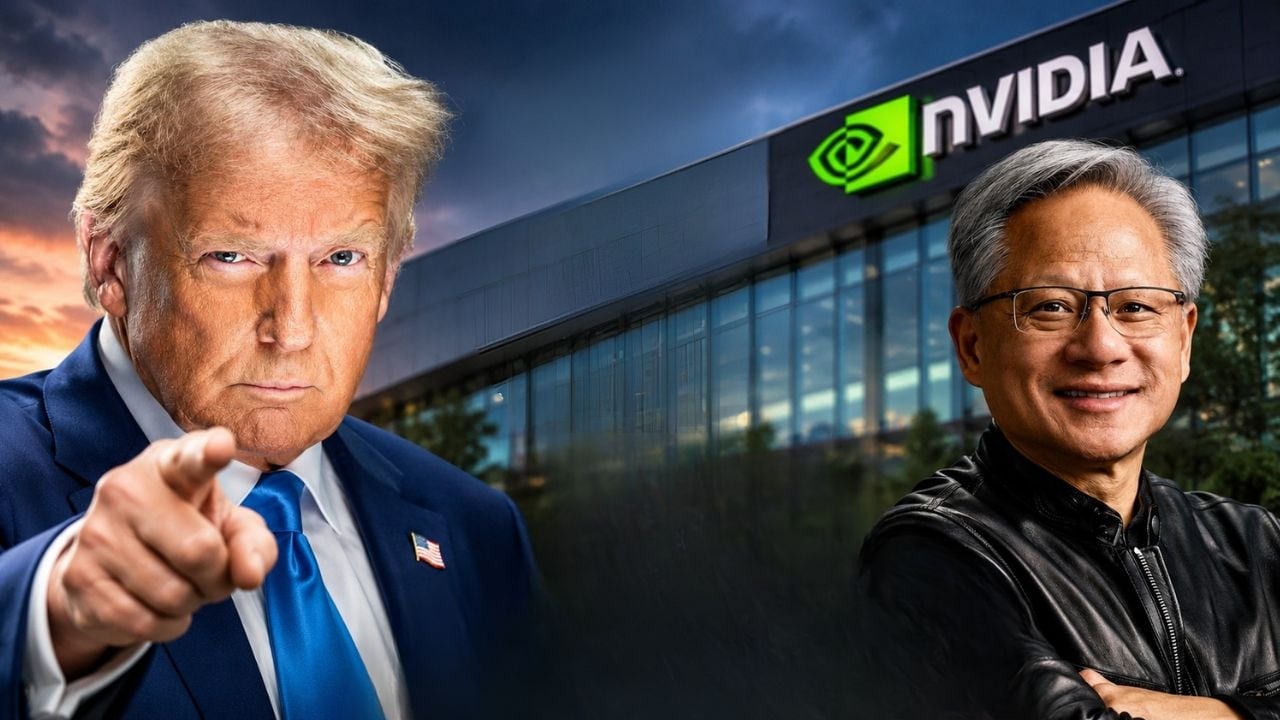
Most headlines framed Donald Trump’s push to reinstate Jensen Huang as simple political favoritism or another chaotic chapter in Washington's relationship with Silicon Valley. They missed the actual story. When Trump publicly urged Nvidia to give Jensen Huang a second chance—and then worked behind the scenes to make it happen—he wasn't just defending a billionaire friend. He was trying to stop a $4 trillion pillar of the American economy from fracturing in real time.
For 11 days in November 2026, the world's most valuable chipmaker operated without the co-founder who built it from a Denny's booth in 1993. Watching the saga unfold from the intersection of tech policy and corporate governance, the sheer speed of the reversal still feels surreal. One week, Nvidia's board was telling investors there was zero chance Huang would return. Days later, after direct intervention from the White House, the board unanimously handed him back the keys to the kingdom.
If you only read the surface-level news alerts, you probably think this was just a tabloid scandal involving extramarital affairs and a corporate board caving to presidential pressure. The reality is much messier, involving alleged Chinese espionage, $740 billion in wiped-out market value, and a fierce debate over whether one executive can become too big to fire.
How a Personal Scandal Became a National Security Crisis
To understand why the President of the United States stepped into a corporate HR nightmare, you have to look at how the crisis started. On November 12, 2026, Jensen Huang abruptly resigned as president, chief executive, and board director of Nvidia.
His departure followed explosive reporting from The New York Times detailing an extramarital affair between Huang and Alice Huang—a Chinese businesswoman who shares his last name but has no family relation. Subsequent reports revealed at least two additional affairs. In most corners of corporate America, a CEO's personal life triggers a standard ethics review, a quiet severance package, and a search for a successor.
This wasn't a standard corporate ethics violation.
Alice Huang (also known as Huang Le) was the controlling shareholder and former executive of Megaspeed, a Singapore-based cloud and data-center company. Megaspeed had been under federal investigation since 2024 over suspicions that it was acting as a pass-through to illegally divert restricted Nvidia AI chips into China. Even worse, U.S. intelligence agencies had tracked Alice Huang maintaining contact with an officer from China's Ministry of State Security (MSS) during her relationship with Nvidia's chief.
Suddenly, a personal scandal collided head-on with American national security. Lawmakers in Washington panicked at the thought that the architect of America's AI hardware dominance might have been compromised by a foreign intelligence asset. Nvidia's stock tanked, shedding roughly $740 billion from its pre-scandal peak of $4.5 trillion down to $3.76 trillion. Chief Financial Officer Colette Kress stepped in as interim CEO, while board chair Harvey C. Jones and independent directors launched an internal probe.
Why Trump Urged Nvidia to Give Jensen Huang a Second Chance
While Wall Street hit the panic button and Nvidia's board insisted the door was shut on a comeback, Trump took the exact opposite stance. On Friday, November 20, standing in the James Brady Press Briefing Room, Trump made his pitch directly to the cameras.
"You have one of the truly most brilliant minds in the world, and where is he going to go?" Trump told reporters. "I think that I would love to see Jensen be given a second chance. We're a country of second chances."
He even offered public relations advice, suggesting Huang issue a big apology so the company could accept it and let him get back to work. Trump also mentioned he had briefly discussed Huang with Chinese President Xi Jinping during his trip to Asia, noting that Xi called Huang a "brilliant man".
Trump's public remarks were only half the story. Behind closed doors, the White House launched an aggressive pressure campaign to flip Nvidia's board:
- Direct Presidential Persuasion: Trump later confirmed to CNBC that he spoke directly to Nvidia's directors over the weekend. "Let me just put it that way," he said. "And I convinced them... I made the deal."
- Silicon Valley Emissaries: According to reporting from the Associated Press, the administration tapped Vice President JD Vance—leaning on his prior background in Silicon Valley venture capital—to help persuade skeptical board members to drop their resistance.
- Intelligence Assurances: Nvidia's directors had demanded clarity on whether Huang's personal entanglement compromised U.S. secrets. Senior administration officials assured the board that intelligence assessments did not prove Alice Huang had been actively tasked with extracting national security secrets from him, clearing the biggest hurdle to his return.
By Monday, November 23, Nvidia's board executed a complete U-turn. They reinstated Huang to all three of his previous roles—president, CEO, and board director—citing input from senior U.S. government officials that his return posed no national security risk.
The Economic Logic Behind the White House Intervention
Critics immediately slammed the move as crony capitalism. Democratic senators, including Chuck Schumer and Chris Van Hollen, accused the administration of gutting export enforcement and prioritizing corporate loyalty over national security. Reports that Trump's own financial holdings gained up to $15 million from the post-reinstatement stock bounce only poured gasoline on the political fire.
You don't have to defend the optics to see why the White House was terrified of a permanent Huang exit. In 2026, Nvidia isn't just another tech company—it's the load-bearing wall of the entire U.S. stock market and broader GDP growth.
When Huang resigned, economists openly warned that a prolonged slide in Nvidia's shares could trigger a broader market contraction, wiping out household wealth tied up in 401(k) plans and chilling consumer spending. Trump explicitly pointed to Huang's irreplaceable technical leadership, arguing that very few people on earth could shepherd the complex rollout of next-generation architectures like Blackwell and Rubin on Nvidia's breakneck schedule.
From the administration's perspective, leaving Nvidia rudderless during a fierce global AI race against China—and amid rocky tech IPOs like Anthropic's market debut—was a bigger strategic risk than bringing back a compromised founder.
What Changed When Jensen Huang Returned
The version of Nvidia that Huang returned to on November 23 isn't the unchecked founder-led empire he left on November 12. Even with the president's backing, the board forced through major structural guardrails to appease regulators, institutional investors, and Congress.
New Compliance Guardrails
Nvidia's board established a dedicated National Security and Export Control Oversight Committee to monitor where advanced GPUs actually end up. They also launched an external search for a brand-new Chief Compliance Officer who won't report to Huang—instead, that executive will report directly to the Nominating and Corporate Governance Committee.
The Blacklisting of Megaspeed
On the exact same day Huang got his job back, the U.S. Commerce Department officially placed Megaspeed and its subsidiaries in Malaysia and Thailand onto its trade blacklist. That move effectively cuts the Singapore-based firm off from receiving American AI chips. Alongside tighter export licensing rules across Southeast Asia and Brazil, Washington tried to prove it was cracking down on chip smuggling even while pardoning Nvidia's CEO.
What Investors and Tech Leaders Should Watch Next
If you hold tech stocks, manage enterprise AI budgets, or track semiconductor policy, this episode permanently changes how you should evaluate founder-led companies. The "second chance" saga exposed massive vulnerabilities that haven't disappeared just because Huang is back in his leather jacket.
- Expect Brutal Congressional Scrutiny: House and Senate committees aren't dropping this. Lawmakers from both parties are moving forward with hearings into Nvidia's export controls, Megaspeed's chip purchases, and the White House's backchannel lobbying. Brace for headline-driven volatility every time a subpoena drops or a committee releases licensing data.
- Factor in Key-Person Risk: Nvidia's board admitting—through its actions—that no external CEO or internal veteran like Colette Kress could replace Huang proves just how concentrated the company's operational brainpower is. If you're heavily weighted in AI semiconductors, diversify your exposure across the broader supply chain rather than betting everything on a single executive's invincibility.
- Prepare for Tighter Export Audits: If your business operates data centers in Asia, the Middle East, or Latin America, expect compliance checks on Nvidia hardware to slow down procurement timelines. With a new Chief Compliance Officer coming in and federal investigators breathing down Nvidia's neck, grey-market cloud capacity is drying up fast.
The board gave Jensen Huang his second chance, and Wall Street breathed a temporary sigh of relief. Now comes the hard part—proving that a company worth trillions can survive political polarization, federal investigations, and its own founder's blind spots.