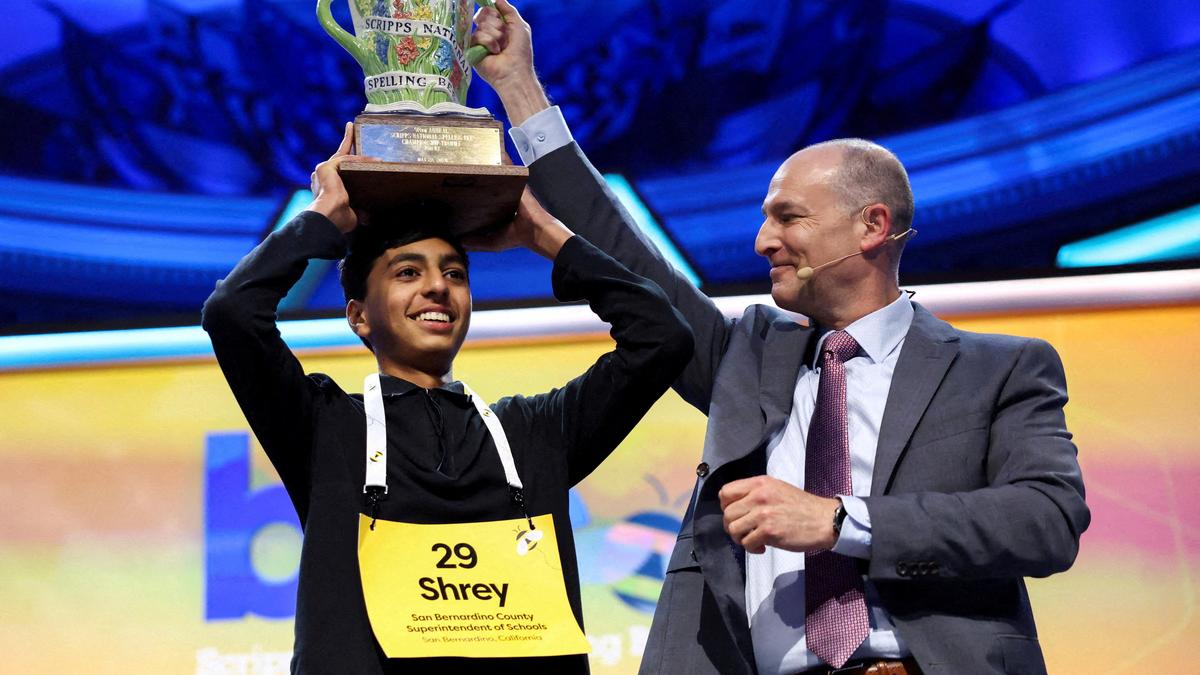
Every year, millions of viewers watch a hyper-focused middle schooler stand before a microphone, stare down an imposing panel of judges, and rattle off a string of impossible letters to claim the national spelling title. If you watched the 2026 Scripps National Spelling Bee, you saw 14-year-old Shrey Parikh from Rancho Cucamonga, California, pull off an absolute masterclass in linguistic speed. He didn't just win; he shattered records by correctly spelling 32 words in a blistering 90-second lightning round to edge out 12-year-old Ishaan Gupta.
But if you think this victory was just about memorizing the dictionary, you completely misunderstand what it takes to survive modern competitive spelling. Learn more on a similar issue: this related article.
The public sees the glory, the giant trophy, and the $52,500 cash prize. What they miss is the psychological warfare, the devastating regional setbacks, and a controversial shift in the competition format that turns linguistic scholars into sprint athletes. Shrey Parikh didn't win because he had a photographic memory. He won because he mastered a high-stakes system that breaks most adult minds.
The Brutal Reality of the Modern Spell-Off
For decades, the Scripps National Spelling Bee was a war of attrition. Spellers stood at the podium for hours, slowly parsing roots, definitions, and languages of origin. That era is effectively over. More journalism by BBC News delves into comparable perspectives on the subject.
Introduced in 2021, the lightning-fast "spell-off" format has redefined the entire endgame of the competition. When two or more elite spellers outlast the standard dictionary rounds, the judges trigger a 90-second countdown. Each speller enters the stage alone, facing the exact same list of words in a rapid-fire sprint. Speed matters just as much as accuracy.
Shrey crushed the previous record of 29 words set by Bruhat Soma in 2024 by hitting an astonishing 32 correct words. Think about that pace. That is one insanely complex word deciphered and articulated every 2.8 seconds.
This structure has polarized the spelling community. Critics argue that rapid-fire buzzer mechanics cheapen the educational intent of the bee. Traditional spelling relies on deep logic—asking for the language of origin, etymology, and usage to deduce a word you've never seen before. The spell-off strips that away. It relies purely on instant muscle memory and raw reflex.
Even Shrey admitted to reporters right after his victory that he wasn't thrilled about the format initially, noting that regular spelling offers a much better display of what the discipline is meant to be. But adapt or die is the rule of the modern stage. Shrey calmed his mind, grabbed some water, and treated it like another day of practice.
Bouncing Back From Total Isolation and Heartbreak
The road to the 2026 title wasn't a smooth, linear ascent. It was defined by a massive mental hurdle that almost ended Shrey's spelling career a year earlier.
In 2024, Shrey was already a top-tier competitor, finishing in a tie for third place nationally. He was widely expected to dominate the following year. Instead, a brutal viral illness hit him right during his school-level bee. Compounding the physical sickness, he stumbled on the word "calipers"—a relatively straightforward word for someone of his caliber—and failed to even qualify for the regional stage.
Imagine dedicating five hours a day to a single craft, reaching the precipice of a national title, and then watching your entire season vanish before you even get to Washington, D.C., because of a fever and a single missed word.
Most eighth-graders would walk away. The pressure is immense, and the public defeat hurts. Shrey used the heartbreak to reconstruct his training regimen. He spent the next twelve months dominating private online spelling circuits, facing down the exact same elite competitors he would later meet at DAR Constitution Hall.
The real lesson here isn't that champions don't fail. It's that they handle the administrative and mental cleanup of failure better than everyone else. When faced with the word "Bhubaneswar"—a city in India—during the regular rounds of the 2026 finals, doubt crept in. He wasn't entirely certain about the starting letters. Instead of panicking, he relied on the instincts built during those grueling months of isolation and pushed through.
The Linguistic Science Behind the Victory Word
The official winning word attributed to Shrey's run was bromocriptine. To the untrained ear, it sounds like a random collection of syllables. To a competitive speller, it's a map.
bromocriptine = bromo- (Greek for stench/bromine) + -criptine (chemical suffix relating to ergot alkaloids)
Elite spelling isn't rote memorization of letters. It's the real-time breakdown of linguistic roots. You have to know that a polypeptide alkaloid mimicking dopamine activity is going to draw from specific Greek and chemical nomenclature.
During the grueling 18 rounds of the three-day competition, the remaining field of 247 spellers was systematically decimated by obscure vocabulary and treacherous phonetic traps. Words like Faesulae, vaesite, and catometope claimed victims left and right. The vocabulary rounds now force contestants to answer multiple-choice definition questions, ensuring that a speller can't just memorize shapes of letters—they must actually understand the mechanics of the English language and its global influences.
Why the Indian-American Spelling Dynasty Persists
Shrey’s historic victory continues an astonishing cultural phenomenon. Over the last nearly four decades, Indian-American spellers have utterly dominated the Scripps stage, claiming 31 of the last 37 championships.
Pundits love to speculate about why this specific demographic excels so consistently in this arena. The truth is far less mystical than people think. It comes down to structural community scaffolding and institutional knowledge.
Ever since Balu Natarajan became the first Indian-origin student to win the bee in 1985, the community has built an incredibly robust competitive ecosystem. Minor leagues like the North South Foundation spelling bees act as elite proving grounds for young children long before they ever step onto the Scripps national stage. Families share coaching insights, study methodologies, and software stacks specifically designed to parse the Merriam-Webster Unabridged dictionary.
Shrey’s own coaching team included seasoned experts like Sohum Sukhatankar and Sam Evans. They didn't just quiz him on words; they trained him like an elite athlete prepares for a decathlon. It is a masterclass in deliberate practice, a concept popularized by psychologist Anders Ericsson, which emphasizes targeted, intense focus on weaknesses rather than comfortable repetition.
The Real Value of Five Hours of Daily Practice
If you want to apply the exact same discipline that took Shrey Parikh to the top of the spelling world to your own academic or professional pursuits, you need to change how you work. Hours spent mindlessly scrolling through flashcards won't cut it.
Start by isolating your failures. When Shrey missed a word during his year of isolation, he didn't just write it down; he analyzed the root cause of the misspell. Did he mistake the language of origin? Did he mishear the schwa sound?
Break your goals into high-intensity, timed intervals. The 90-second spell-off proves that knowledge under pressure is the only knowledge that matters. Force yourself to execute tasks under strict time constraints to build psychological resilience.
Finally, build a feedback loop. Find a mentor, a coach, or a peer group that will call out your blind spots without sugarcoating them. True elite performance requires a level of candor that forces you to confront your weaknesses daily. Shrey Parikh is the 2026 champion because he refused to hide from his mistakes.