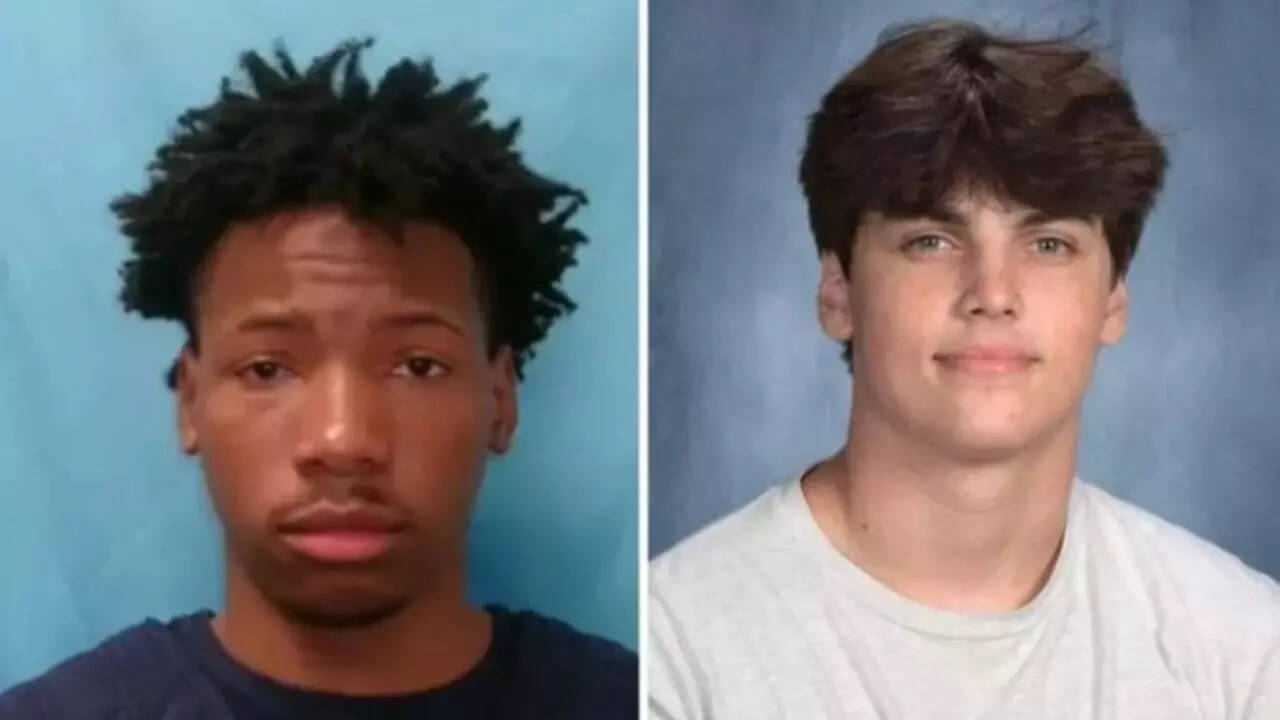
The line between an unprovoked murder and a tragic act of survival can warp in a matter of seconds. In April 2025, a sudden downpour at a high school track meet in Frisco, Texas, set off a chain of events that ended with 17-year-old Austin Metcalf dead and fellow athlete Karmelo Anthony facing life in prison. Now that opening statements have wrapped up in a packed Collin County courtroom, the public narrative is colliding hard with the actual legal realities of Texas self-defense law.
This isn't just another tragedy. It's a high-stakes legal chess match. Prosecutors call it a calculated "sneak, surprise attack". The defense calls it a split-second reaction born out of pure fear. If you think this case is open and shut based on the headlines, you're missing the entire battleground being fought in front of the jury. Don't miss our recent post on this related article.
The Reality Under the Tent
To understand why this trial is so fiercely contested, you have to look at the massive disparity between what happened and how both sides are framing it.
On April 2, 2025, David Kuykendall Stadium became a pressure cooker. A severe thunderstorm halted the track meet. Anthony’s school, Centennial High, didn't have a team tent setup. Seeking shelter, the 19-year-old Anthony walked into the team tent belonging to rival Memorial High School. To read more about the context of this, Associated Press provides an in-depth summary.
According to prosecutors, Anthony didn't belong there and was asked to leave by multiple people. They allege he defied the requests, taunting Metcalf and his teammates with phrases like, "Move me. Make me." Witnesses claim Anthony warned, "Touch me and see what happens," while reaching into his backpack for a black knife.
But the defense presents a radically different picture of those exact same moments. Anthony’s attorney, Mike Howard, points out that Anthony was a 3.7 GPA honors student, a varsity track athlete, and a football captain with absolutely no criminal history. He didn't walk into that tent looking for blood; he went to talk to someone he recognized. Suddenly, he found himself surrounded by strangers who wanted him gone.
Size Disparity and the Physiology of Fear
One of the biggest details missing from initial news reports is the physical dynamic between the two teens. This isn't a minor detail. In a Texas self-defense case, it changes everything.
- Karmelo Anthony: 5'8" tall, weighing 130 pounds.
- Austin Metcalf: 6'1" tall, weighing 213 pounds.
Metcalf wasn't just bigger; he was an MVP varsity linebacker. When the verbal argument escalated, Metcalf allegedly shoved Anthony on the stadium bleachers.
"Self-defense is useless if you wait too late to defend yourself," Howard told the jury. The defense's core argument relies on the physical intimidation of a 130-pound teen being confronted and shoved by a much larger athlete alongside his twin brother. In that exact fraction of a second, did Anthony face a reasonable fear of bodily injury? The defense says yes. He reacted in a blind panic, stabbed Metcalf once in the chest, and immediately sought out a coach.
Why Texas Law Makes This a Rough Battle for the Defense
Claiming self-defense sounds straightforward, but the Texas Penal Code puts a heavy burden on the person who pulls the weapon.
First, let's talk about the use of deadly force. To legally justify using a knife against an unarmed person, the defense must prove that Anthony reasonably believed deadly force was immediately necessary to protect himself against the other person's use or attempted use of unlawful deadly force. A shove on the bleachers, even from a 213-pound linebacker, doesn't automatically grant someone the legal right to use a blade.
Second, there's the issue of provocation. Under Texas law, you cannot provoke a difficulty and then use deadly force when the other person responds to your provocation. Prosecutor Bill Wirskye is leaning heavily into this, telling the jury that Anthony deliberately baited Metcalf into laying hands on him just so he could use the knife. If the prosecution convinces the jury that Anthony goaded Metcalf into the physical altercation, the self-defense claim completely evaporates under state law.
What the Surveillance Video Actually Shows
The state’s case relies on granular surveillance footage captured from multiple angles around the stadium. The prosecution showed these videos to the jury during the opening days of the trial to paint a picture of Anthony’s intent.
However, because of heavy rain and zoomed-in angles, the footage doesn't explicitly capture the exact moment the blade pierced Metcalf's chest. What it does show is the immediate aftermath. Prosecutors argue Anthony ran away from the scene to try and blend in with the crowd and slip out the front gate. The defense counters that he ran directly toward a track coach, completely overwhelmed by what had just occurred.
The immediate reactions captured on camera and by responding officers will be crucial. When police detained Anthony, he didn't deny what happened. He blurted out, "I’m not alleged. I did it. He touched me first." He was crying hysterically, asking if Metcalf was going to be okay, and frantically asking officers if his actions counted as self-defense.
The Elephant in the Courtroom
You can't talk about the context of this trial without addressing the immense outside noise surrounding it. The online discourse became incredibly toxic early on, turning a complex local tragedy into a polarized national debate because Anthony is Black and Metcalf was white.
The jury selection process itself became a major flashpoint. Out of a pool of nearly 600 people, the final seated panel contains zero Black jurors. The defense raised a Batson challenge, accusing prosecutors of systematically striking three Black female educators from the pool. The state argued they struck those individuals strictly because they were teachers who work with school-aged children, given that the incident occurred at a school function. Judge John Roach Jr. ultimately sided with the state, leaving an all-non-Black jury to decide Anthony's fate.
Despite the cultural firestorm outside the McKinney courthouse, both families have tried to strip the politics away from the tragedy. Metcalf's father, Jeff Metcalf, went on national television to plead with the public to stop weaponizing his son's death, stating flatly, "This was not a race thing... This is a human being thing."
Reading Between the Legal Lines
As testimony moves forward over the next two weeks, the verdict will hinge entirely on how the jury interprets those chaotic 15 minutes under the stadium tent. If you are keeping tabs on this trial, stop looking at the emotional social media commentary and focus on these specific legal points:
- Watch the witness cross-examinations closely: The exact phrasing of the verbal exchange matters. Did Anthony explicitly threaten Metcalf before any physical contact occurred, or was he responding to an aggressive crowd?
- Analyze the timeline of the knife: Did Anthony have the knife out and ready before Metcalf pushed him, or did he pull it from his bag only after being shoved onto the bleachers?
- The definition of "reasonable": The jury will be instructed to look at the situation through the eyes of a 130-pound teenager in that exact moment, not with the benefit of hindsight.
The trial is expected to last roughly two weeks. Because Texas treats 17-year-olds as adults in the criminal justice system, Anthony faces anywhere from five years to life in prison if convicted of first-degree murder. Because of his age at the time of the offense, the death penalty and life without parole are off the table, but his entire adult life hangs in the balance.