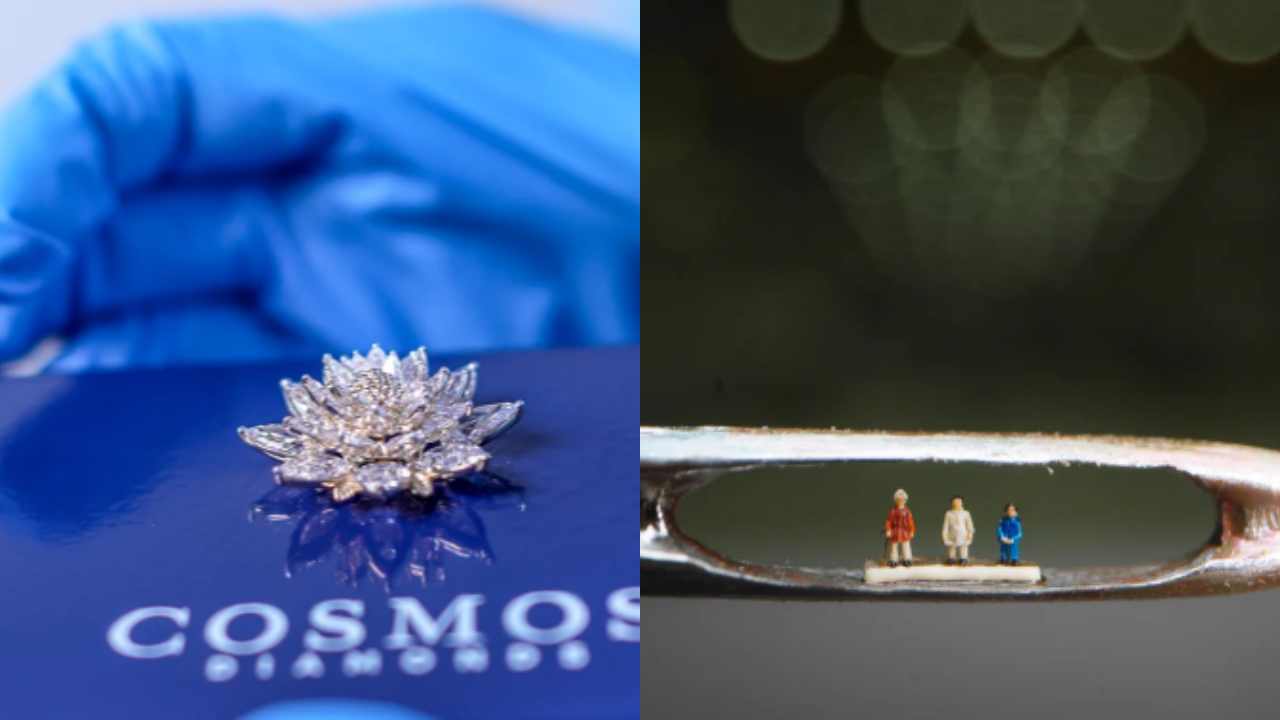
When you hear about a private rocket blasting a diamond into Earth's orbit, it's easy to roll your eyes. It sounds like the ultimate billionaire flex or a flashy marketing gimmick for a luxury brand. But look past the initial glitter of India's upcoming Vikram-1 mission, and you'll find that sending a gemstone into the cosmos is actually a massive test for the future of space tech.
Hyderabad-based Skyroot Aerospace has locked in its launch window from July 12 to August 4, 2026, for "Mission Aagaman" (Sanskrit for "Arrival"). Operating from the historic first launchpad at the Satish Dhawan Space Centre in Sriharikota, this flight marks the debut of India's first privately developed orbital-class rocket. Tucked inside the payload deck is an artistic creation called Cosmic Bloom, crafted by Karnataka-based Cosmos Diamonds. It features an engineered diamond mounted on an aluminum base plate. For another view, check out: this related article.
This isn't about vanity. It's about data. Space is an absolute nightmare for structural materials, and the industry desperately needs better hardware to survive it.
The Brutal Physics of Low Earth Orbit
We tend to think of space as a peaceful, empty void. In reality, Low Earth Orbit is a hostile environment of extreme thermal swinging, intense solar radiation, atomic oxygen degradation, and micrometeorite impacts. Satellites constantly cycle from blistering direct sunlight to the freezing shadow of Earth, enduring temperature swings of hundreds of degrees in mere minutes. Further insight on the subject has been shared by The Verge.
Most conventional materials warp, degrade, or crack under these conditions. NASA and planetary researchers have long established that ground testing cannot completely replicate the multi-variable stresses of a true orbital flight. That's where engineered diamonds enter the conversation.
Diamonds are prized in high-end jewellery, but engineers care about entirely different properties. Laboratory-grown diamonds possess a unique combination of extreme hardness, unmatched thermal conductivity, and heavy radiation resistance. They can act as an elite thermal management layer, pulling heat away from sensitive electronic components faster than almost any other material on Earth. By flying Cosmic Bloom, engineers can observe how an engineered diamond structure holds up against launch vibrations and orbital thermal cycling.
If these lab-grown gems prove they can handle the environment, they could transition from an art piece to a core component in quantum computing satellites, deep-space optical communications, and high-performance radiation detectors.
Inside the Seven Storey Carbon Rocket
The diamond might grab the headlines, but the real star of Mission Aagaman is the vehicle carrying it. Vikram-1 is a four-stage, expendable small-lift launch vehicle standing roughly 20 metres tall. Building a rocket of this size usually requires massive industrial factories and heavy metal alloys. Skyroot took a different path.
The entire multi-stage structure is built from an all-carbon composite airframe. This drastically reduces the structural weight of the vehicle, meaning it can carry more weight up to orbit per kilogram of fuel. For propulsion, Skyroot uses a hybrid approach. The first three stages rely on high-thrust solid-fuel rocket boosters, while the fourth upper kick stage utilizes custom, 3D-printed liquid engines running on storable propellants. This final stage is what allows for precise orbital injection and maneuvering.
With a carrying capacity of up to 350 kg to Low Earth Orbit, Vikram-1 is tailored specifically for the booming small-satellite market. Instead of forcing small-satellite operators to hitch a ride as a secondary payload on a massive government rocket—waiting months for the primary customer to be ready—Skyroot is pitching a "Cab to Space" model. It's on-demand, flexible, and fast.
The Rest of the Weird Manifest
Skyroot isn't risking a brand-new rocket architecture on heavy, multi-million-dollar commercial imaging satellites just yet. Instead, Mission Aagaman is a partially commercial test flight packing a highly unusual, diverse manifest of six payloads.
Alongside the diamond artwork sits a microscopic gold tribute. Created by Telangana artist Ajay Kumar Mattewada, this payload is an 18-karat gold miniature rocket holding three micro-sculptures. Measuring just 700 by 980 microns—each smaller than a single grain of rice—they depict Nobel laureate Sir C.V. Raman, Indian space pioneer Dr. Vikram Sarabhai, and aerospace scientist Dr. A.P.J. Abdul Kalam.
But it's not all art. The mission includes heavy-hitting tech demonstrations that could reshape orbital logistics:
- Embrace by Cosmoserve Space: A Telangana-based startup is testing an in-orbit robotic arm. The arm will remain attached to the rocket’s payload deck, demonstrating soft-robotic capture capabilities. This is a foundational step toward active space debris removal and automated in-orbit satellite servicing.
- SOLARAS S3 by Grahaa Space: A 1U CubeSat platform designed to validate next-generation satellite systems built entirely within India.
- uD3PP and mD3RN by DCubed: Two in-orbit technology demonstration payloads supplied by a German space engineering firm, proving that international space companies are looking at India’s private sector for fast transit to orbit.
- SCOPE by Skyroot: The company’s own internal instrument package designed to log live flight data, tracking exactly how the rocket handles the physical reality of ascent.
Moving India Past the Suborbital Ceiling
I watched closely when Skyroot launched the Vikram-S rocket back in November 2022. It was a historic moment, making them the first private Indian entity to put a rocket into space. But that was a suborbital flight. It went up, crossed the Karman line, and came right back down. It was a glorified tech demo.
Achieving orbit is a completely different beast. You don't just need to go high; you need to go fast enough—roughly 28,000 kilometres per hour—to match the curvature of the Earth and stay up there. The data gathered during the 20-minute flight of Vikram-1 cannot be faked in a lab. Skyroot needs real-world confirmation on stage separation, guidance software navigation, and thermal shielding performance.
India's space economy currently hovers around $8.4 billion, but the national target is to aggressively scale that to $44 billion by 2033. The Indian National Space Promotion and Authorisation Centre (IN-SPACe) has been systematically clearing regulatory hurdles to make this happen. Government agencies like ISRO simply cannot handle the sheer volume of commercial launches required to hit those economic goals. Private entities have to shoulder the load.
Skyroot has already achieved unicorn status with backing from heavyweights like GIC, Temasek, and funds managed by BlackRock. They are already manufacturing their second and third test vehicles. If Mission Aagaman goes off without a hitch, it validates India's private supply chain and sets up a high-cadence commercial launch program before the year ends.
To track this mission effectively as the launch window approaches, monitor the official updates from Skyroot Aerospace and IN-SPACe. Keep a close eye on the telemetry data released after liftoff, specifically looking for the successful separation of the carbon-composite stages and the stabilization of the upper liquid-engine platform at the targeted 450 km orbit. That's where the real engineering victory lies, long after the sparkle of the diamond fades.