Stop looking at the I Ching as a magical crystal ball. It isn't one. If you think this ancient Chinese text is just about predicting whether you will win the lottery or find a soulmate next Tuesday, you're missing the entire point. Most western translations treat it like a fortune-telling parlor trick. That's a mistake.
The I Ching, or Book of Changes, is a manual for understanding time. Specifically, it maps how situations transform from one state into another. It's a psychological tool, a philosophical framework, and arguably the oldest decision-making system on earth.
When you consult it, you aren't talking to ghosts. You're talking to your own subconscious mind.
Understanding what the I Ching is really about requires stripping away centuries of mystical hype. It requires looking at data, history, and human psychology.
The Ancient Code That Preceded Computers
The foundations of this book go back over three thousand years. It started with simple observations of nature. Light turns to dark. Summer turns to winter. Growth turns to decay.
Ancient thinkers realized everything moves in cycles. They captured these cycles using two basic lines. An unbroken line represents yang, meaning action, light, and masculine energy. A broken line represents yin, meaning receptivity, darkness, and feminine energy.
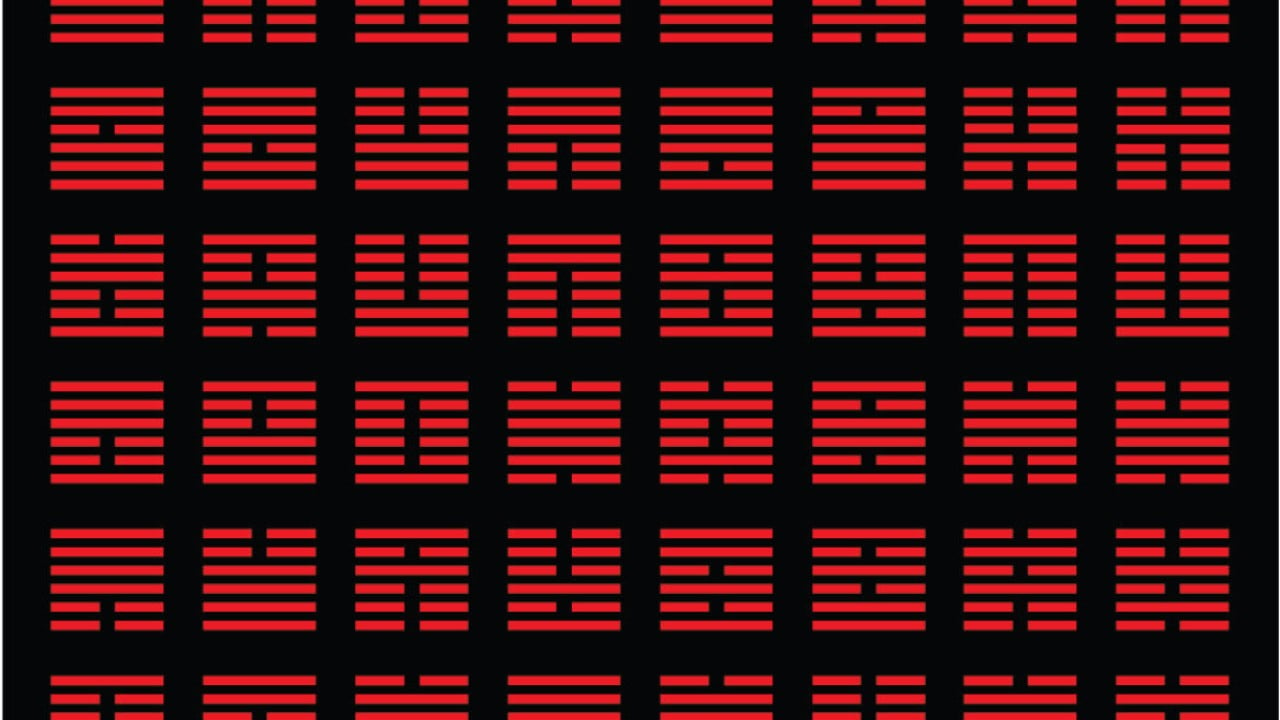
By stacking these lines in groups of three, they made eight trigrams. By stacking them in groups of six, they created the 64 hexagrams.
Hexagram 1 (The Creative)    Hexagram 2 (The Receptive)
======                       --  --
======                       --  --
======                       --  --
======                       --  --
======                       --  --
======                       --  --
This isn't primitive superstition. It's a binary system.
German mathematician Gottfried Wilhelm Leibniz discovered modern binary code in the late 17th century. He was shocked to find that the I Ching had already used the exact same system thousands of years earlier. Yang lines are 1s. Yin lines are 0s. The 64 hexagrams represent a complete map of cosmic and human possibilities.
Think of it as a master spreadsheet for human experience.
Why Fortune Telling Misses the Mark
If you go to a cheap psychic, they tell you what will happen. The I Ching tells you why things are happening right now and how to position yourself for what comes next. It assumes the future isn't fixed. You have agency.
The text uses archetypes to describe situations. You might get Hexagram 36, which translates to "Darkness Hurting the Light." Or Hexagram 48, "The Well." These aren't fortunes. They're situational analyses.
If you ask the text about your failing business and you get Hexagram 33, "Retreat," it doesn't mean you're doomed. It means the current energy requires a strategic withdrawal. It tells you to gather your resources rather than wasting them on a losing battle.
People fail with the I Ching because they want easy answers. They want a simple yes or no. The book never gives a simple yes or no. It forces you to think.
Carl Jung and the Science of Meaningful Coincidence
You might wonder how tossing coins or counting yarrow stalks can yield a meaningful answer. It sounds random. It sounds unscientific.
Famous Swiss psychiatrist Carl Jung tackled this problem head-on. He spent decades studying the I Ching. He even wrote a famous forward to Richard Wilhelm’s translation, which remains the gold standard for English readers.
Jung coined the term "synchronicity" to explain how the book works. He defined synchronicity as a meaningful coincidence between an internal psychological state and an external event. There's no causal link. Tossing coins doesn't physically cause your business problems to resolve. Instead, the random pattern of the coins mirrors your current mental state.
Think of it like a Rorschach inkblot test. The inkblot doesn't contain a picture of your mother. Your brain projects your mother onto the inkblot because that's what's sitting in your subconscious mind.
The I Ching works the same way. The cryptic texts and poetic images force your brain to make connections you normally ignore. It breaks your habitual thinking patterns. It makes you see blind spots.
The Problem with Modern Translations
Most books you find in mainstream bookstores ruin the text. They sanitize it. They make it sound like a generic self-help guide full of positive affirmations.
The original text is brutal. It reflects a turbulent time in Chinese history during the transition from the Shang Dynasty to the Zhou Dynasty around 1046 BC. It speaks of executions, battles, crossing great rivers, and surviving political traps.
When a modern translation changes "punishment by cutting off the feet" into "feeling restricted in your career," it loses its teeth. You need the raw energy of the original imagery to shock your brain out of its comfort zone.
If you want to use this system seriously, get the Richard Wilhelm translation published by Princeton University Press. Avoid versions that promise quick fixes or spiritual shortcuts. They lie.
How to Run a Strategy Session with an Ancient Text
Don't use the I Ching for trivial nonsense. Don't ask what you should eat for lunch. Use it when you face a genuine dilemma where logic alone fails you.
Here is the exact method to use it as a strategic tool.
First, clarify your question. Don't ask "Should I quit my job?" That's a passive question. Ask "What happens if I quit my job to start my own company?" Frame the question around your actions.
Second, use the coin method. The traditional yarrow stalk method takes forty minutes and requires intense concentration. Coins are faster. You use three identical coins. Assign a value of 2 to heads and 3 to tails. Toss them six times to build your hexagram from the bottom up.
Third, read the text objectively. Don't look for the answer you want to see. Look at the hard truths. If the text warns of arrogance, look at where you're being arrogant in your real life.
Moving From Theory to Action
The ultimate value of the I Ching lies in action. It's an ethical guide. It assumes that alignment with natural laws leads to good fortune, while fighting against the natural flow of time leads to disaster.
Stop treating it as a mystical relic. Treat it as an ancient algorithm for human behavior.
Next time you hit a wall in your career, your relationships, or your personal growth, stop scrolling social media for answers. Grab three coins. Ask a direct question about your own behavior. Construct the hexagram. Read the commentary with an open, critical mind. You might find that a three-thousand-year-old code understands your current crisis better than any modern expert. Use the insights to adjust your strategy, change your perspective, and move forward with clarity.