Four hundred ballots. That single number sparked a fierce legal and political tug-of-war between the U.S. Department of Justice and election officials in Washington state, leaving most voters completely confused about what actually happens when federal prosecutors question a state's voter rolls.
You've probably seen the headlines screaming about potential noncitizen voting in Washington. Maybe you read a quick blurb claiming the DOJ demanded that state officials pull 400 ballots out of the count over citizenship concerns. The reality behind that request is way more complicated—and honestly, way more revealing—than a viral social media post will ever tell you. When federal authorities ask a state to "set aside" specific ballots, they aren't necessarily proving fraud happened. They're triggering a high-stakes collision between federal oversight, state election law, and the messy mechanics of voter roll maintenance. Don't miss our previous article on this related article.
Let's cut through the noise. If you want to understand why this clash happened, how Washington's mail-in system actually handles challenged ballots, and what the law says about federal intervention, you need to look at the mechanics behind the curtain.
Why the DOJ Asked Washington to Set Aside 400 Ballots
Federal prosecutors don't just wake up and randomly pick a number out of a hat. When the Department of Justice approaches a state election office regarding a specific batch of ballots—in this case, roughly 400 cast by individuals flagged as potential noncitizens—it usually stems from cross-referencing government databases. To read more about the background of this, NBC News offers an informative breakdown.
Here's how that database friction happens in real life. States maintain voter registration lists under the guidelines of the National Voter Registration Act (NVRA) and the Help America Vote Act (HAVA). Meanwhile, federal agencies hold immigration and naturalization records, like those managed by U.S. Citizenship and Immigration Services (USCIS) or the Department of Homeland Security (DHS). Sometimes, data from driver's license bureaus—especially in states like Washington that offer Enhanced Driver's Licenses alongside standard licenses—gets tangled up in administrative cross-checks.
Think about the lag time in government paperwork. Someone obtains a driver's license as a legal permanent resident. Three years later, they pass their naturalization test, take the oath, and become a U.S. citizen. They register to vote immediately, because they're excited to participate in their first American election. Yet the underlying state licensing database or a federal lookup table still reflects their old immigration status from three years ago.
To a raw database query, that person looks like a noncitizen who just cast a ballot. To an election administrator who actually pulls the paper file, that person is a newly naturalized citizen exercising a constitutional right.
That exact discrepancy is why the DOJ's phrasing matters so much. Asking election officials to "set aside" or segregate ballots isn't the same thing as ordering them shredded. Segregation preserves the physical envelopes and ballots separately from the general pool while eligibility gets verified, protecting both the integrity of the count and the due process rights of the voter if the federal flag turns out to be wrong.
How Washington State Handles Voter Eligibility and Mail Ballots
If you've never worked inside a county auditor's office in the Pacific Northwest, it's easy to assume mail-in voting is just envelopes dropping into a giant bin with nobody checking the names. That assumption couldn't be further from the truth.
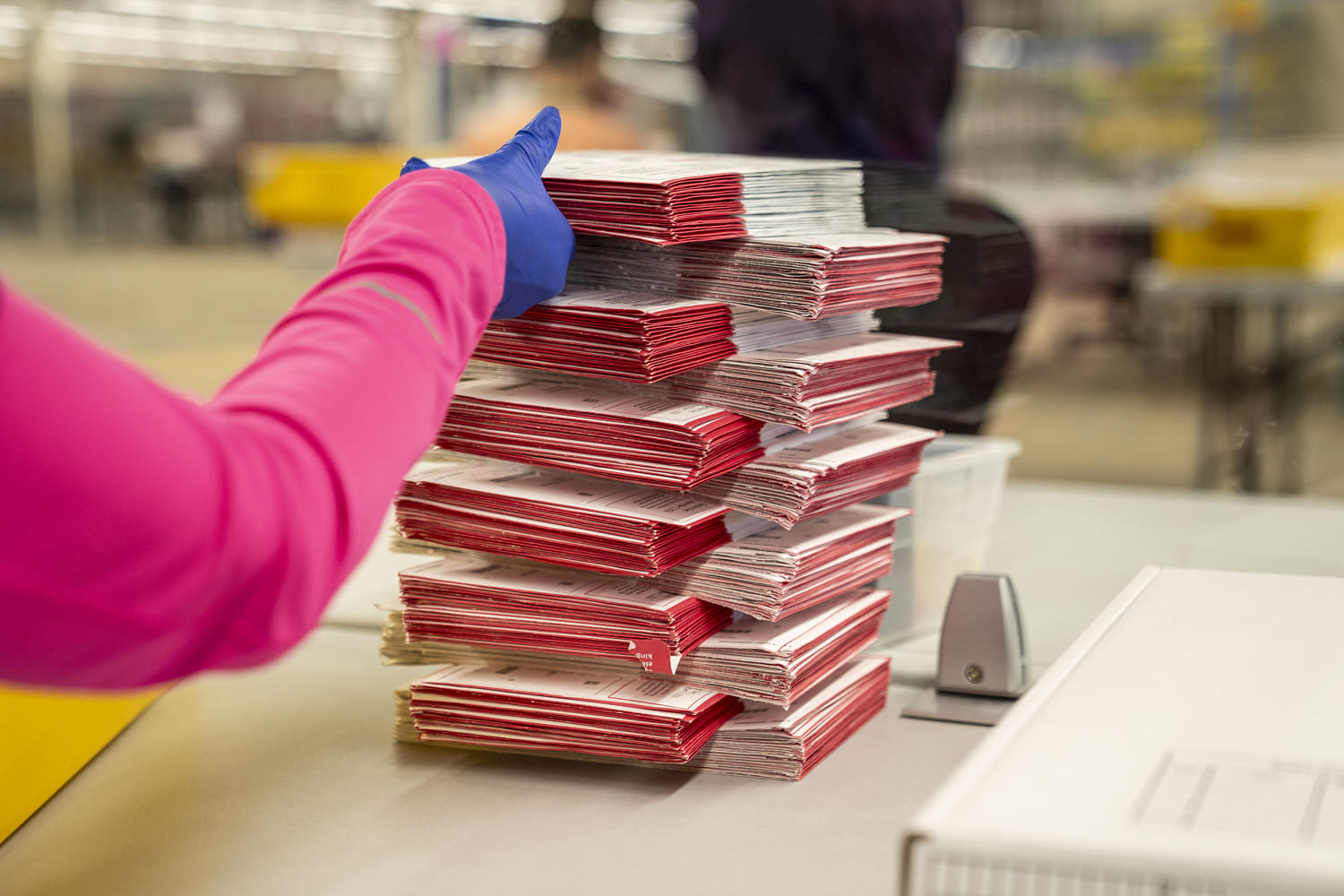
Washington operates an all-mail voting system across all 39 counties, overseen by the Washington Secretary of State and executed locally by county auditors. Every single ballot goes through a strict verification pipeline before it ever touches a tabulator.
- Registration attestation: Under both federal and state law, anyone registering to vote in Washington must affirm under penalty of perjury that they are a U.S. citizen. Lying on that form is a felony, and for a noncitizen, it carries the devastating consequence of permanent deportation and a lifetime bar from naturalization.
- Signature verification: When a ballot arrives at a county elections office, staff members compare the signature on the outer return envelope against the signature on file in the voter's registration record. If it doesn't match, the ballot stops right there and enters a formal cure process.
- Ballot separation: Once the outer envelope is verified and opened, the inner secrecy sleeve is separated from the identifiable envelope. That anonymity is guaranteed by the Washington State Constitution.
Look closely at that third bullet point. It creates a massive logistical hurdle whenever an outside agency asks officials to pull specific ballots after processing has already begun. Once a ballot is separated from its outer envelope, you physically cannot trace it back to an individual voter. You can only set aside ballots whose outer envelopes haven't been opened and processed yet—or challenge a voter's registration moving forward.
The Legal Tug-of-War Between Federal Oversight and State Sovereignty
Americans love arguing about states' rights until an election gets close, and then suddenly everyone wants Washington, D.C., to step in—or stay out—depending on which side benefits. Under the Elections Clause of the U.S. Constitution, states hold the primary authority to set the time, place, and manner of holding elections, while Congress retains the power to make or alter those regulations.
When the DOJ gets involved in a dispute over 400 ballots, they are usually operating under specific federal statutes like the NVRA or the Civil Rights Act. However, federal law also puts strict guardrails on what officials can do right before or during an election.
The 90-Day Quiet Period Rule
Under Section 8 of the National Voter Registration Act, states are explicitly prohibited from conducting systematic programs to remove ineligible voters from the rolls within 90 days of a federal election. Congress wrote that rule for a very practical reason. Last-minute database purges inevitably sweep up eligible citizens—people with common names, recently naturalized voters, or folks whose paperwork hit a bureaucratic snag—leaving them zero time to fix the mistake before Election Day.
While individual removals based on criminal conviction, death, or a voter's own request can still happen inside that 90-day window, broad database sweeps are off-limits. So when federal officials point to a list of 400 names flagged by an external data match, state officials have to walk a tightrope. If they blindly purge or toss those ballots without individualized proof, they risk violating the NVRA and disenfranchising lawful American citizens. If they ignore credible evidence of noncitizen registration, they invite federal litigation and erode public trust.
What History Tells Us About Noncitizen Voting Claims
Whenever a headline mentions hundreds of suspected noncitizen ballots, cable news panels immediately split into two predictable camps. One side claims widespread fraud is stealing the election. The other side insists noncitizen voting is a complete myth that never happens anywhere.
Both extremes miss the actual evidence.
Noncitizen voting does happen occasionally, though usually in tiny, isolated numbers driven by confusion rather than coordinated malice. Look at past audits across the country—from Texas to Georgia to California. Nearly every time a state or federal agency flags hundreds or thousands of "suspected noncitizens" on the voter rolls, subsequent manual verification slashes that number down to a tiny fraction.
A few years ago, state officials in Texas announced they had identified roughly 95,000 noncitizens on their voter rolls. Within weeks, after county officials actually checked the records, they realized tens of thousands of those people were naturalized citizens whose driver's license records simply hadn't been updated. The whole effort collapsed in a federal court settlement.
Does that mean zero noncitizens ever end up on Washington's rolls? No. Automatic Voter Registration (AVR) systems, which Washington implemented at Department of Licensing offices for Enhanced Driver's Licenses, rely on human clerks and software prompts working seamlessly together. Occasionally, a clerk clicks the wrong box, or an applicant misunderstands a prompt at the DMV counter. Out of millions of registered voters in Washington state, a few dozen or a few hundred administrative errors can easily happen over several election cycles.
Four hundred ballots out of roughly four million cast in a statewide Washington election represents roughly 0.01 percent of the vote. That's one ten-thousandth of the electorate. Even if every single one of those 400 flags turned out to be an actual noncitizen—which history suggests is wildly unlikely—it wouldn't swing a statewide race, though it could theoretically matter in an ultra-tight local city council or state legislative contest decided by a handful of votes.
Why Provisional and Challenged Ballots Exist for This Exact Scenario
People hear "set aside ballots" and picture a dark room where votes get tossed in a dumpster. In reality, election administration already has built-in tools designed specifically for moments when a voter's eligibility is in question.
In Washington, any registered voter can actually challenge another voter's eligibility under RCW 29A.08.810, provided they submit formal evidence rather than vague speculation. When a ballot is challenged or flagged before tabulation, county auditors don't destroy it. They place it in administrative hold—essentially treating it like a challenged or provisional ballot—while the voter is notified and given an opportunity to present proof of citizenship, such as a U.S. passport, birth certificate, or Certificate of Naturalization.
If the voter proves they're a citizen, the ballot gets counted. Every time.
If the voter fails to respond or confirms they aren't a citizen, the ballot isn't tabulated, and the case gets referred to the county prosecutor or the Secretary of State's office for investigation. That's the exact mechanism meant to balance two competing priorities: making sure every eligible citizen's voice counts, and making sure illegal ballots don't dilute lawful ones.
Practical Ways to Verify Your Own Voter Status and Follow Ballot Audits
Watching federal and state officials argue over 400 ballots shouldn't make you cynical about voting—it should make you proactive about your own registration record. Administrative mismatches happen to ordinary people all the time, especially if you've moved recently, changed your name, or updated your driver's license.
- Check your registration directly through VoteWA. Visit the official Washington Secretary of State portal (VoteWA.gov) to verify that your name, residential address, and status show as "Active" well ahead of any election deadline.
- Track your ballot at every stage. Washington's online portal lets you see the exact date your ballot was mailed, when the county received it back, and whether your signature was accepted or flagged for a cure.
- Update your records after naturalization. If you or someone in your family recently became a U.S. citizen, bring your naturalization certificate when updating your driver's license at the Department of Licensing so your state and federal records align cleanly.
- Watch official county canvassing board meetings. Every Washington county holds public canvassing board meetings before certifying election results, where challenged ballots, signature mismatches, and eligibility flags are reviewed on the public record.
Skip the partisan pundits screaming about stolen elections or pretending administrative errors never occur. Look at the actual canvassing board records once the verification process finishes, because those public audits will tell you exactly how many of those 400 ballots belonged to newly minted citizens versus people who never should have been on the list in the first place.