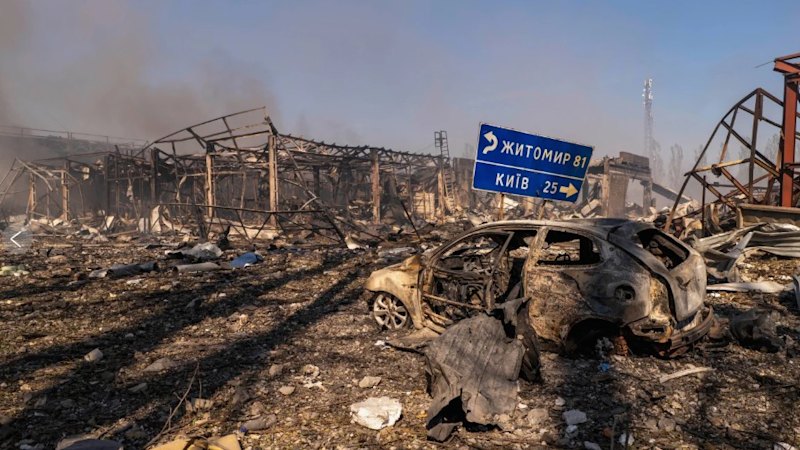
Thirty-seven people are dead because someone decided civilian homes made a fine neighborhood for an ammunition stockpile.
Let's cut right through the fog of war. When a Russian drone hit a warehouse in the western Kyiv suburb of Myla, the subsequent secondary explosions didn't just wreck a military supply line. They tore through residential neighborhoods, flattened homes, and triggered an institutional disaster that President Volodymyr Zelenskyy has labeled blatant, criminal negligence.
This wasn't just another distant tactical blast. It was a completely avoidable catastrophe that highlights deep organizational failures within Ukraine's wartime infrastructure management.
The Anatomy of a Disaster in Myla
The strike happened late on a Friday night. An unmanned aerial vehicle slammed into a commercial enterprise building in Myla, located in the Bucha district.
What people miss when reading surface-level reports is that the warehouse wasn't supposed to be holding explosives. Ukrainian military officials later confirmed the site stored artillery shells, mines, and drone components. Storing heavy munitions yards away from populated areas is basic military protocol. Doing otherwise invites exactly what happened here: a chain-reaction explosion that reduced surrounding residential blocks and local care facilities to smoldering rubble.
Kyiv region governor Tymur Tkachenko reported that the death toll hit 37, making it the single deadliest strike in the capital region this year. Hundreds of residents had to be evacuated into the dark while secondary detonations sent shockwaves across western Kyiv's outer ring.
Why This Keeps Happening
You'd think a nation fighting for its survival would learn its lesson the first time. It didn't.
Back in July, a similar strike targeted a munitions facility in the Kyiv suburb of Vyshneve, killing over twenty people and sparking massive residential fires. Prime Minister Serhii Koretskyi didn't mince words following the Myla tragedy, publicly stating that failing to decentralize and secure ammunition depots after the Vyshneve disaster crosses the line from mere oversight into outright criminal negligence.
Why are these storage sites still sitting near population centers? Bureaucratic inertia, poor oversight, and a desperate shortage of hardened, purpose-built underground military logistics hubs play massive roles. When supply chains are forced to expand rapidly under constant aerial bombardment, corners get cut. Local commanders and logistics officers often utilize civilian-zone commercial warehouses because they blend in or offer pre-existing loading infrastructure—ignoring the catastrophic human cost if the site takes a direct hit.
Zelenskyy has already announced that criminal proceedings are officially underway. Prosecutors are looking closely at how private enterprises and military logistics coordinators received permits to warehouse high-explosive materials right next to civilian homes and care facilities. Heads are going to roll, and frankly, they need to.
The Broader Air War Escalation
Context matters. The strike on Myla didn't happen in a vacuum. It occurred during a brutal three-day aerial blitz where Moscow flooded Ukrainian airspace with swarms of advanced, jet-powered drones and hard-to-intercept missiles.
Russia's defense ministry claimed the target was part of a network supplying components for long-range drone production and cruise missile parts. Whether targeting specific military assets or simply trying to overwhelm air defense grids through sheer volume, the tactic is working with horrifying efficiency.
Civilians are paying the price for both enemy fire and internal mismanagement. In separate strikes over the same weekend, a two-year-old child and a fourteen-year-old girl were killed in and around Kyiv. Air raid sirens have become a permanent, exhausting soundtrack for millions who thought they might find a semblance of safety away from the front lines.
Accountability has to move past fiery social media posts. The Ukrainian government faces an urgent internal crisis: clean up military supply logistics immediately, or watch preventable secondary blasts tear apart the very communities the army is trying to defend.