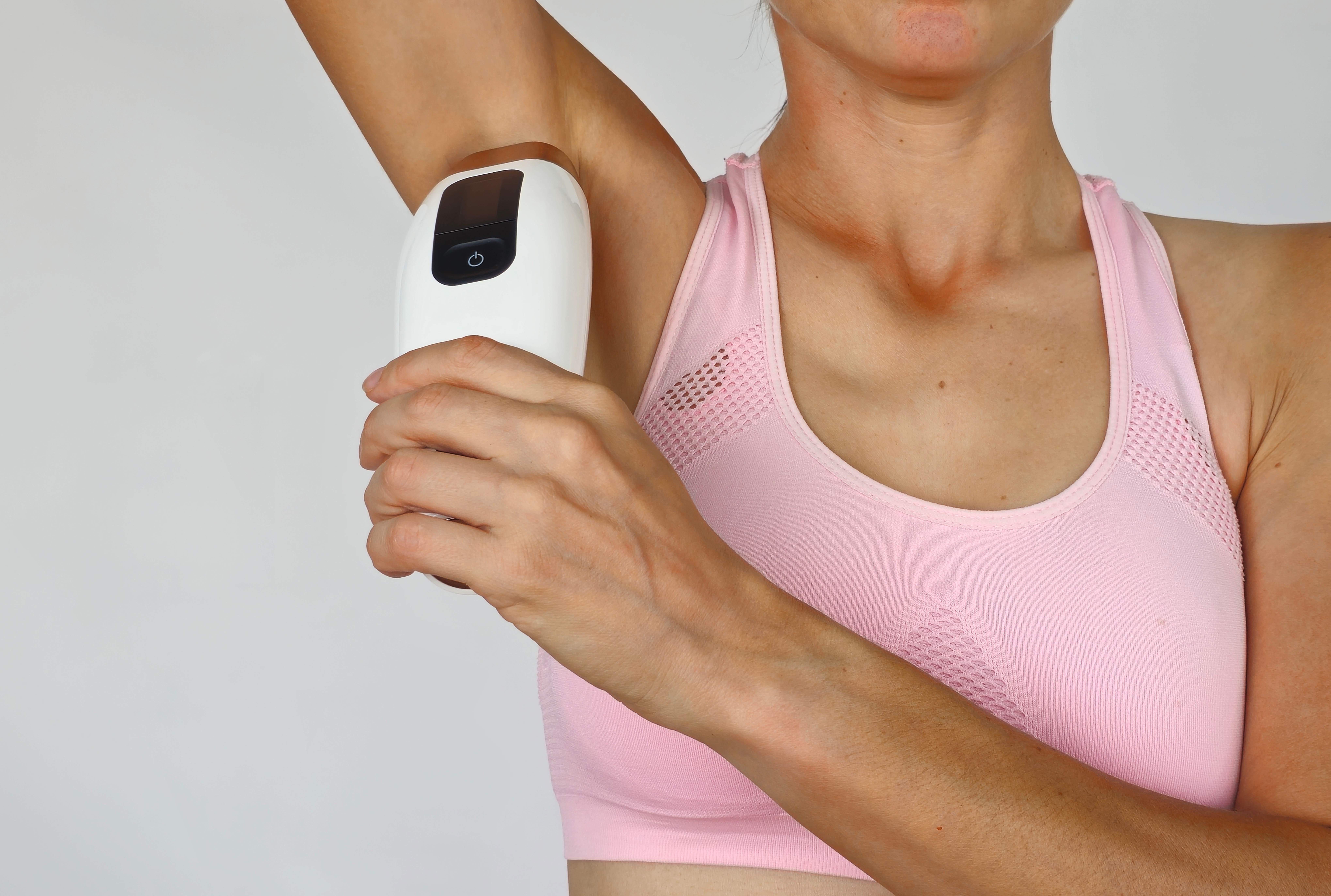
You’re tired of the strawberry legs and the constant prickly regrowth that shows up twelve hours after a shave. You’ve looked at the price of professional clinic packages—easily $2,000 for a full body—and decided that a $400 handheld device is the smarter move. It’s a logical choice. But most people who buy an at-home laser device end up throwing it in a drawer after three weeks because they don't see results.
The truth is that at-home laser hair removal works, but only if you stop treating it like a magic wand. It’s a medical procedure you’re performing on yourself in your bathroom. If you don't understand the physics of your own skin and the specific limitations of consumer hardware, you’re just flashing a bright light at your legs for no reason.
The science of zap and why your hair color matters
Let’s get the terminology right first. Most "laser" devices you buy for home use are actually Intense Pulsed Light (IPL). While actual lasers like Diode or Alexandrite use a single, concentrated wavelength of light, IPL uses a broad spectrum. Think of a laser as a sniper and IPL as a flashlight. Both aim to do the same thing: heat up the melanin in your hair follicle until the germinative cells are destroyed.
This is why the "ideal" candidate is someone with very pale skin and very dark hair. The light needs a clear target. If your skin is dark, the IPL can't distinguish between the melanin in your hair and the melanin in your skin. This isn't just an effectiveness issue; it’s a safety one. Using a standard IPL device on deep skin tones can cause serious burns or permanent hyperpigmentation.
If you have blonde, red, or grey hair, I have bad news. It won't work. There isn't enough pigment in the root for the light to grab onto. No amount of "extra strength" settings will change the basic physics of light absorption.
Picking the right device without falling for marketing
You’ll see a hundred different brands on Amazon promising permanent results. Most are junk. When you’re shopping for at-home laser hair removal, you need to look at fluence, which is the energy density measured in Joules per square centimeter ($J/cm^2$).
Professional machines at a dermatologist’s office operate at $20$ to $40$ $J/cm^2$. Most home devices hover around $3$ to $6$ $J/cm^2$. That is a massive difference. It’s why you have to use home devices every week or two, whereas you go to a clinic every six weeks.
If you want something that actually approaches clinical results, look for the Tria 4X. It’s one of the few true Diode lasers available for home use. It’s painful. It has a tiny treatment window that makes doing your legs feel like a part-time job. But it delivers higher energy than IPL. If you prefer the speed of IPL, the Braun Silk-expert Pro 5 is the gold standard because it has a built-in sensor that adjusts the intensity based on your skin tone in real-time. It’s foolproof, which is what you want when you’re literally shooting radiation at your skin.
The prep work nobody tells you about
You can't just unbox the thing and start zapping. Your skin needs to be in a specific state for the light to reach the follicle effectively.
First, you must shave. Not wax. Not pluck. Not epilate. If you pull the hair out by the root, there’s no target for the laser to hit. You want the hair shaft to be present beneath the skin, but you don't want any hair sitting on top of the skin. If there’s long hair on the surface, the energy will singe the hair and burn your epidermis instead of traveling down to the bulb.
Second, get your skin bone-dry. No lotions, no oils, and definitely no "numbing creams" unless they are specifically approved for use with light-based devices. Some oils can act as a lens, magnifying the heat and causing blisters.
Why your schedule is ruining your results
The biggest mistake is inconsistency. Hair grows in three phases: anagen (growth), catagen (transition), and telogen (resting). Laser and IPL only kill hair in the anagen phase. At any given time, only about $15%$ to $20%$ of your hair is in this phase.
If you zap your legs today, you’re only killing a fraction of the total hair. You have to wait for the next "crop" of hair to enter the growth phase. This is why you need to stick to the manufacturer’s schedule—usually once a week for the first 12 weeks. If you skip a week, you’ve missed a window for a whole set of follicles. You can’t make up for it by doing it twice the following week. That just irritates your skin without adding any benefit.
Managing the pain and the "sting"
Is it going to hurt? Yeah, a bit. People describe it as a rubber band snapping against the skin. Areas with thinner skin and denser hair—like the bikini line or underarms—will hurt significantly more than your shins.
If it’s unbearable, you’re likely using a setting that’s too high for your skin tone, or you didn't shave closely enough. I’ve found that using a cold compress or a "chilled" roller on the skin immediately before and after the flash helps a lot. Some high-end devices now come with "ice-cool" technology built into the head of the device. It’s a nice luxury, but it’s not strictly necessary if you have a bag of frozen peas nearby.
Safety protocols and the danger of the sun
We need to talk about sun exposure. This is the part people ignore until they end up with weird white spots on their legs.
Both IPL and laser make your skin incredibly photosensitive. If you spend a Saturday at the beach and then try to use your device on Sunday, you are asking for a disaster. Tanned skin has active melanin that will absorb the laser’s heat. You should avoid direct sun exposure on the treated area for at least two weeks before and after a session. Honestly, if you’re planning a tropical vacation in the middle of your treatment cycle, just pause the treatments. It’s not worth the risk of scarring.
Also, wear the goggles. Even if the device says it has "safety sensors" that prevent it from flashing unless it’s flat against your skin, the stray light is incredibly bright. Long-term exposure to those flashes can damage your retinas. Don't risk your eyesight for the sake of smooth armpits.
Maintenance and the "permanent" myth
The FDA actually classifies these devices as "permanent hair reduction," not "permanent hair removal." You are never going to be $100%$ hair-free forever. Hormones change. Your body can create new follicles.
After your initial 12-week "attack" phase, you’ll likely move to a maintenance phase. For most people, this means a quick touch-up once every two or three months. The hair that does grow back will be much thinner, lighter, and softer. It won't be that coarse, dark stubble you’re used to.
If you stop using the device entirely, a significant portion of the hair will eventually return. You’re buying a tool for a lifestyle change, not a one-time fix.
Troubleshooting common issues
If you’ve been using a device for six weeks and see zero change, check these three things:
- The energy level: Are you using the lowest setting because you're scared of the sting? If the energy is too low, you’re just warming the hair, not killing it. Crank it up to the highest level you can comfortably tolerate.
- The windows: Are you overlapping your passes? You should slightly overlap each "stamp" of the device to ensure you aren't leaving strips of untreated hair.
- The device age: Many IPL lamps have a fixed number of "flashes." If you bought a used device or a cheap knock-off, the bulb might be losing its intensity even if it still flashes.
Your immediate checklist for starting
Stop plucking or waxing today. If you did it recently, wait four weeks for the hair roots to grow back before you start your laser journey. Order a high-quality device from a reputable brand like Braun, Philips, or Tria. Clear your Friday nights for the next three months. Buy a fresh pack of razors and some high-SPF sunscreen.
Once you start, keep a log on your phone. Record the date and the intensity level you used. It’s the only way to track progress when the changes are subtle. Stick to the plan and stop expecting miracles in week two.