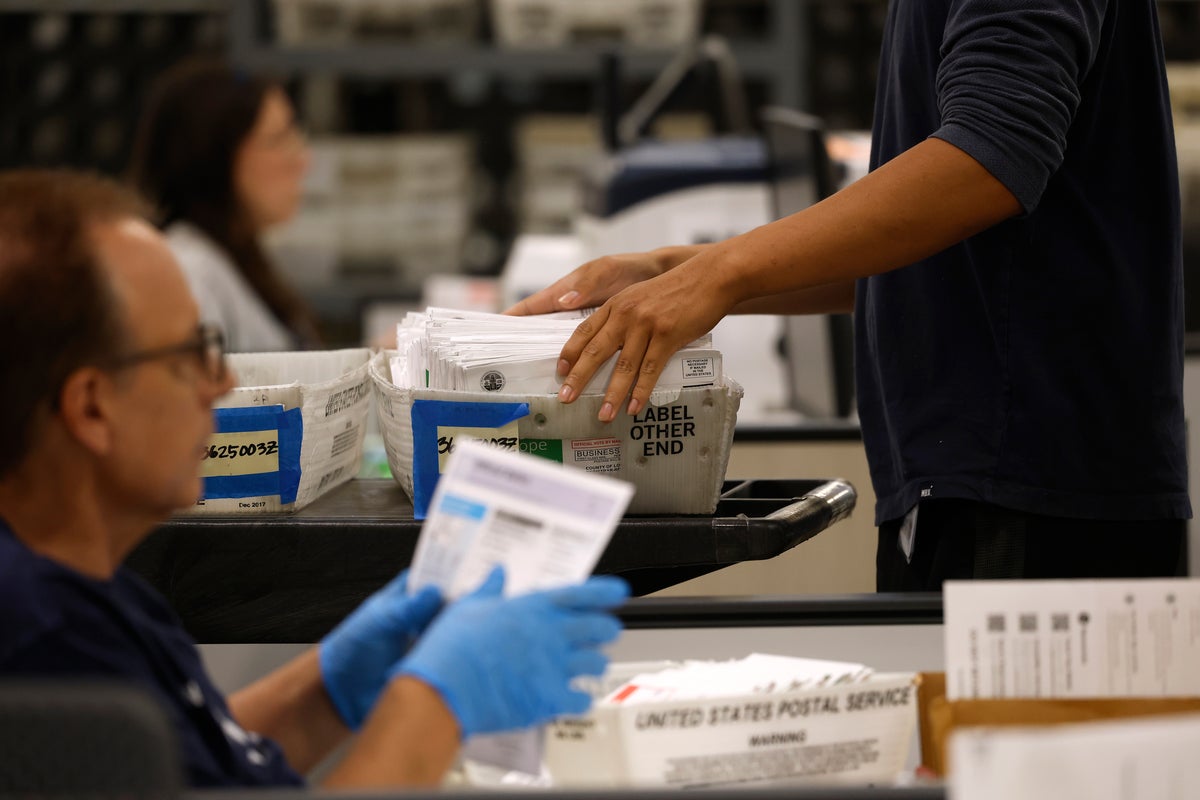
The mailbox sits at the end of a dusty gravel drive, waiting. Inside it lies a piece of blue paper, a folded envelope, and the quiet weight of a citizen's voice. For millions of Americans, democracy does not happen behind a grand mahogany curtain in a municipal gymnasium. It happens at the kitchen table, illuminated by the amber glow of a desk lamp, signed with a ballpoint pen while coffee cools in a mug.
That kitchen table is currently under federal surveillance. For another view, see: this related article.
Consider a hypothetical voter named Clara. Clara is seventy-two, lives in a farmhouse three counties away from the nearest polling precinct, and relies entirely on a rural mail carrier named Marcus to carry her political choices back into the machinery of government. To Clara, the postal service is not a bureaucratic abstraction. It is Marcus waving from his white truck. It is a predictable rhythm.
Recently, that rhythm stuttered. Further coverage on the subject has been shared by The New York Times.
The executive branch attempted to redraw the boundaries of how that ballot moves. Under directives stemming from the White House, an executive order sought to weaponize the United States Postal Service, turning the nation’s oldest delivery network into a gatekeeper that would screen out mail-in ballots unless names matched a centralized federal database. The machinery of the state was steered toward a single goal: intercepting the paper trail before it reached the local registrar.
Chaos followed.
Courts do not usually move with poetic grace, but they moved with speed. A federal judge in Boston stepped into the fray, issuing a sharp preliminary injunction that blocked the postal service from executing the plan. The legal logic was stark. The executive branch possesses zero constitutional authority to regulate elections. That power belongs to the states and to Congress, written in ink that has dried over centuries.
Yet the administration refused to yield. An emergency appeal was pitched upward toward the steps of the Supreme Court, asking the highest bench in the land to pierce the lower court's block and clear the path for the autumn midterms.
The legal battle lines are drawn.
On one side stand voting rights coalitions, civil rights groups, and state attorneys general arguing that weaponizing the mail service causes irreparable harm by manufacturing systemic confusion. On the other side sit administration lawyers pressing for federal oversight, insisting that election integrity demands a centralized eye on every envelope dropped into a slot.
The clock ticks down toward November.
Every legal motion filed in Washington ripples outward, transforming into anxiety for local election workers who are already printing ballots, testing tabulators, and preparing for the surge. When rules shift by judicial fiat week after week, the cost is paid by ordinary people trying to figure out if their vote will count or if it will be impounded by a bureaucratic checkpoint.
The Supreme Court now holds the balance of the scale.
Will the high court permit the executive branch to reshape the plumbing of American voting? Or will the constitutional firewall hold firm against the attempt to federalize the mailbox?
Back on the gravel drive, Marcus the mail carrier pulls up to Clara’s box. He drops off the daily circulars. He takes the outgoing mail. For now, the envelope rests safely in his satchel, moving down the line toward a destination unknown, bearing the quiet hope of someone who just wants to be heard.