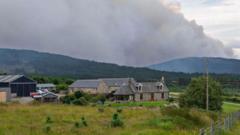
The flashing blue lights and urgent press releases are out. emergency services just declared a major incident in the Cairngorms because the wind shifted. The media is doing what it always does: painting a picture of sudden catastrophe, assigning blame to a changing breeze, and treating the natural world like a ticking bomb that humans must desperately diffuse.
They have it completely backward.
The real disaster in the Scottish Highlands is not that a fire is burning. The disaster is the decades of systematic suppression that turned these hills into a powder keg in the first place. By treating every spark as a crisis, we have created the exact conditions for the uncontrollable blazes we now fear.
The Myth of the Pristine, Fire-Free Highland
Walk into any boardroom of a major environmental charity or read a government briefing on rural land management, and you will encounter the same lazy consensus. The narrative claims that the ideal state of the Scottish uplands is an untouched, permanently damp blanket of moss and ancient pine where fire never occurs.
This is historical and ecological revisionism.
Ecosystems like the Cairngorms evolved with fire. Heathlands and boreal forests require periodic disturbance to regenerate. When we rush to extinguish every single ignition point instantly, we do not save the landscape. We merely postpone the bill, and interest accumulates in the form of dead biomass.
- The Fuel Load Trap: For decades, land managers have suppressed small, low-intensity burns. The result? A massive accumulation of older, woody heather (Calluna vulgaris) and deep, dried-out peat layers.
- The Wind Excuse: A shift in wind direction is not a freak weather anomaly. It is basic meteorology. If a minor breeze alteration turns a fire into a major incident, the vulnerability was already baked into the land.
I have spent years analyzing land-use data and watching policy decisions unfold in rural communities. I have seen conservation groups spend millions trying to freeze a dynamic landscape in time, completely ignoring the basic physics of fuel accumulation. When you stop the small fires, you guarantee the mega-fires.
The Misunderstood Anatomy of Upland Burning
To understand why the current panic is misplaced, we need to look at how these habitats actually function. The public is led to believe that all fire destroys peat and releases massive amounts of carbon. The reality is far more nuanced.
When a fire moves quickly across the canopy of the heather—what practitioners call a cool burn—it removes the old, unproductive growth without igniting the underlying peat layer. This stimulates new growth, which actually draws down carbon rapidly.
[Traditional Suppression Approach]
No fire -> Heather gets old/woody -> Fuel load accumulates -> High-intensity wildfire -> Peat burns to the bedrock

[Managed Disturbance Approach]
Periodic cool fires -> Canopy cleared -> Low fuel load -> Wildfire hits area -> Self-extinguishes due to lack of fuel
When we declare a major incident the moment a flame appears, we deploy heavy machinery, gouge firebreaks into fragile soils, and use chemical retardants. The suppression efforts often cause more long-term ecological degradation than the flame itself.
Why You Can Not Fireproof Nature
The popular question asked in parliamentary committees and environmental blogs is: "How do we stop these fires from happening?"
That is the wrong question. The right question is: "How do we ensure that when a fire happens, it does not matter?"
The current strategy relies on absolute control, an illusion that shatters the moment the wind changes. We need to move from a mindset of resistance to one of resilience. That means accepting that fire is a permanent stakeholder in the Cairngorms.
Dismantling the Ignorance Around Land Management
Let's address the elephant in the hills: the intense polarization between traditional land managers and modern rewilding advocates. Both sides are getting this wrong.
Traditional sporting estates often rely too heavily on rigid muirburn schedules designed solely for grouse production, sometimes burning on deep peat where they shouldn't. On the flip side, some rewilding initiatives abandon management altogether, walking away under the naive assumption that nature will balance itself without a hitch in a highly altered, fragmented landscape.
Abandonment is not conservation. It is a dereliction of duty.
When you withdraw human management from a landscape that has been shaped by human influence for millennia, you do not get a pristine wilderness. You get an overgrown, monocultural thicket of rank heather that waits for a lightning strike or a dropped cigarette to explode.
The Trade-offs of True Resilience
Adopting a pro-disturbance strategy is not a magic bullet. It requires accepting short-term discomfort for long-term stability.
- Visual Scars: A managed landscape will sometimes look black, charred, and unattractive to tourists who prefer their nature packaged like a postcard.
- Smoke Management: Communities will have to tolerate periodic smoke during prescribed burning windows rather than unexpected, toxic smoke during a mid-summer crisis.
- Surrendering Control: It means acknowledging that government agencies cannot manage every acre, and that local land managers often possess the observational data needed to make real-time decisions.
The Actionable Pivot: Rethinking Upland Policy
If we want to stop repeating this cycle of panic every time the temperature hits twenty degrees and the wind whips up from the east, we need to completely overhaul our approach to rural risk management.
Stop funding reactionary suppression infrastructure. Instead, incentivize the creation of diverse, mosaic landscapes. Break up the vast, continuous swathes of old heather with native broadleaf woodlands, which act as natural firebreaks due to their higher moisture content and different fuel structure.
Allow controlled, low-intensity fires to burn through designated zones during safe weather windows to naturally reduce the fuel load. Remove the bureaucratic red tape that prevents local keepers and farmers from executing these preventative burns.
The emergency services are reacting to a symptom. The disease is our collective inability to tolerate natural processes. As long as we treat fire as an enemy to be conquered rather than a force to be integrated, the hills will continue to burn, the wind will continue to shift, and the headlines will remain exactly the same. Turn off the blue lights, put away the press releases, and start managing the fuel.