When Pakistan launches deadly strikes on Afghanistan, the headlines usually frame it as a clean counterterrorism move. Strike the hideout, take out the militants, send a message. Simple, right?
Except it hasn't worked that way. Not in 2024, not in 2025, and not across the grim escalation of 2026. Every time Islamabad sends jets or artillery across the frontier, the cycle doesn't close—it widens. Border posts trade fire, civilians pay the price, and the militant groups Pakistan says it's trying to crush keep hitting back inside Pakistani territory.
If you're trying to make sense of why Pakistan launches deadly strikes on Afghanistan—and why the fallout looks so messy—you have to look past the press briefings. The real story sits at the intersection of domestic security panic, decades of broken alliances, and a border that nobody can truly seal.
What Actually Sparked This Escalation
Most surface-level coverage treats cross-border strikes like isolated flare-ups. They aren't.
The modern rupture accelerated after the Afghan Taliban returned to power in Kabul in August 2021. For years, Islamabad bet that a friendly Taliban government in Kabul would give Pakistan "strategic depth" and quiet along its western flank. Instead, attacks inside Pakistan surged sharply.
At the center of Islamabad's anger is Tehrik-e-Taliban Pakistan, commonly known as the TTP. Ideologically aligned with the Afghan Taliban, the TTP has waged a bloody insurgency against the Pakistani state, targeting security forces, police compounds, and infrastructure. By 2025 and 2026, Pakistani security analysts and think tanks documented steep jumps in militant casualties, including a 54 percent rise in security personnel and civilian deaths from militant attacks during the third quarter of 2026 alone. Factions of the Balochistan Liberation Army (BLA) also ramped up complex attacks, adding another layer to Islamabad's security headache.
Pakistan's leadership argues that the TTP and BLA operate from safe havens inside Afghanistan with either active backing or deliberate blindness from Kabul. When diplomatic pressure and border fencing failed to stop the attacks, Islamabad turned to kinetic force—striking alleged militant camps in eastern Afghan provinces like Paktika, Khost, Nangarhar, and Kunar, and even hitting targets deeper inside Afghanistan, including Kabul.
Kabul's response has been consistent: deny harboring anti-Pakistan militants, condemn the strikes as violations of sovereignty, and retaliate along the border. By early 2026, those exchanges had hardened into sustained cross-border hostilities involving Afghan forces and Pakistani military installations.
The Durand Line Problem Nobody Can Erase
You can't understand these strikes without looking at the map. The Durand Line—drawn in 1893 between British India and Afghanistan—cuts straight through Pashtun communities and rugged mountain terrain.
Afghanistan has never formally recognized the Durand Line as a legitimate international border. To Kabul, it was a colonial imposition that split families, tribes, and economies. To Islamabad, inheriting British India's boundary claims, it's a sovereign frontier that Pakistan spent billions trying to fortify with fencing after 2017.
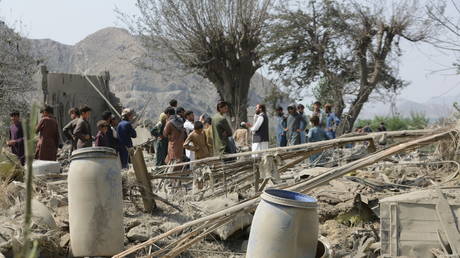
Here's the catch: a fence doesn't erase kinship, smuggling routes, or mountain passes like the Khyber Pass. Across twelve Afghan provinces and three Pakistani provinces, communities move along paths older than either modern state. When Pakistan fires across that line, it rarely hits a neat, isolated military base. It hits contested, porous ground where fighters, traders, and ordinary villagers share the same valleys.
Why Airstrikes Rarely Deliver What Islamabad Wants
On paper, targeted strikes look decisive. A commander gets killed, a camp gets flattened, and domestic audiences see a government refusing to look weak.
In practice, three things blunt the payoff:
- Civilian casualties fuel immediate blowback. Monitoring groups like the United Nations Assistance Mission in Afghanistan (UNAMA) have documented civilian deaths and hundreds of injuries from cross-border violence. Even when Islamabad insists its targets are strictly militants, dead civilians hand the Afghan Taliban a rallying cry and give local recruits fresh reason to hate Pakistan.
- Kabul can't—or won't—crack down cleanly. Even if factions in Kabul wanted to dismantle the TTP, doing so would fracture the Afghan Taliban itself. The TTP and Afghan Taliban fought side by side for years, and senior figures like Interior Minister Sirajuddin Haqqani and the Haqqani Network have deep historical ties across the region. Ordering a total war against the TTP risks civil war inside the ruling movement.
- Retaliation turns a counterinsurgency into an interstate clash. Once Afghan border troops return fire or hit Pakistani posts, Pakistan's army has to respond to protect its own soldiers. That shifts energy and troops away from internal policing and straight into border attrition.
Honestly, this is the trap Pakistan walked into. By treating an internal-plus-cross-border militant problem primarily as an air-and-artillery problem, Islamabad keeps handing Kabul and the TTP a shared grievance.
What Most Coverage Misses About the Domestic Politics
A lot of reporting stops at "Pakistan says X, Afghanistan says Y." That misses why Islamabad feels cornered at home.
Pakistan's military and civilian leadership face intense domestic pressure every time a police compound in Khyber Pakhtunkhwa or a security facility in Karachi gets hit. In October 2026, amid persistent militant violence and political turmoil, Islamabad even imposed federal emergency rule in opposition-governed Khyber Pakhtunkhwa.
When soldiers are dying in routine ambushes, sitting still looks like surrender to Pakistan's security establishment. Field Marshal Asim Munir and other senior officials have repeatedly tied peace to Kabul renouncing support for militant groups. At the same time, Pakistan is juggling broader regional headaches—managing ties with Iran, balancing defense commitments with Saudi Arabia, and watching China attempt mediation in talks like those hosted in Urumqi.
External mediators want stability so trade and infrastructure don't blow up. Yet mediation stalls when neither side trusts the other to keep its word after a ceasefire expires.
Comparing the Approaches Islamabad Has Tried
Look at the track record over the past few years and a pattern jumps out:
- Diplomatic pressure and backchannels: Low immediate cost, slow results, and easily undermined whenever a major attack hits inside Pakistan.
- Border fencing and surveillance: Useful for curbing casual crossings, useless against determined insurgents with local guides and terrain knowledge.
- Cross-border airstrikes and artillery: High dramatic impact, short-term tactical wins at best, and high risk of civilian harm and retaliatory border battles.
None of these three is a magic bullet on its own. Relying heavily on strikes while diplomacy is hollow basically guarantees the next round of violence.
Practical Ways to Read and Track This Conflict
If you follow South Asian security news—or work in policy, risk, or journalism—don't get sucked into daily body-count whiplash. A few habits make the picture way clearer:
- Separate militant claims from verified casualty data. Both sides routinely inflate enemy losses and downplay their own. Look for independent reporting from bodies like UNAMA or established conflict trackers before locking in numbers.
- Watch Khyber Pakhtunkhwa and Balochistan, not just border posts. The real test of whether strikes are working isn't a press release from Islamabad or Kabul—it's whether attacks inside Pakistani districts drop over consecutive quarters.
- Track third-party mediation quietly. Watch what China, Qatar, Turkey, and regional capitals actually commit to behind closed doors, because public statements rarely reflect real leverage.
- Expect episodic truces, not a neat peace treaty. Until Kabul and Islamabad resolve the TTP sanctuary question and stabilize border governance, pauses in fighting are far more likely than a lasting settlement.
Pakistan Hits TTP Targets In Airstrikes Across Afghanistan Border
This video adds useful visual and news context on how Islamabad frames its cross-border strikes against TTP targets inside Afghanistan.