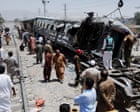
The mainstream media playbook for reporting on South Asian terror incidents is entirely broken. Whenever a tragedy occurs—like the devastating suicide bombing near a Pakistani railway track that claimed at least 23 lives—the analysis instantly defaults to a tired, predictable narrative. Cable news pundits and foreign policy desks rush to paint these acts as evidence of a highly sophisticated, expanding insurgent machine capable of destabilizing a nuclear-armed state at will.
They are reading the chessboard completely backward.
Sovereign states and international observers obsess over the horrific body counts, treating tactical tragedies as strategic victories for the perpetrators. In reality, soft-target infrastructure attacks—specifically targeting civilian rail lines and transit hubs—are not a demonstration of asymmetric power. They are the tactical death rattles of a structurally compromised insurgency.
The Soft Target Illusion
When an insurgent group targets a railway platform or a commuter train, they are choosing the path of least resistance. Western security apparatuses often classify these incidents as high-impact infrastructure terrorism. Let us correct the vocabulary immediately: it is low-yield desperation.
Securing thousands of miles of open, desolate railway track is an operational impossibility for any developing nation. It is an open flank. When militant factions bypass heavily fortified military checkpoints, intelligence headquarters, and economic zones to detonate explosives among civilian commuters, it signals a massive decline in their operational capability, not an escalation.
- Hard Targets: Airbases, military convoys, command centers, and government ministries.
- Soft Targets: Railway stations, public markets, religious shrines, and transport buses.
I have spent years analyzing regional security metrics, and the data tells a consistent story: when an insurgent group loses the capability to strike hard targets, they pivot to mass-casualty civilian strikes to maintain media relevance. They trade strategic utility for maximum psychological shock value. It costs almost nothing to infiltrate a crowded civilian platform. It requires zero advanced military intelligence, minimal reconnaissance, and basic logistics.
Treating these events as a sign of an ascendant enemy gives the perpetrators exactly what they want: a manufactured aura of omnipotence.
Dismantling the Failed State Narrative
Every time a bomb goes off in Balochistan or Khyber Pakhtunkhwa, international analysts dust off the "Failed State" thesis. They argue that Pakistan's inability to prevent transit bombings proves the federal government is losing control of its sovereign territory.
This premise is deeply flawed. Let us look at the historical precedents and structural realities that the lazy consensus completely ignores.
The Geography of Vulnerability
Consider the sheer scale of the network. The Pakistan Railways network spans over 4,700 miles of track, running through some of the most rugged, inaccessible terrain on earth.
To demand absolute security across this vast expanse is to misunderstand the nature of asymmetric warfare. Even the most advanced, heavily funded surveillance states on the planet cannot fully protect open civilian infrastructure.
- In 2004, the Madrid train bombings killed 193 people in Spain.
- In 2005, the London underground attacks paralyzed the UK capital.
- In 2016, the Brussels bombings struck a subway station and an airport.
Did anyone argue that Spain, the United Kingdom, or Belgium were failed states on the verge of collapse? No. They recognized those tragedies for what they were: horrific breaches of civilian security by asymmetric actors exploiting the inherent openness of a free society. Yet, when the exact same operational mechanics occur in South Asia, the commentary shifts to existential doom. This double standard distorts actual risk assessment and skews foreign policy decisions.
The Funding Fallacy: Why Terror Groups are Broke
The conventional wisdom insists that high-profile attacks attract massive waves of foreign funding and local recruitment. The theory goes that a high body count proves viability to deep-pocketed financiers.
The opposite is true. Mass civilian casualties frequently backfire, alienating the local populace and choking off domestic support networks. When a group shifts its targeting from state security forces to everyday workers, laborers, and families riding a train, it ruptures its own ideological justification.
The history of counterinsurgency shows that groups relying on indiscriminate civilian slaughter eventually face severe internal fracturing. Local tribes and informants, disgusted by the senseless carnage, begin cooperating with state intelligence. The short-term media spike achieved by a railway bombing comes at a catastrophic long-term cost: the total loss of the human terrain.
The Real Crisis is Economic, Not Kinetic
The true threat to regional stability is not the kinetic capability of the insurgents; it is the economic stagnation that turns these remote transport corridors into flashpoints.
Railways in developing nations are economic lifelines. They move the labor force, the grain, and the fuel. When security forces react to bombings by shutting down transport lines, deploying massive standing armies to rural platforms, and choking trade with endless checkpoints, they inadvertently complete the terrorists' mission for them.
The state’s response must decouple security from economic paralysis.
A New Framework for Infrastructure Defense
Instead of deploying static infantry units to guard thousands of miles of dirt and steel, resources must shift toward dynamic resilience.
- Redundant Logistics: Developing rapid-repair capabilities to ensure that when a line is struck, it is operational again within hours, nullifying the economic disruption.
- Decentralized Intelligence: Shifting focus away from massive physical barriers and toward localized, human-intelligence networks around transit villages.
- Algorithmic Threat Monitoring: Utilizing basic, low-cost sensor arrays at critical junctions rather than trying to man every mile of track with boots on the ground.
Stop Playing the Insurgent's Game
The media obsession with body counts and graphic imagery plays directly into the insurgent strategy. A suicide bombing near a railway track is an admission of tactical bankruptcy. It is the action of an entity that can no longer hold territory, can no longer defeat conventional military forces in the field, and can no longer sway the political consciousness of the population.
Stop treating these tragedies as strategic turning points. They are horrific, localized security failures occurring within an open, vulnerable transit system. Until the international community and regional governments stop overreacting to the theater of terrorism, they will remain trapped in a cycle of defensive panic, burning billions to protect static lines of steel while the real economic and political battlefields are left completely undefended. Turn the trains back on. Clear the tracks. Refuse to validate the desperate acts of a dying insurgency.


