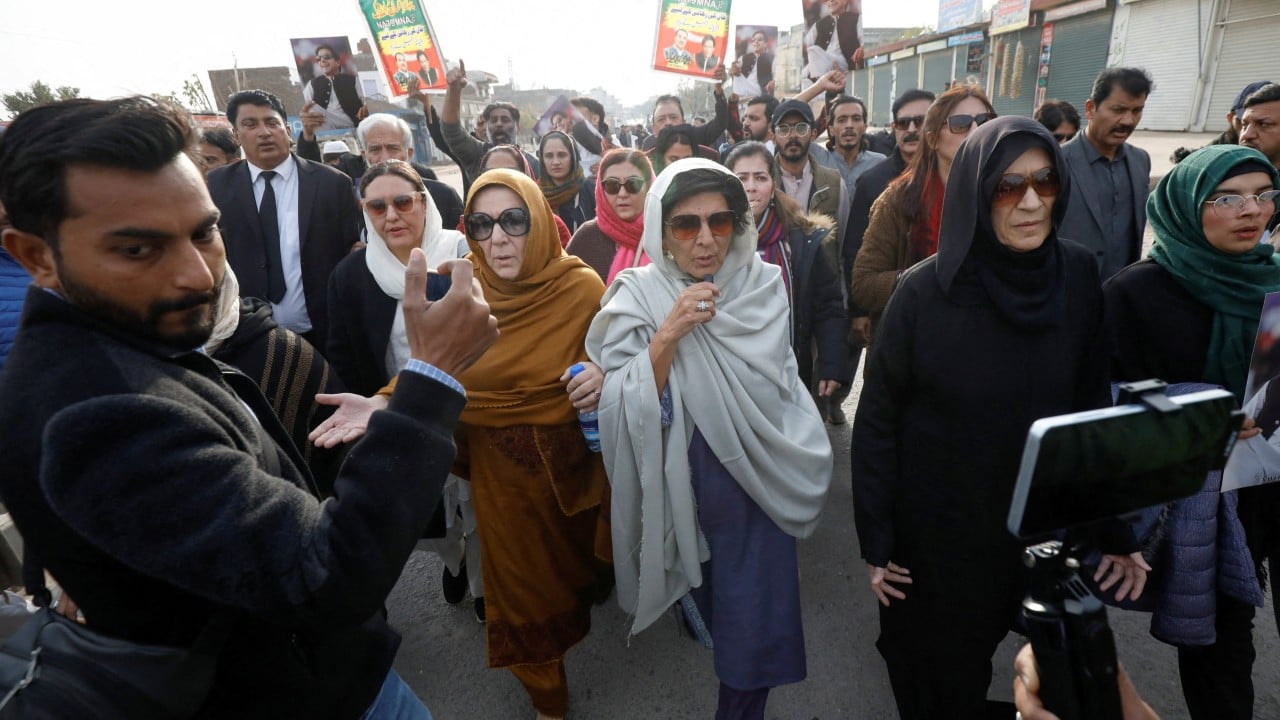
Pakistani authorities released Dr. Uzma Khan and Noreen Niazi, two sisters of jailed former prime minister Imran Khan, from Lahore’s Kot Lakhpat Jail on November 12, 2026. The Punjab provincial government abruptly withdrew their preventative detention orders after holding both women for 53 days without formal charges or a trial. Yet their older sister, Aleema Khan, remains locked inside the same prison. This selective release exposes how Pakistan’s ruling establishment deploys colonial-era preventative detention statutes to decapitate opposition mobilization while keeping its most effective street organizers neutralized.
Most wire reports treated the release as a routine administrative update. They missed the real story. When a state detains elderly relatives of an imprisoned political leader for nearly two months without filing a charge sheet, and then quietly opens the cell door for two while keeping the third under lock and key, you are looking at precision political containment.
The Mechanics of Preventive Detention in Punjab
To understand how Uzma Khan and Noreen Niazi vanished into Kot Lakhpat Jail in September 2026 without a warrant or a judge's signature, you have to look at Section 3 of the Punjab Maintenance of Public Order (MPO) Ordinance.
Originally drafted to give executive magistrates sweeping emergency powers to quell riots before they start, Section 3 allows provincial authorities to arrest and detain any citizen merely on the suspicion that they might act in a manner prejudicial to public safety or the maintenance of public order. There is no requirement to present evidence in open court before taking someone into custody. No formal criminal complaint needs to be registered at a police station. A deputy commissioner or provincial home department official simply signs an executive order, and the police make the arrest.
In September 2026, Imran Khan’s party, Pakistan Tehreek-e-Insaf (PTI), was gearing up for a major nationwide protest march on Islamabad to demand the former prime minister’s release. With Khan incarcerated since August 2023 and much of PTI’s second-tier parliamentary leadership either in hiding, behind bars, or sidelined by defections, his sisters had evolved from private family members into public conduits between Adiala Jail and the street.
The state moved first. Authorities swept up Noreen Niazi, Dr. Uzma Khan, and Aleema Khan under Section 3 of the MPO.
The planned Islamabad march ultimately did not materialize. Once the immediate threat of street mobilization passed, the legal justification for holding Uzma and Noreen under an administrative order evaporated. By November 12, Punjab authorities rescinded their joint detention order, and their lawyer, Rana Mudassar Umer, confirmed they walked out of Kot Lakhpat Jail around 2:00 PM.
Arbitrary Incarceration and Medical Secrecy
Executive detention orders operate in a legal gray zone where family members often lose basic visibility into a detainee's condition. That opacity became a flashpoint during the 53-day confinement.
Noreen Niazi, who is in her seventies, experienced a medical emergency roughly two weeks before her release and had to be transported to a cardiac hospital. According to her son, Wali, prison and provincial officials never notified the family when she was moved. The government later downplayed the incident in the Senate; Rana Sanaullah, adviser to the prime minister on political affairs, insisted on October 29 that she was fine and that all her medical tests had returned normal.
"For 53 days they were held under Section 3 of the MPO. No charge. No trial. Two weeks ago, Noreen, in her seventies, was taken to a cardiac hospital. No one told us. Today they were let out. No reason given. Neither decision rested on law. Their jailing was arbitrary and so is their release." — Wali, son of Noreen Niazi
This pattern highlights a structural vulnerability in Pakistan’s civil liberties framework. Even when the Lahore High Court or provincial review boards are petitioned to examine MPO detentions, the bureaucratic clock works in favor of the state. By the time judicial scrutiny catches up to an executive detention order, weeks have passed, the political calendar has shifted, and the government can simply withdraw the notification—rendering habeas corpus petitions moot without ever having to defend the legality of the arrest on the merits.
Why Aleema Khan Remains Behind Bars
If the September protest threat is over, why did Aleema Khan not walk out of Kot Lakhpat Jail alongside her sisters?
The answer lies in the difference between administrative detention and substantive criminal prosecution—and in the specific political role Aleema plays inside the PTI movement.
While Uzma and Noreen were held purely on preventative MPO orders, Aleema Khan is entangled in active criminal litigation tied to the November 26, 2024 Islamabad protest. During that demonstration, more than 10,000 PTI supporters breached lockdowns and clashed with security forces in the federal capital. Police at the Sadiqabad station named Aleema and ten others in a case prosecuted before an Anti-Terrorism Court (ATC).
Unlike an MPO order, which a provincial home secretary can cancel with a stroke of a pen, an ATC case locks a defendant into a slow, punishing judicial grinder. On November 26, 2026—two years to the day after the protest—ATC Judge Amjad Ali Shah deferred the verdict in Aleema’s case for the sixth time, pushing the ruling date to December 16 without conducting further proceedings. Her defense counsel objected on the record that the court had reserved its verdict without even hearing final defense arguments.
From a political standpoint, the distinction is unmistakable. Among Khan’s three sisters, Aleema has functioned as the primary strategic messenger. Following prison visits with her brother, it was routinely Aleema who stepped in front of television microphones outside Adiala Jail to relay Khan’s instructions to party cadres, criticize military leadership, and keep grassroots pressure alive. Neutralizing her through protracted anti-terrorism litigation achieves what a temporary MPO order cannot. It removes the most vocal surrogate from the public square while maintaining the veneer of judicial due process.
The Counter-Argument From Islamabad and Lahore
To view this solely through the lens of opposition victimization ignores the state’s stated security calculus, even if that calculus is heavily contested.
Pakistani officials and leaders of the ruling coalition argue that PTI’s protest campaigns repeatedly cross the line from peaceful assembly into violent disruption of the capital. Government spokespeople point to the November 2024 clashes, blocked highways, seized shipping containers, and economic paralysis in Islamabad and Rawalpindi as proof that pre-emptive action is necessary to protect public infrastructure and commercial life. From the perspective of the Punjab Home Department, using Section 3 of the MPO to temporarily detain key mobilizers before a scheduled march is a standard, lawful crowd-control measure designed to prevent street casualties before they occur.
Moreover, government officials reject the framing that the judiciary or prosecution is taking orders from the executive branch. They point out that Imran Khan himself has seen almost all of his initial convictions suspended or overturned on appeal—leaving only a single conviction active while appeals proceed—as evidence that Pakistan’s courts operate independently and grant relief when legal standards are met.
Yet that defense runs into an obvious contradiction. If the state possessed credible evidence that Uzma Khan and Noreen Niazi were organizing violent unrest in September 2026, prosecutors had 53 days to file formal charges before a magistrate. They filed nothing. Holding citizens for nearly two months and releasing them without a single charge sheet confirms that the arrest was never meant to build a criminal case. It was meant to impose a cost.
A Familar Playbook in Pakistani Politics
Nothing happening outside Kot Lakhpat or Adiala Jail is unprecedented in Pakistan’s turbulent political history. Every civilian administration and military-backed setup over the past four decades has reached for the exact same tools when cornered by a popular street movement.
During the 1980s and 1990s, when Benazir Bhutto led the Pakistan Peoples Party against military rule and rival civilian governments, female members of the Bhutto family—including her mother, Nusrat Bhutto, and sister, Sanam Bhutto—faced repeated house arrests, travel bans, and preventative detentions under colonial-era public order laws. Later, during Imran Khan’s own tenure as prime minister between 2018 and 2022, leaders of the Pakistan Muslim League-Nawaz (PML-N), including Maryam Nawaz, were arrested by anti-graft authorities and held in Kot Lakhpat Jail while facing protracted court battles.
The faces in the cells change. The statutory machinery never does.
In Pakistan’s hybrid political system, where power is negotiated between elected civilian politicians and the military establishment led by Army Chief Asim Munir, street agitation remains the opposition's ultimate leverage. When parliamentary avenues are blocked and media coverage is restricted, the ability to put tens of thousands of bodies onto the Grand Trunk Road toward Islamabad is the only card left to play.
What the Partial Release Signals
Releasing Uzma Khan and Noreen Niazi while keeping Aleema Khan and Khan’s wife, Bushra Bibi, in custody is a calibrated pressure valve.
By freeing two sisters—particularly an ailing septuagenarian whose hospitalization drew unwanted scrutiny in the Senate—the Punjab government lowers the immediate humanitarian temperature without surrendering its strategic grip on the PTI leadership. Senior PTI figure Moonis Elahi acknowledged as much upon their release, noting that while the family welcomed their return home, freeing two sisters neither ends the broader legal cases nor alters the reality of Khan’s continued imprisonment.
For Imran Khan, incarcerated since August 2023 and still facing scores of overlapping cases ranging from corruption to treason, the message from Lahore is unambiguous. His family is no longer insulated by traditional political norms that once spared non-parliamentary relatives from prolonged jail time. Until the Anti-Terrorism Court rules on December 16—or until a broader political settlement is reached behind closed doors—Kot Lakhpat Jail remains the front line of Pakistan's political deadlock.