History isn't just written by the victors. Sometimes, it gets rewritten by a handful of rocks and some very stubborn scientists at Oxford.
For generations, biology textbooks preached a neat, tidy timeline of life on Earth. We learned that complex animals burst onto the scene during the Cambrian explosion roughly 540 million years ago. Simple single-celled organisms hung out alone in the primordial soup for billions of years before a sudden evolutionary spark changed everything. In similar news, we also covered: Why Ten New Branching Worms Inside Sea Sponges Change Marine Biology Forever.
Turns out, that timeline is completely wrong.
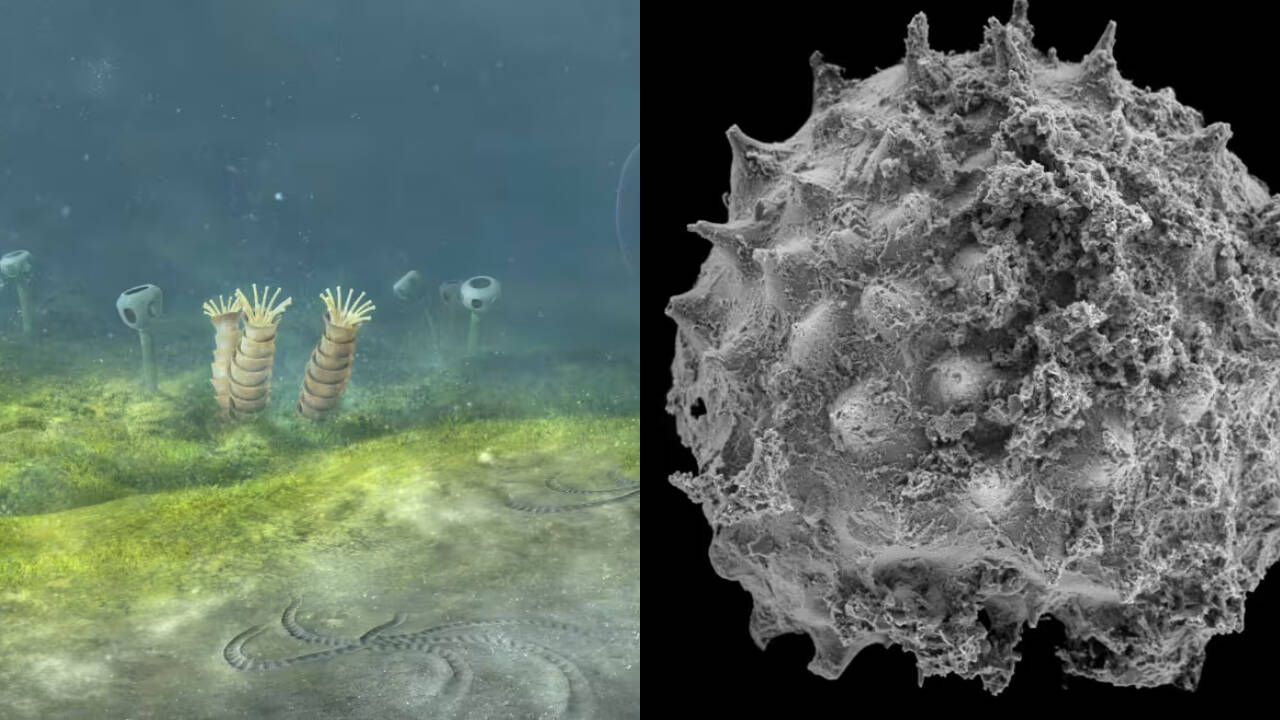
A landmark study out of Oxford University pushed the evolutionary clock back by an astonishing 200 million years. If the researchers are right, early animal life didn't kick off in the Cambrian period. It started hundreds of millions of years earlier during the Tonian period, long before the planet ever experienced its famous global icehouse events or the rise of swimming predators. Science Magazine has also covered this important topic in great detail.
Let's look at why this discovery matters, what the researchers actually found, and how it forces us to rethink the entire origin story of multicellular life on our planet.
The Problem With the Old Timeline
Science relies on the fossil record. If you can't point to a physical body frozen in stone, you struggle to prove it ever existed. For centuries, that standard constrained paleontology.
Soft-bodied organisms don't fossilize easily. Jellyfish, sponges, and early microbial mats decay into nothingness long before mineral-rich waters can turn them into permanent stone records. Because of this preservation bias, scientists used to assume that if we didn't find fossils of complex organisms in rocks older than 540 million years, those organisms simply weren't there.
That assumption was always a bit lazy. Absence of evidence isn't evidence of absence. Yet, textbook publishers loved the clean narrative of the Cambrian explosion. It felt like a starting gun.
Then geochemical markers and molecular clocks entered the picture. Geneticists began comparing DNA sequences across modern species to trace mutations backward through time. These molecular clocks kept ticking back further than the physical fossils allowed. They suggested that lineages split hundreds of millions of years before the Cambrian boundary.
Paleontologists scoffed. Geneticists stood their ground. A quiet war brewed in earth science departments.
What the Oxford Researchers Actually Did
Instead of hunting for rare body fossils in ancient shales, the Oxford team took a different route. They looked at environmental chemistry and biomarker preservation in ancient sedimentary rocks.
Lead researchers analyzed the oxygen and nutrient levels of ancient oceans. They focused on periods when atmospheric oxygen rose and fell dramatically. Complex multicellular life requires a lot of oxygen. Without it, cellular respiration fails, and large bodies cannot develop or move.
By mapping the geochemical fingerprints of ancient marine environments against molecular clock estimates, the Oxford scientists realized that the environmental prerequisites for animal life existed far earlier than previously thought. The oceans weren't total dead zones of anoxic sludge during the Tonian period. They had pockets of breathable water, stable shelf environments, and enough chemical gradients to sustain early sponge-like organisms or similar basal metazoans.
The study bridged the gap between genetic predictions and physical reality. It showed that the environment could support animals 700 to 800 million years ago, making the genetic models far more credible than skeptics wanted to admit.
Why Biology Textbooks Need a Rewrite
This shift isn't just an academic footnote about ancient rocks. It completely changes how we view evolutionary resilience.
If animals evolved 200 million years earlier than we thought, they lived through some of the most violent climate swings in Earth's history. They survived Snowball Earth scenarios—periods when global ice sheets stretched from the poles nearly to the equator.
Think about that for a second. If complex life can persist through a frozen planet, life is a lot tougher than we give it credit for.
This discovery also forces a rethink on extinction rates and evolutionary rates. If animal lineages sat around in low numbers or micro-habitats for hundreds of millions of years without dominating the globe, evolutionary progress isn't always a fast, explosive march upward. Sometimes, it's a slow burn. Species linger in the background until the right ecological pressure or environmental shift unlocks a massive adaptive radiation event like the Cambrian explosion.
Common Misconceptions About Deep-Time Evolution
People hear "animals evolved 200 million years earlier" and picture T-Rex swimming with trilobites in the Precambrian. Let's clear that up immediately.
We aren't talking about fish, insects, or shelled creatures. We are talking about microscopic precursors, benthic filter feeders, and soft-bodied sponges that looked more like muddy blobs than anything you would see at an aquarium.
Another common mistake is assuming the Oxford study proves animals were thriving everywhere. They weren't. The oceans were harsh, nutrient-poor, and chemically volatile. These early organisms scraped by in extreme isolation. They were biological pioneers holding on by a thread while the planet slowly prepared the atmosphere for prime-time biology.
What Happens Next in Paleontology
The debate won't settle overnight. Science rarely works that way. Traditional paleontologists will continue searching for the elusive body fossils that match these older dates. Organic geochemists will keep refining molecular extraction techniques to pull ancient lipid biomarkers out of billion-year-old shales.
Every time we dig deeper into Earth's crust, we find that life finds a way to exist earlier, stranger, and more persistently than our current models predict.
The story of life on Earth is much older and stranger than we were taught in school. Keep that in mind the next time you look at a beach pebble. You might be holding a witness to a billion-year experiment in survival.