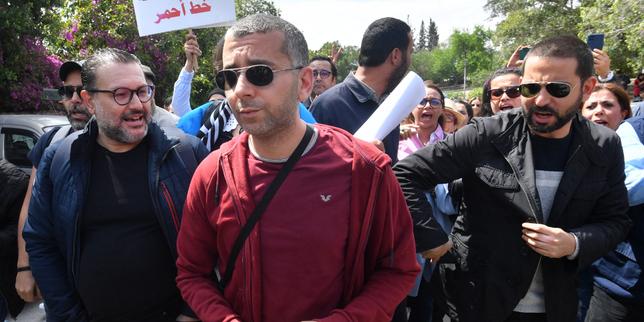
The Western press corps has its favorite script, and they are running it again.
On one side, you have the cartoonish villain: Tunisian President Kaïs Saïed, the populist strongman consolidating absolute control over the cradle of the Arab Spring. On the other side, you have the tragic hero: Haythem El Mekki, the sharp-tongued, cigarette-smoking columnist of Mosaïque FM, sentenced to a year in prison for daring to speak truth to power.
The commentary writes itself. It is a predictable lamentation about democratic backsliding, the death of free speech, and the tragic slide of the region back into the dark ages of autocracy.
It is also a completely superficial reading of what is actually happening on the ground in Tunis.
Screaming about human rights violations might make human rights advocates feel morally superior, but it does absolutely nothing to help us understand why El Mekki is behind bars, or why the Tunisian public is largely watching this crackdown with a collective, indifferent shrug.
To understand the tragedy of Tunisia, you have to stop looking at it through the sanitised lens of international NGOs. You have to look at how the media class itself spent a decade alienating the very public that was supposed to protect them.
The Illusion of the Post-Revolutionary Fourth Estate
Let us clear up the first major misconception: the pre-2021 Tunisian media was not a shining beacon of objective, investigative journalism.
When the dictatorship of Zine El Abidine Ben Ali fell in 2011, it did not give rise to a professional, independent fourth estate. Instead, it created an chaotic, unregulated media free-for-all where airwaves were carved up by oligarchs, political parties, and foreign interests.
- Political Clientelism: Talk shows on major stations became proxy battlegrounds for rival political factions.
- Sensationalism Over Substance: While the Tunisian economy was quietly suffocating under soaring inflation and a ballooning deficit, prime-time television was dominated by screaming matches, ideological culture wars, and superficial political gossip.
- The Oligarchic Guard: Media owners frequently used their platforms as shields to protect their business interests or attack political rivals, rather than holding the state accountable.
The average Tunisian did not look at the media and see a defender of their hard-won liberties. They saw an arrogant, self-serving metropolitan elite that was completely disconnected from the daily struggle of buying bread, finding milk, or securing a job.
When Kaïs Saïed suspended parliament and seized exceptional powers in July 2021, the international community panicked. But on the streets of Tunis, Sfax, and Kasserine, people celebrated. They were tired of the political theater. They wanted someone to clean house.
And when Saïed turned his sights on the media, he did so knowing that the press had no domestic army of defenders.
The Lethal Mechanics of Decree 54
To understand how a figure like Haythem El Mekki ends up with a one-year prison sentence, you have to understand the specific bureaucratic weapon used to put him there: Decree 54.
Promulgated by President Saïed in September 2022, Decree 54 was ostensibly designed to combat cybercrime and "fake news." In practice, it is a legal dragnet designed to criminalize political dissent.
Specifically, Article 24 of the decree imposes prison sentences of up to five years (doubled if the target is a public official) for anyone who uses communication networks to "produce, transmit, disseminate, or write false news, statements, or rumors" with the intent of "defaming others, damaging their reputation, harming them financially or morally, or inciting attacks against them."
Look closely at that language. It is intentionally vague. Who decides what constitutes "false news"? The state-appointed judiciary. Who defines "damaging reputation"? The public officials being criticized.
+------------------+------------------------------------+----------------------------------------+
| Law / Mechanism  | Official Intent                    | Actual Political Utility               |
+------------------+------------------------------------+----------------------------------------+
| Decree 54        | Combatting cybercrime & fake news  | Criminalizing political dissent        |
| Article 24       | Protecting public safety           | Silencing independent columnists       |
| Judicial Reform  | Ensuring state security            | Neutralizing political opposition      |
+------------------+------------------------------------+----------------------------------------+
When El Mekki criticized the government’s handling of sub-Saharan migration or pointed out administrative failures on Mosaïque FM, he was not committing a crime under any standard democratic framework. But under the sweeping, elastic definitions of Decree 54, any critique that embarrasses the presidency is a threat to state security.
Yet, focusing solely on the authoritarian nature of Decree 54 misses the structural point. The law works because it exploits a pre-existing vacuum of trust.
The High Price of the NGO Bubble
For over a decade, international organizations poured tens of millions of dollars into Tunisian media development. They held workshops in five-star hotels in Gammarth, trained journalists on "democratic values," and funded glossy digital startups that spoke the language of Western liberalism.
This donor-funded ecosystem created a massive distortion. It insulated journalists from the market and, more importantly, from their own audience.
Instead of building viable business models that relied on local subscribers or local advertising, many independent outlets became dependent on foreign grants. Their primary audience ceased to be the working-class Tunisian citizen; instead, it became the program officers in Brussels, Berlin, and Washington.
The resulting coverage was predictable:
- High-concept explainers on gender equality and climate change—vital topics, but luxuries for a population currently standing in three-hour queues for semolina.
- An obsession with constitutional mechanics that bored the average citizen to tears.
- A complete failure to connect macro-level economic corruption with the micro-level misery of the population.
When Saïed’s prosecutors came for Mosaïque FM or arrested Syndicate of Journalists members, the international NGOs issued their press releases. But those press releases do not translate into popular mobilization.
If the public does not believe you are fighting for them, they will not stand in the street to fight for you. The media built a house of cards on foreign sand, and Saïed simply blew it over.
The Naive Fantasy of the Western Savior
Whenever a journalist like El Mekki is sentenced, the immediate response from Western commentators is to call on the US, France, or the EU to exert pressure on Carthage. They demand that financial aid, IMF loans, or security cooperation be conditioned on Tunisia respecting human rights and press freedom.
This is a profound misunderstanding of contemporary geopolitics.
First, the West has zero leverage. Kaïs Saïed knows that Europe’s primary interest in Tunisia is not democracy; it is migration control. As long as the Tunisian National Guard is stopping migrant boats from leaving the coast of Sfax for Lampedusa, European capitals will limit their protests to mild expressions of "concern."
Second, external pressure actually strengthens Saïed’s hand domestically.
[Western Public Condemnation]
       │
       ▼
[Saïed’s Narrative of "Foreign Interference"]
       │
       ▼
[Increased Domestic Support for the Regime]
Every time a Western embassy issues a statement criticizing a court ruling, Saïed’s communication machine frames it as an imperialist attack on Tunisian sovereignty. For a public weary of decade-long economic humiliation, a leader standing up to foreign powers—even if it is performance art—is incredibly appealing.
By making the battle about "Western values" versus "national sovereignty," the international community accidentally plays right into the presidency's hands.
The Inevitable Death of the Legacy Press
The era of the prominent, nationally recognized political columnist in Tunisia is over. The sentencing of Haythem El Mekki is not the beginning of this trend; it is the final nail in the coffin.
What comes next will not be a return to the quiet conformity of the Ben Ali era, nor will it be a sudden democratic awakening. Instead, we are entering an era of deep, fragmented underground information.
With the mainstream radio stations silenced or housebroken, the real conversation is shifting.
- Encrypted Networks: Private Telegram channels and Signal groups are replacing the public square.
- Pseudonymous Writing: High-quality analysis is being published anonymously to avoid the reach of Decree 54.
- Hyper-Local Substacking: Independent newsletters operating outside the Tunisian jurisdiction are serving as the only reliable sources of policy analysis.
This shift is messy, insecure, and highly vulnerable to actual misinformation. But it is the only logical response to a state that has made public truth-telling a jail-able offense.
To survive, Tunisian journalists must abandon the expectation that international norms or foreign embassies will save them. The only shield against authoritarianism is deep, undeniable local utility.
If the press wants to matter again, it must stop talking to the elite and start reporting on the brutal, unglamorous realities of survival in a collapsing economy. It must make itself so indispensable to the daily life of the ordinary citizen that silencing a journalist becomes a political cost too high for even an autocrat to pay.
Until then, the courts will keep hand delivering one-year sentences, the NGOs will keep writing reports, and the silence in the streets of Tunis will only grow louder.