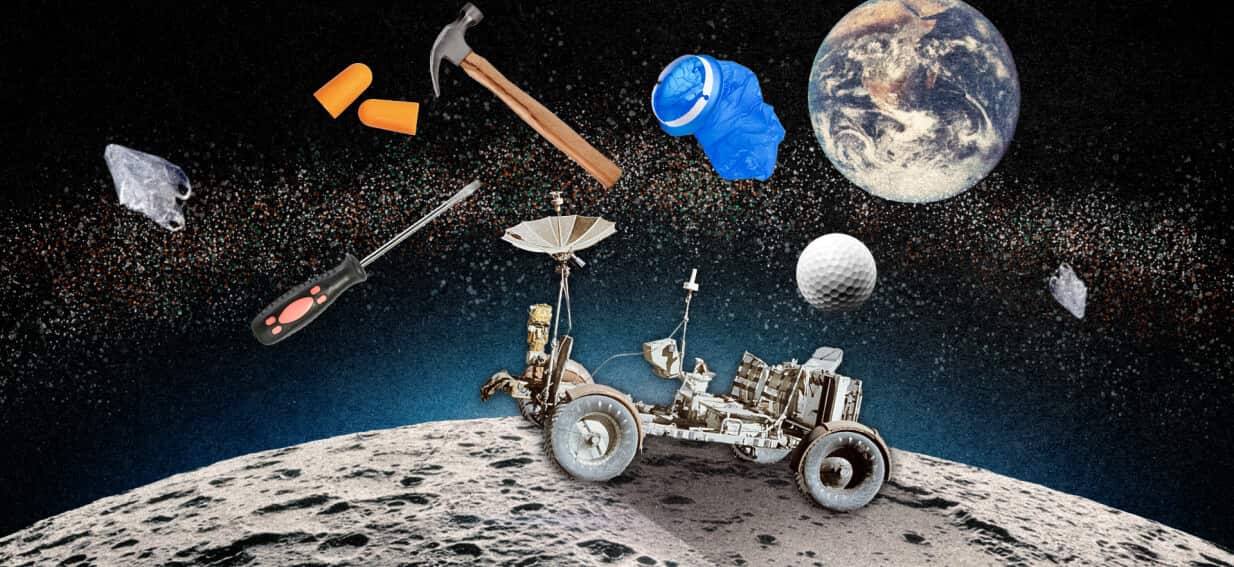
We built an industrial revolution in the sky and forgot to install a garbage chute. For decades, the narrative surrounding space debris has been dominated by sterile computer simulations of orbiting metal shards and polite warnings from space agencies about future risks. That future arrived years ago. Low Earth orbit is no longer a pristine frontier waiting to be mapped; it is a congested, hyper-velocity junkyard where millions of discarded rocket bodies, defunct communication satellites, and microscopic paint flakes travel at speeds exceeding seventeen thousand miles per hour.
Space debris, or orbital debris, is the accumulation of defunct human-made objects in Earth orbit that no longer serve any useful function. Right now, this industrial waste threatens the viability of global telecommunications, weather forecasting networks, and scientific observation platforms. The physical reality of the situation is stark. When kinetic energy scales with the square of velocity, even a fragment the size of a marble carries the destructive force of a hand grenade.
[Image of space debris orbiting Earth]
The Mathematics of Kessler Syndrome
Donald Kessler knew what was coming in 1978. As a NASA scientist, he formulated a mathematical model predicting a self-sustaining cascade of collisions in low Earth orbit. The logic was simple and terrifying. Once the density of objects in a specific orbital shell crosses a critical threshold, every collision generates hundreds of new pieces of shrapnel. Those pieces strike other objects, creating thousands more fragments.
We are currently hovering on the razor edge of that threshold, known widely as the Kessler Syndrome.
The problem is not just large dead satellites that can be tracked by ground-based radar and optical telescopes. It is the invisible swarm. The United States Space Surveillance Network tracks roughly thirty thousand objects larger than ten centimeters. But statistical models estimate there are over one million pieces between one and ten centimeters, and more than one hundred million pieces smaller than one centimeter.
You cannot dodge what you cannot see.
In 2009, a defunct Russian military communications satellite named Kosmos-2251 smashed into an operational Iridium commercial communications satellite at an altitude of nearly eight hundred kilometers over Siberia. The impact added over two thousand trackable pieces of debris to the orbital environment, instantly increasing the cataloged population of large debris by roughly ten percent. More than a decade later, fragments from that single collision continue to threaten other spacecraft, forcing constant defensive maneuvers.
Economic Incentives for Pollution
Why do we leave our trash in the sky? The answer is economics, pure and simple.
Putting mass into orbit is phenomenally expensive. Every kilogram allocated to a spacecraft matters, and every ounce of fuel spent on end-of-life de-orbit maneuvers cuts into payload capacity or mission lifespan. Historically, commercial operators and sovereign space programs alike treated orbit as an infinite sink. Once a satellite ran out of fuel, turning off the transponder and walking away was the cheapest option.
Regulatory frameworks evolved at a glacial pace compared to the commercialization of space. For a long time, international guidelines suggested that satellites in low Earth orbit should be removed within twenty-five years of mission completion. Twenty-five years is an eternity in an environment congested by thousands of new mega-constellations.
Operators now launch satellites by the thousand. Companies like SpaceX, OneWeb, and Amazon are deploying vast constellations of broadband satellites to provide global internet coverage. While these modern operators generally build automated collision-avoidance systems into their hardware, the sheer volume of traffic multiplies the statistical probability of a catastrophic failure.
When a satellite loses power or suffers a computer glitch, it turns into a dead brick flying through the dark. It cannot maneuver. It cannot respond to ground commands. It simply waits for something else to cross its path.
The Blind Spots in Tracking Infrastructure
Ground-based radar systems and optical telescopes form the backbone of our space situational awareness. But they face severe limitations. Weather interferes with optical tracking. Radar struggles to resolve objects smaller than a few centimeters unless they pass very close to a ground station.
Space-based sensors help, but they are expensive to deploy and maintain. Consequently, satellite operators often receive collision warnings with agonizingly little lead time. Sometimes, an automated alert arrives mere hours before a potential impact, leaving ground teams scrambling to calculate an evasive burn.
These maneuvers cost fuel. Every time an operational satellite fires its thrusters to dodge a piece of debris, its operational lifespan shrinks. We are burning valuable propellant just to dodge our own historical negligence.
Insurance markets have started waking up to the risk. For years, space insurance was a niche product focused primarily on launch failure. Today, underwriters are looking closely at orbital decay and collision risks. As premiums rise for operators in crowded orbital bands, the financial penalty for poor space hygiene may finally outweigh the cost of proactive debris mitigation.
The Technical Nightmare of Active Removal
Cleaning up low Earth orbit sounds simple in a boardroom presentation. Just send up a robotic arm, grab the dead satellite, and drag it down into the atmosphere to burn up safely.
The reality involves monumental engineering hurdles.
Most dead satellites were never designed to be grappled. They lack standard docking fixtures, magnetic capture points, or specialized grappling rings. They tumble end-over-end in chaotic rotations, combining pitch, roll, and yaw into unpredictable patterns. Attempting to clamp onto a spinning, irregularly shaped piece of aluminum with jagged solar panels requires sub-millimeter precision. A single miscalculation turns the cleanup spacecraft into a shrapnel generator, doubling the problem instead of solving it.
Experimental missions have tested various concepts. Magnetic capture, harpoons, nets, and ion beam shepherd satellites have all moved from science fiction into engineering laboratories. The European Space Agency contracted a mission scheduled for later this decade to capture a single Vespa payload adapter left behind by a Vega rocket. It is a vital proof of concept, but it removes only one object out of millions.
Scaling this capability to an industrial level requires a massive capital investment with no direct commercial return. Cleaning up someone else's dead rocket body does not generate revenue. Unless governments mandate cleanup operations or subsidize the market, commercial entities will struggle to build a profitable business model around garbage collection in the thermosphere.
Diplomatic Gridlock in the Void
Space governance resembles the wild frontier of the nineteenth-century American West, minus the sheriff. The cornerstone of international space law is the 1967 Outer Space Treaty. Drafted during the height of the Cold War, the treaty establishes that space is the province of all mankind, that national appropriation is prohibited, and that states retain jurisdiction over their launched objects.
Crucially, the treaty states that launching nations remain liable for damage caused by their space objects. This creates a bizarre legal paradox. If a private company or foreign agency attempts to capture and remove a dead satellite belonging to another nation without explicit permission, it could legally be construed as an act of theft or interference with sovereign property.
International consensus moves slowly when superpowers are competing for military and commercial dominance in low Earth orbit. Anti-satellite missile tests conducted by various nations over the past fifteen years have demonstrated a flagrant disregard for the long-term health of the orbital environment. A single intentional missile strike shatters a target into thousands of persistent high-speed projectiles that threaten everyone's assets indiscriminately. When security calculations override environmental stewardship, long-term sustainability takes a back seat to immediate geopolitical posturing.
The Real Cost of Inaction
We treat the sky as a limitless expanse, but low Earth orbit is finite real estate. Certain altitude bands and inclination angles are already turning into high-risk traffic zones.
If a severe cascade event triggers, the consequences will ripple through modern civilization instantly. Global navigation systems, financial transaction timing, maritime tracking, and emergency communications depend heavily on uninterrupted access to space. Losing those capabilities would not merely inconvenience smartphone users; it would paralyze logistics networks, disrupt agricultural yields, and blind defense systems.
The cleanup will not be cheap, easy, or popular with budget committees. But waiting for a major disaster to force our hand guarantees that the eventual bill will be paid in lost infrastructure and compromised security. The tools to secure orbit exist on paper and in early prototypes. What remains missing is the collective institutional will to clean our own backyard before the door to the stars slams shut behind us.