Mechanics of the African Humid Period
The North African climate system operates as an orbital-scale hydrological oscillator, transitioning between hyper-arid desert conditions and lush, vegetated landscapes every 21,000 years. This transition—historically referred to as the African Humid Period (AHP)—is driven by variations in solar radiation hitting the Earth's Northern Hemisphere. When solar radiation peaks during Northern Hemisphere summer, the temperature contrast between the landmass and the neighboring Atlantic Ocean increases. This thermal differential drives the West African Monsoon inland, shifting rain bands hundreds of kilometers north into what is today the Sahara.
The primary mechanism controlling this cycle is Milankovitch forcing, specifically the precession of the equinoxes. Axial precession alters the season during which Earth reaches perihelion (its closest distance to the Sun). When summer solstice in the Northern Hemisphere aligns with perihelion, summer insolation increases by up to 7% or 8% relative to modern baselines. This increased thermal load triggers three specific physical reactions:
- Thermal Low Intensification: Solar heating of the Saharan landmass lowers atmospheric pressure, creating a persistent continental low-pressure center.
- Monsoonal Gradient Amplification: Ocean surface temperatures rise at a much slower rate than land temperatures. This creates a steep pressure gradient between the cool, high-pressure eastern Atlantic and the hot, low-pressure landmass, drawing moist maritime air far inland.
- Intertropical Convergence Zone Displacement: The Intertropical Convergence Zone (ITCZ), a band of low pressure where northern and southern trade winds meet, migrates further north than its contemporary limit of approximately 18°N, reaching up to 28°N to 30°N.
[Equinoctial Precession Peak] ──> [Maximized Northern Hemisphere Summer Insolation]
                                             │
                                             ▼
                               [Saharan Landmass Overheating]
                                             │
                                             ▼
                      [Persistent Continental Low Pressure Established]
                                             │
                                             ▼
               [Inland Migration of West African Monsoon & ITCZ (up to 30°N)]
                                             │
                                             ▼
                     [Equatorial Precipitation Expands Across Sahara]
Feedback Loops Amplifying Regional Hydrology
Solar forcing alone is insufficient to account for the full magnitude of the greening observed during the mid-Holocene (roughly 11,000 to 5,000 years ago). Orbital calculations show that radiative forcing increased precipitation by an initial margin, but paleoclimate records indicate actual rainfall increased by over 100% across the region. This discrepancy highlights the role of non-linear environmental feedback systems.
Vegetation Albedo Dynamics
Bare sand reflects approximately 30% to 40% of incoming solar radiation back into space. As monsoon rains creep northward, drought-tolerant vegetation, grasses, and shrubs colonize the landscape. Surface vegetation darkens the land, dropping the albedo down to 15–20%. The darker surface absorbs significantly more radiation, transferring heat directly to the lower atmosphere. This added heat further lowers atmospheric pressure, driving stronger monsoonal winds and bringing more ocean moisture into the interior.
Soil Moisture Recirculation
In an arid state, precipitation quickly evaporates or runs off without altering the regional atmospheric column. During an African Humid Period, the expansion of vegetation stabilizes topsoil and increases evapotranspiration. Roots absorb groundwater and release water vapor directly into the boundary layer. Rather than relying entirely on continuous ocean air imports, the regional atmosphere begins to recycle its own moisture, sustaining precipitation deep into the interior of the continent.
Lake-Atmosphere Coupling
Increased rainfall fills structural basins across North Africa, forming major inland water bodies such as Lake Megachad. At its maximum extent, Lake Megachad covered over 350,000 square kilometers—larger than the modern Caspian Sea. Large water bodies reduce local surface temperatures while serving as continuous sources of surface evaporation, stabilization, and microclimatic moisture feeding adjacent cloud systems.
[Initial Rain Expansion] ──> [Vegetation Growth] ──> [Albedo Drops (40% to 15%)]
          ▲                                                     │
          │                                                     ▼
[Regional Precipitation] <── [Enhanced Evapotranspiration] <── [Higher Heat Absorption]
Paleontological and Environmental Artifacts
The presence of sprawling lakes and river networks reconfigured North Africa's biogeography. Paleoclimate proxy data—including lake sediment cores, fossilized pollen, leaf-wax biomarkers, and cave speleothems—demonstrate that the modern dry desert was once dominated by savanna ecosystems, river valleys, and permanent wetlands.
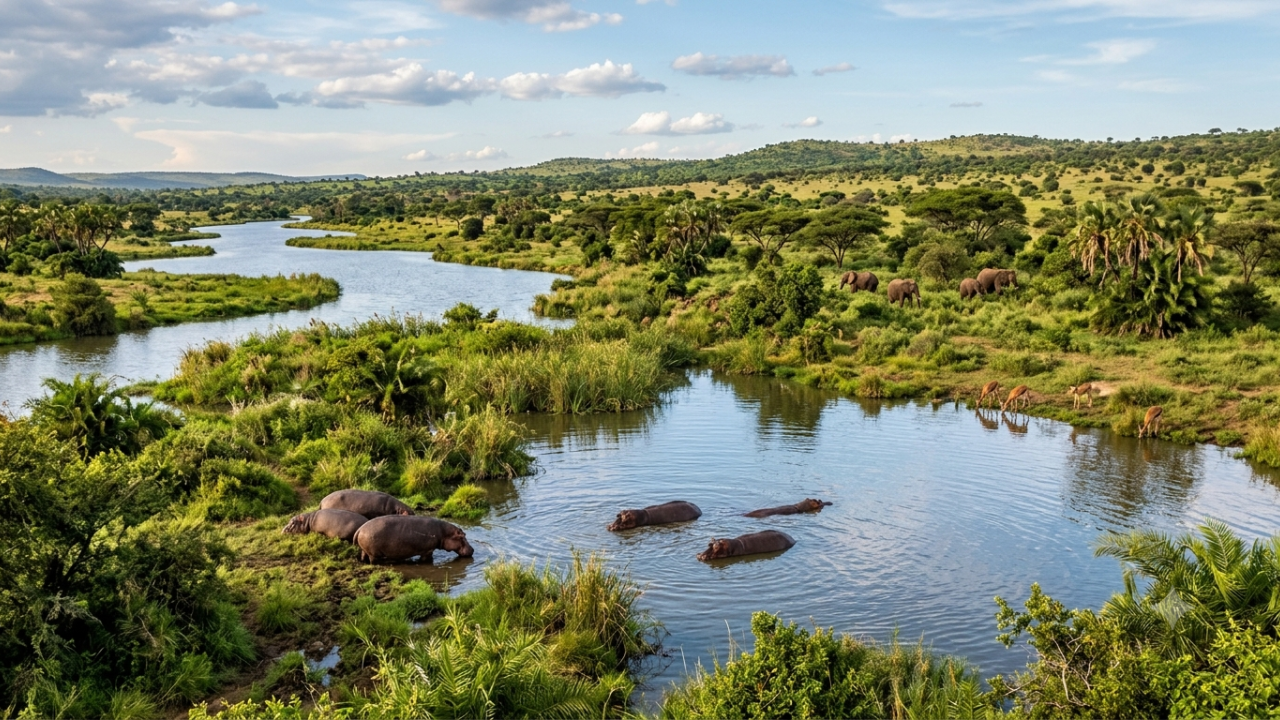
Taxonomic remains recovered from locations like the Chad Basin and the Western Desert of Egypt confirm the presence of fauna that require permanent open water or abundant grazing lands. Fossilized skeletons of hippopotami, crocodiles, and large freshwater fish species (such as Lates niloticus, the Nile perch) are widely distributed across areas that now receive less than 10 millimeters of rainfall per year.
The drainage architecture of the region during these wet phases differed dramatically from modern maps:
- The Tamanrasset River System: An ancient, continent-scale river network that drained west out of the Ahaggar Mountains across Western Sahara into the Atlantic Ocean near modern Mauritania.
- The Mega-Fezzan System: A complex network of interconnected lakes and river valleys in southwest Libya that sustained permanent aquatic ecosystems.
- The Kufra Basin Lake System: A massive freshwater body located in southeastern Libya that linked seasonal drainage channels across thousands of square kilometers.
These water systems served as migration corridors for both wildlife and early human populations. Archaeological sites throughout the Central Sahara preserve rock art depicting pastoralism, cattle herding, swimming humans, and megafauna hunting, offering a clear record of human adaptation to a changing climate.
The Nonlinear Collapse of the Green Sahara
The end of the mid-Holocene African Humid Period illustrates the vulnerability of ecosystems governed by feedback mechanisms. As Earth's orbital configuration shifted, summer insolation in the Northern Hemisphere began a slow, linear decline starting roughly 6,000 years ago.
Despite the gradual nature of orbital forcing, the transition from a green Sahara to a desert was rapid in many sub-regions. When insolation dropped below a critical threshold, vegetation cover decreased enough for albedo to rise. The increase in surface reflectivity cooled the landmass, weakened the pressure gradient, and pushed the West African Monsoon back south. Less rainfall further reduced vegetation, initiating a self-reinforcing drying cycle.
The collapse occurred over a few centuries rather than millennia in certain zones, stranding human populations near remaining water sources like the Nile River corridor and isolated Saharan oases. This collapse demonstrates that regional climate systems with strong feedback loops rarely respond in a simple, linear fashion to external drivers; instead, they remain stable until a physical tipping point is breached, after which state shifts happen rapidly.
Orbital Timelines and Modern Anthropogenic Factors
Understanding the historical orbital timeline provides insight into when the Sahara might naturally green again. Because precession operates on an approximate 21,000-year cycle, peak summer insolation in the Northern Hemisphere will not occur again for roughly 10,000 to 12,000 years. Based purely on natural orbital mechanics, North Africa is expected to remain in a dry state for several millennia.
However, modern greenhouse gas emissions introduce a unprecedented variable into this system. Rising global temperatures alter ocean-atmosphere thermal gradients in ways that diverge from orbital forcing alone.
Increased ocean temperatures in the North Atlantic can pull precipitation belts northward, potentially boosting rainfall across parts of the Sahel region. Conversely, warmer ocean surfaces elsewhere can alter global atmospheric circulation, suppressing monsoonal flow or causing erratic, unpredictable rainfall distribution across North Africa. High atmospheric carbon dioxide levels also affect plant water-use efficiency, altering evapotranspiration feedback loops independently of orbital geometry.
The future state of North African hydrology will depend on the interplay between natural orbital forcing—which currently favors aridity—and anthropogenic climate disruption, which is rapidly altering the energy balance of the atmospheric column.


