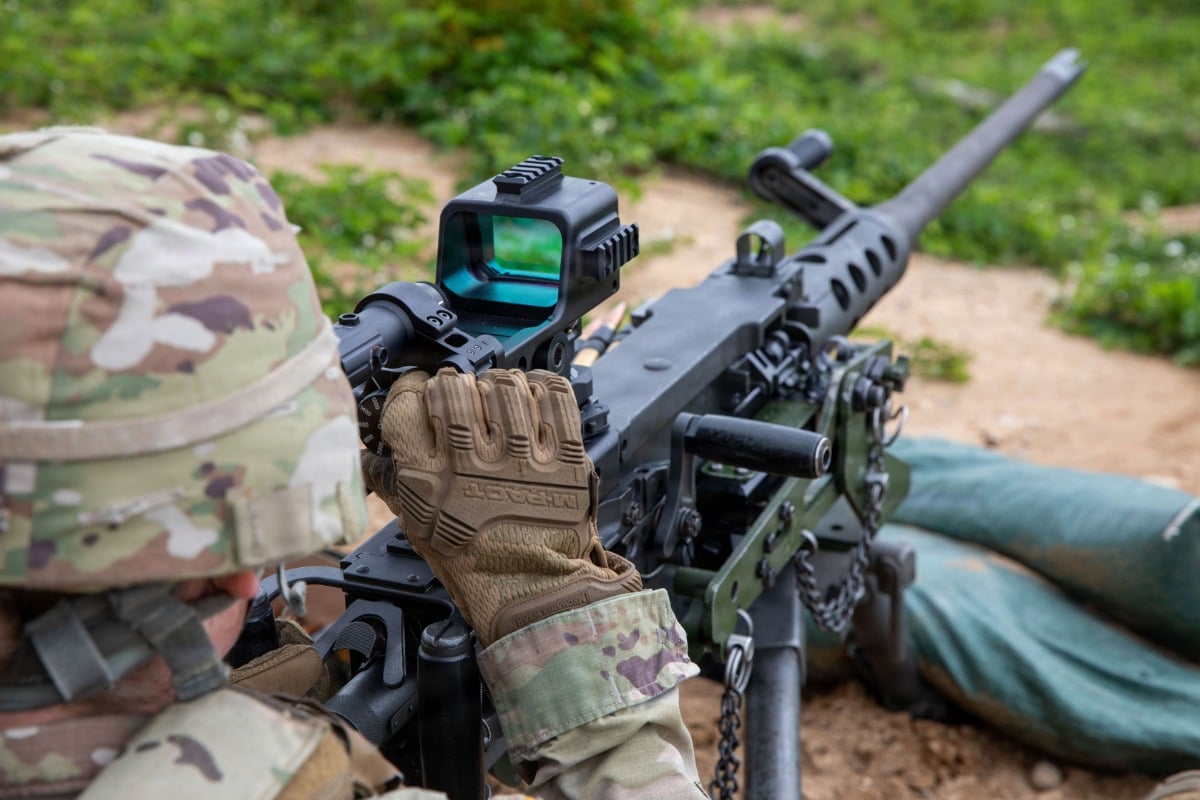
The procurement and integration of a standardized optical sight for the M2 .50-caliber heavy machine gun addresses a critical asymmetry in modern infantry and mechanized warfare: the disparity between a weapon system’s mechanical maximum effective range and the human operator's physiological visual limits. For nearly a century, the M2 relies primarily on iron sights, a design that tethers a weapon capable of suppressing targets at 1,830 meters to the naked-eye detection capabilities of the gunner. Integrating a specialized optic is not a simple accessory upgrade; it is a fundamental recalibration of the weapon’s lethality function.
To evaluate the strategic impact of this modernization effort—specifically focusing on systems like the heavy weapon optoelectronic sights currently entering service—one must analyze the intersection of ballistics, human factors engineering, and operational economics.
The Three Pillars of Heavy Weapon Lethality
The operational efficacy of a heavy machine gun system relies on three distinct variables: target acquisition time, kinetic probability of hit ($P_h$), and sustained suppression capacity. Iron sights degrade the first two variables as range increases linearly. By introducing an optical suite featuring magnification and thermal or infrared channels, the system redefines these pillars.
                  +-----------------------------------+
                  |   Modernized M2 Lethality Matrix  |
                  +-----------------------------------+
                                    |
       +----------------------------+----------------------------+
       |                            |                            |
       v                            v                            v
[Pillar 1: Spatial          [Pillar 2: Angular          [Pillar 3: Kinetic
 Resolution]                 Deviation]                  Efficiency]
Resolution increases        Standoff range scales       Suppression economy
via optical magnification.  via precise reticles.        via reduced rounds fired.
1. Spatial Resolution and Target Discrimination
At 1,500 meters, a human-sized target or a light technical vehicle occupies a minuscule fraction of an operator’s field of view. Iron sights obscure the target itself at these distances due to the width of the front sight post relative to the target's angular size (milli-radians). An optical system with $4\times$ or $6\times$ magnification expands the operator's visual resolution, converting a ambiguous cluster of pixels into a positive identification zone. This structural shift moves the bottleneck of the engagement cycle from detection to discrimination.
2. Angular Deviation and Standoff Range
The M2 firing the .50 BMG (12.7×99mm) cartridge possesses an incredibly flat trajectory relative to smaller calibers, yet at ranges exceeding 1,000 meters, gravitational drop and wind drift require precise compensation. Iron sights force gunners to rely on crude holdovers or mechanical adjustments that lack granularity. Modern combat optics introduce ballistic drop compensating (BDC) reticles and integrated rangefinders. This quantification of angular deviation allows the gunner to map the trajectory precisely to the target’s distance, shifting the $P_h$ curve upward at extreme ranges.
3. Kinetic Efficiency and Logistical Relief
A machine gun suppresses by creating a zone of beaten zone density where the enemy faces a high probability of interdiction. When un-aimed or poorly aimed via iron sights, operators compensate by increasing the volume of fire. This behavioral pattern accelerates barrel erosion, increases thermal signatures, and strains the logistical supply chain. A stabilized, magnified optic reduces the number of rounds required to achieve effects on target, optimizing the logistical tail of the unit by conserving high-weight ammunition.
The Environmental and Operational Cost Function
Implementing an optical solution on an open-bolt, high-recoil weapon system like the M2 introduces severe mechanical and environmental stressors. The design requirements for a heavy machine gun optic differ fundamentally from those of an infantry rifle sight.
       +---------------------------------------------+
       | Structural Stressors on Heavy Weapon Optics |
       +---------------------------------------------+
                              |
       +----------------------+----------------------+
       |                                             |
       v                                             v
[Recoil Impulse G-Forces]                    [Thermal Dissipation]
High-amplitude, bidirectional vibration      Radiant heat from barrel creates
shatters standard internal prisms.           mirage effects & thermal bloom.
Recoil Impulse and Optical Durability
The M2 utilizes a short-recoil operating system. When fired, the heavy barrel and receiver group move backward together, absorbing and transferring massive kinetic energy. The peak acceleration forces experienced by an optic mounted to the receiver rail are bidirectional and high-amplitude. Standard glass prisms and delicate internal adjustment turrets found in small-arms optics shatter or lose zero rapidly under these conditions. The engineering solution requires ruggedized housings, shock-isolated lens elements, and reinforced mounting brackets capable of surviving millions of cumulative G-force spikes without zero shifting.
Thermal Dissipation and Atmosphere Interference
Heavy machine guns generate immense heat during sustained firing cycles. Because optics are mounted directly above or adjacent to the receiver and barrel shroud, they are subject to intense radiant heat. This creates two distinct failure modes:
- Thermal Bloom: High temperatures rising from the barrel distort the air, creating a mirage effect that blurs the optical image through magnified glass.
- Component Degradation: Internal seals, electronics, and battery compartments must be insulated from thermal transfer to prevent premature component failure or catastrophic battery rupture during prolonged engagements.
Structural Bottlenecks in System Integration
The deployment of a modern sight onto a legacy platform reveals deep systemic frictions within military procurement and doctrine. The hardware itself is only the first step; full capability realization requires addressing secondary and tertiary dependencies.
The Receiver Modification Paradox
Early-generation M2 machine guns (the M2HB variant) do not feature an integrated Picatinny rail (MIL-STD-1913) on the receiver top cover. Upgrading these weapons requires either the installation of aftermarket rail adapters or the comprehensive depot-level retrofitting of the weapons to the M2A1 standard, which includes a quick-change barrel system and a fixed headspace and timing configuration. If the underlying mechanical platform exhibits loose tolerances or timing variances, the precision offered by a modern optic is entirely neutralized by the mechanical inaccuracy of the weapon itself.
Training Overhead and Operator Cognitive Load
Transitioning from iron sights to an advanced optoelectronic system introduces a significant training tail. Operators must master:
- Optical zeroing procedures at short ranges and how they translate to long-range ballistic tracks.
- The management of focal planes, illumination settings, and thermal polarities under stress.
- Secondary battery maintenance and power management profiles in austere environments.
Failure to embed these workflows into standard operating procedures results in operators reverting to iron sights or treating the optic as a fragile liability rather than a survivability asset.
Comparative Matrix: Iron Sights vs. Modern Optoelectronic Suites
The operational disparities between legacy targeting methods and advanced optical sights illustrate why this modernization is mathematically justified despite the capital expenditure.
| Performance Metric | Legacy Iron Sights | Modern Optoelectronic Suites |
|---|---|---|
| Maximum Effective Target Discrimination | ~500 to 800 Meters (Daylight Only) | 1,500+ Meters (Daylight/Low-Light/Thermal) |
| First-Burst Hit Probability ($P_h$) at 1km | Low (< 20%) | High (> 60% based on rangefinder data) |
| Night Operations Capability | Nil (Requires auxiliary tracer illumination) | High (Integrated infrared or thermal overlay) |
| Target Acquisition Speed (Degraded Visibility) | Poor (Obscured by dust, smoke, or foliage) | Rapid (Multi-spectral sensors bypass obscuration) |
| System Weight & Profile | Negligible | Moderate increase (Requires robust mounting) |
Strategic Play: Optimizing Deployment Architecture
To maximize the return on investment for this optical modernization program, defense procurement strategies must avoid treating the optic as an isolated piece of hardware. The deployment framework must follow a rigid, three-phase optimization sequence.
+---------------------------------------------------------------------------------+
|                         Deployment Optimization Protocol                       |
+---------------------------------------------------------------------------------+
                                         |
                       [Phase 1: Platform Standardization]
                       Enforce M2A1 specifications across inventory.
                                         |
                                         v
                      [Phase 2: Sensor-to-Shooter Integration]
                      Link optic telemetry with digital battlefield nets.
                                         |
                                         v
                         [Phase 3: Lifecycle Sustainment]
                      Establish forward-deployed sensor calibration labs.
1. Platform Standardization
Prioritize the distribution of optics exclusively to units fully equipped with the M2A1 variant. Mounting a precision optic onto a legacy M2HB with variable headspace and timing yields unacceptable shot group dispersion, rendering the optical precision useless.
2. Sensor-to-Shooter Digital Integration
Future iterations of the heavy weapon sight must feature digital video-out or wireless data sharing capabilities. This allows the gunner's view to be streamed to a vehicle commander’s display or integrated into broader battlefield management networks, transforming a crew-served weapon from an isolated kinetic platform into a node within a distributed intelligence, surveillance, and reconnaissance (ISR) grid.
3. Predictive Lifecycle Sustainment
Establish forward-deployed diagnostic and calibration stations. Because these optics operate in hyper-violent vibration environments, their internal alignment will degrade over time. Units must possess the organic capability to verify optical and mechanical alignment without sending the units back to depot-level facilities, preserving operational readiness rates at the tactical edge.