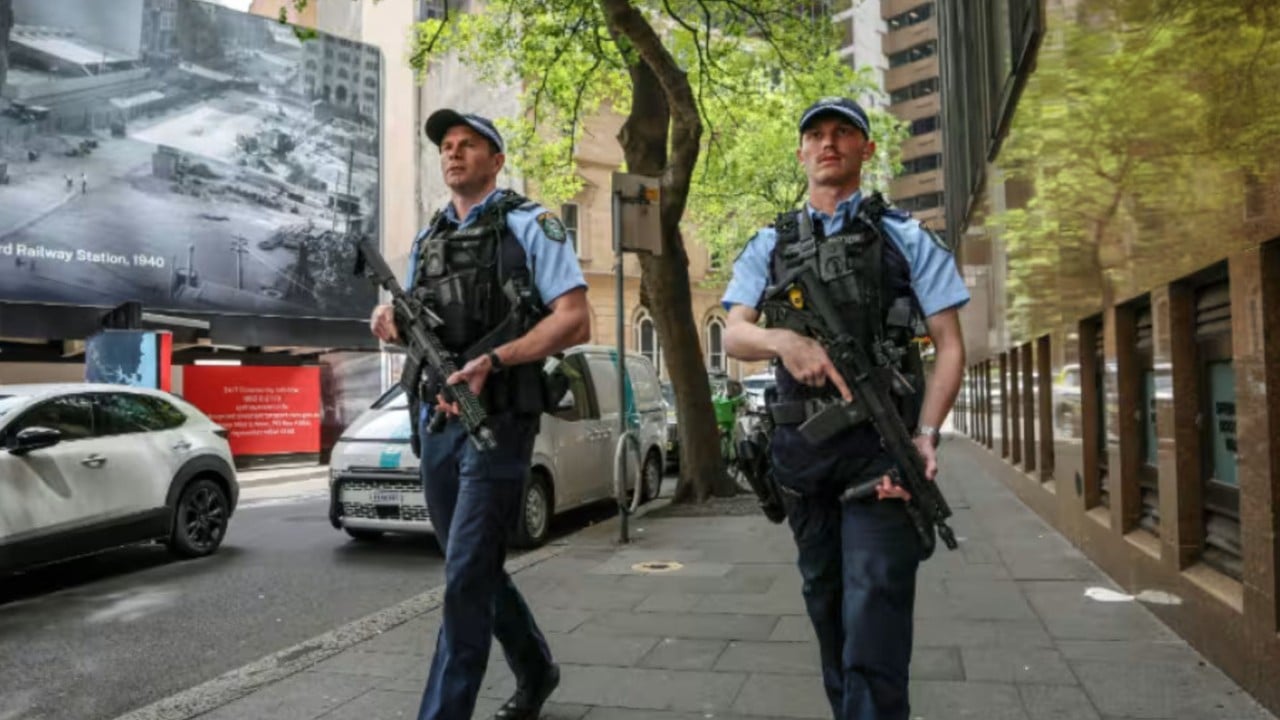
The deployment of general-duties police officers equipped with long-arm rifles on routine patrols in Sydney marks a structural break from nearly three decades of Australian domestic policing doctrine. Initiated directly in response to the Bondi Junction mass stabbing attack, this operational pivot replaces a reactive containment model with visible, high-caliber deterrence. To understand the implications of this shift, one must separate the immediate tactical mechanics of active-threat neutralization from the long-term institutional costs of police militarization.
The Architecture of the Doctrine Shift
Since the 1996 Port Arthur massacre and the subsequent National Firearms Agreement, Australian state policing operated on a strict tiered-response hierarchy. General-duties officers carried non-lethal deterrents—batons, oleoresin capsicum spray, and conducted electrical weapons—alongside standard-issue semi-automatic sidearms (typically 9mm Glock pistols). High-velocity rifles were restricted exclusively to specialized tactical units, such as the New South Wales Police Force Tactical Operations Unit (TOU).
The Bondi attack exposed the primary failure point of this tiered model: response latency. In an active-killer scenario within a high-density commercial environment, the critical variable is the time elapsed between the onset of violence and the arrival of an officer capable of terminating the threat.
- The Sidearm Limitation: Standard 9mm handguns suffer from severe accuracy degradation beyond 15 to 25 meters, particularly under acute physiological stress (elevated heart rate and auditory exclusion). In a crowded atrium or multi-level shopping center, firing a handgun at range creates an unacceptable risk of collateral injury to bystanders.
- The Tactical Unit Bottleneck: Specialized tactical teams possess the ballistics and marksmanship training required for long-range engagement, yet their centralized deployment structure guarantees a response lag measured in tens of minutes. By the time a tactical unit breaches a perimeter, the acute phase of a mass casualty event has typically concluded.
Equipping regular patrol units with semi-automatic rifles—specifically AR-15 platform variants—attempts to collapse this timeline. The operational objective is to place long-gun capability at the initial point of contact, bypassing the dispatch-to-arrival delay of specialized units.
Ballistic Reality vs. Deterrence Theory
Evaluating the efficacy of visible rifle patrols requires distinguishing between two distinct operational goals: active-threat neutralization and psychological deterrence.
From a purely mechanical standpoint, a 5.56x45mm carbine offers vastly superior terminal ballistics, reduced muzzle flip, and exponentially higher hit probability at 50 meters compared to a 9mm pistol. When stabilized against the shoulder, a rifle allows an officer to place precise shots in high-consequence environments, reducing the likelihood of stray rounds hitting civilians. In an active-shooter or mass-stabbing scenario involving armored or barricaded suspects, the platform provides an undeniable tactical advantage.
However, the deployment of these weapons on routine foot patrols relies heavily on deterrence theory—the assumption that the visible presence of overwhelming force will dissuade potential attackers from initiating an operation. This hypothesis encounters severe friction when applied to the typology of modern domestic attackers.
- Rational Actor Fallacy: Deterrence models assume an adversary who weighs the probability of capture or death against the utility of the attack. Perpetrators of mass public violence, whether ideologically motivated or driven by acute psychiatric crises, overwhelmingly operate with suicidal intent. They anticipate lethal force; the presence of a rifle does not alter their cost-benefit calculation, though it may alter their target selection toward softer, unpatrolled perimeters.
- Weapon Retention Vulnerabilities: Carrying a long gun in dense pedestrian crowds introduces a critical physical security liability. Unlike a holstered sidearm secured by Level III retention mechanisms, a slung rifle exists in the open environment. In close-quarters crowd crush or sudden physical ambushes, an officer must dedicate significant cognitive and physical bandwidth to weapon retention, potentially degrading their situational awareness and ability to execute lower-force interventions.
The Institutional Cost Function of Visible Militarization
Every tactical upgrade imposes a corresponding operational and social cost. Transitioning general-duties officers to long-arm patrols alters the foundational relationship between law enforcement and the public, governed by the Peelian principles of policing by consent.
Escalation Dynamics and Cognitive Narrowing
The availability of a tool dictates its use. In behavioral psychology, the "weapons effect" demonstrates that the mere presence of firearms increases aggressive priming in both the carrier and the observer. When an officer patrols with a rifle slung across their chest, their baseline posture shifts from community engagement to perimeter defense.
This posture creates an escalation trap. Routine public order incidents—such as an intoxicated individual, a domestic dispute, or a mental health crisis—require de-escalation, verbal judo, and physical proximity. An officer encumbered by a long gun cannot easily transition to hands-on control without first securing or slinging the weapon, creating a dangerous transition gap. If that transition fails, the officer is forced to rely on the primary weapon system in their hands, increasing the probability of lethal outcomes in scenarios that previously would have been resolved with non-lethal force.
Training Deficit and Skill Decay
A semi-automatic rifle is not a self-aiming device; it is a complex mechanical system requiring continuous, high-stress repetition to operate safely. Tactical units spend up to 30 percent of their operational hours on the range and in shoot-houses, mastering malfunction clearances, transitional shooting, and backdrop assessment.
General-duties officers do not have this bandwidth. Their training budgets are stretched across traffic enforcement, domestic violence protocols, cybercrime reporting, and administrative compliance. Issuing rifles to patrol officers without a commensurate, permanent increase in range time and ammunition budgets creates an acute competency gap. Under the extreme sympathetic nervous system arousal of an active attack, an under-trained officer armed with a high-velocity rifle poses a severe over-penetration risk in urban environments built of glass, drywall, and concrete.
The Normalization of Exception
Historically, the introduction of military-grade hardware into civilian policing follows a predictable ratchet effect. Initially justified as a temporary measure in response to an extraordinary trauma—such as the 2014 Lindt Cafe siege or the Bondi attack—the hardware quickly becomes embedded in standard operating procedures. Once procurement contracts are signed, armories are retrofitted, and union agreements are updated to mandate equipment allowances, rolling back the deployment becomes politically and bureaucratically impossible. The temporary exception becomes the permanent baseline.
Strategic Execution for Command Staff
Police command and municipal policymakers must treat the Sydney rifle deployment not as a completed security solution, but as a high-risk operational experiment that requires strict containment protocols to prevent systemic degradation. To maximize the tactical utility of long-arm patrols while mitigating the risks of escalation and skill decay, leadership must execute three structural controls:
- Enforce Strict Containment Parameters: Prohibit the deployment of rifles during routine community policing, public protests, or low-risk municipal events. Restrict long-arm patrols exclusively to designated high-density transit hubs and major commercial precincts, utilizing a randomized deployment schedule to prevent predictable patrol patterns while minimizing continuous public exposure.
- Mandate Quarterly Dynamic Qualification: Abandon standard static-range annual qualifications for rifle-carrying patrol officers. Establish a hard operational rule: any officer who fails to pass a quarterly, stress-induced shoot/no-shoot qualification course—incorporating elevated heart rates and complex urban backdrops—must immediately surrender their long-arm certification until remediated.
- Decouple Equipment from Doctrine: Pair every rifle-equipped patrol unit with a dedicated non-lethal specialist whose primary mandate is crowd management and low-level de-escalation. This division of labor ensures that the presence of a high-velocity weapon system does not default to the primary response mechanism for routine street-level friction.