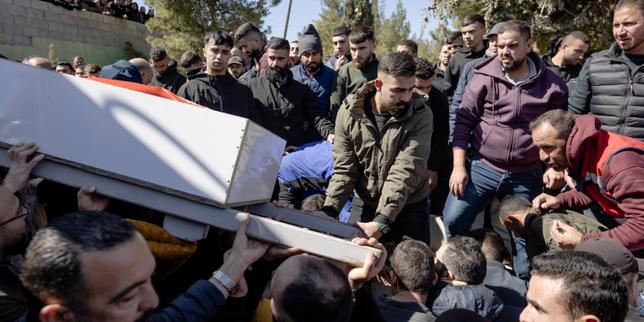
The death of four family members during an Israel Defense Forces (IDF) operation in the West Bank is not an isolated tactical event but a data point within a broader shift toward high-intensity urban warfare in Area A and B territories. This shift is characterized by the breakdown of the 2005-era security coordination model and the emergence of hybrid militant cells that do not follow traditional hierarchical command structures. To understand these casualties, one must analyze the convergence of intelligence-driven targeting, the use of heavy engineering assets in civilian corridors, and the rules of engagement governing "active threat" neutralization in high-density environments.
The Triad of Tactical Friction
The escalation of fatalities in the West Bank is driven by three primary structural shifts in how military operations are conducted in 2024 and 2025.
1. Intelligence-Led Kinetic Proactivity
Military doctrine has moved from reactive containment to proactive disruption. This involves "mowing the grass" at a higher frequency. When the IDF identifies a cell planning an imminent "ticking time bomb" scenario, the speed of the deployment often outpaces the ability to clear civilian bystanders. The result is a compressed decision-making window for ground commanders where the distinction between a combatant and a non-combatant becomes physically blurred by proximity and rapid movement.
2. The Infrastructure War
A hallmark of recent incursions is the systematic use of armored bulldozers (D9s) to rip up asphalt. This is not arbitrary destruction; it is a counter-IED (Improvised Explosive Device) measure. Militant groups have begun burying large explosive charges under primary and secondary roads to target IDF troop carriers. The destruction of this infrastructure creates a secondary layer of risk for civilians:
- Emergency services lose the ability to navigate the terrain.
- The "fog of war" expands as visual landmarks are altered.
- Structural damage to adjacent residential buildings increases the likelihood of accidental collapses or stray fire penetrating weakened walls.
3. Asymmetric Armament Parity
The influx of high-grade small arms and locally manufactured explosives into the West Bank has forced the IDF to escalate its force package. Operations that once required a squad of paratroopers now involve drones (UAVs), snipers, and undercover (Mista'arvim) units. When a family is caught in the crossfire, it is often the result of a "nested engagement" where the target is located within a multi-generational household, turning a private residence into a frontline.
Quantifying the Escalation Cycle
The logic of the West Bank conflict follows a feedback loop where tactical successes often generate strategic deficits. The death of four members of a single family serves as a potent radicalization catalyst, which in turn necessitates further military operations to suppress the resulting unrest.
The Recruitment Multiplier
In counter-insurgency (COIN) theory, the "insurgent math" suggests that for every unintended civilian casualty, a specific number of new recruits are generated within the immediate social circle. In the West Bank, this multiplier is intensified by the "martyrdom" economy and social media amplification. The IDF’s tactical objective of neutralizing a specific threat is frequently offset by the creation of a dozen decentralized threats.
Command and Control Decentralization
The traditional "Lion's Den" or "Jenin Battalion" models have given way to "Lone-Wolf Plus" cells. These are small groups of 3–5 individuals with no formal ties to Hamas or Islamic Jihad political wings but who utilize their technical resources. For the IDF, this means there is no central "head of the snake" to remove. Every operation is a localized battle against an atomized enemy, making intelligence gathering more difficult and the risk of collateral damage higher due to the lack of clear military uniforms or bases.
The Mechanism of Modern Urban Siege
When the IDF enters a town like Tulkarem or Jenin, the operation follows a rigid sequence that dictates the likelihood of civilian casualties.
- Encirclement and Isolation: Electronic warfare units jam cellular signals to prevent the detonation of remote IEDs. This isolates the family inside the target zone from outside information.
- The Pressure Cooker: If a suspect refuses to surrender, the "Pressure Cooker" (Sir Lachatz) protocol is initiated. This involves the incremental destruction of the building—starting with windows, then doors, then outer walls—to force an exit.
- Positive Identification (PID) Failures: In the chaos of a midnight raid, PID relies on thermal signatures and movement patterns. A family member moving toward a window to check on the noise can be misinterpreted as a sniper taking a position.
The Economic and Governance Vacuum
The security situation cannot be divorced from the insolvency of the Palestinian Authority (PA). As the PA loses its ability to pay security forces and provide basic municipal services, the "security vacuum" is filled by local armed committees.
- Security Coordination Erosion: Historically, the PA would arrest high-profile militants before the IDF felt the need to enter Area A. That buffer is now gone.
- Economic Desperation: With work permits into Israel revoked for the majority of the population, the opportunity cost of joining a militant cell has dropped to near zero.
- Governance at Gunpoint: In the absence of a functional judiciary, armed cells provide "street justice," further embedding them into the social fabric of the neighborhoods where the IDF operates.
Tactical Reality vs. Strategic Deadlock
The military maintains that these operations are essential to prevent 7 October-style incursions from the East. However, the data suggests a diminishing return on kinetic force. While individual cells are dismantled, the underlying infrastructure of resistance—both physical and psychological—remains intact.
The specific tragedy of a family killed in their home highlights the inherent flaw in high-intensity policing: the tool is too blunt for the environment. A standard 5.56mm or 7.62mm round can penetrate multiple interior walls of standard Palestinian cinderblock construction. When fire is exchanged in a hallway, every occupant of the house is effectively in the line of fire, regardless of their involvement in the hostilities.
The second limitation is the "Time-on-Target" variable. The longer an IDF unit remains in a hostile neighborhood to ensure a target is neutralized, the higher the probability of a "neighborhood-wide" mobilization. This forces the use of broader suppression fire to allow for a safe extraction, which is the phase where the highest percentage of non-combatant casualties typically occurs.
Strategic Play
The immediate path forward requires a shift from "Kinetic Dominance" to "Precision Containment."
First, the IDF must recalibrate the use of heavy engineering in residential zones. While the IED threat is real, the secondary effects of road destruction create a permanent state of hostility that makes future intelligence-led, low-impact raids impossible.
Second, the re-establishment of a credible third-party security buffer—whether through a reformed PA or an international task force—is the only mechanism to reduce the frequency of IDF incursions into civilian centers. Without a localized force to manage internal security, the IDF will continue to function as a high-friction police force, a role for which no conventional military is optimally equipped.
The current trajectory points toward a permanent state of "low-boil" urban conflict where the distinction between a military operation and a localized massacre is separated only by the quality of a split-second decision by a twenty-year-old soldier in a high-stress environment. Reducing these fatalities requires changing the environment, not just the rules of engagement.