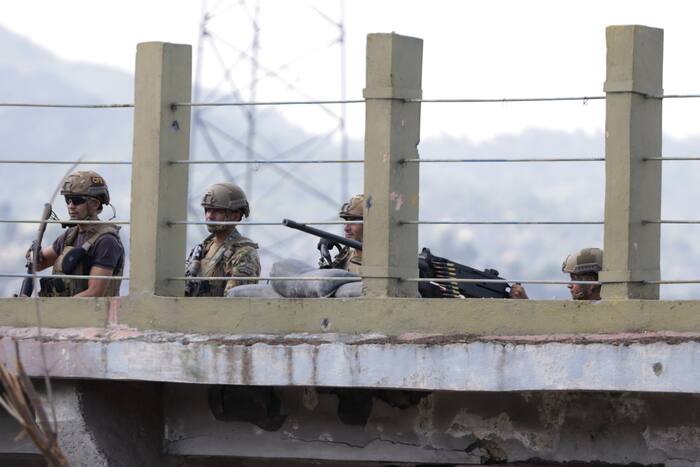
Exporting a domestic counter-gang model across international borders exposes a fundamental asymmetry between territorial pacification and expeditionary warfare. When Salvadoran President Nayib Bukele confirmed the combat deaths of three Salvadoran soldiers deployed to Haiti, the disclosure marked more than a tactical casualty report; it revealed the structural friction of transplanting a localized security doctrine into a fractured foreign theater. Standard coverage frames these fatalities as isolated tragic losses within a broader multinational stabilization effort. That framing misses the operational mechanics driving the attrition. Deploying specialized domestic forces into Port-au-Prince’s urban terrain without the legal, infrastructural, and intelligence architecture that enabled their success at home alters the risk equation entirely.
The Structural Divergence Between Domestic Pacification and Expeditionary Deployment
To evaluate the casualties suffered by El Salvador’s contingent in Haiti, analysts must separate the tactical proficiency of the individual operator from the institutional ecosystem that makes that proficiency effective. El Salvador’s domestic crackdown—codenamed the Territorial Control Plan and reinforced by a prolonged state of exception—succeeded because the state controlled the entire operational stack. The Armed Forces of El Salvador (FAES) and the National Civil Police (PNC) operated with unified command, uncontested sovereign authority, comprehensive signals intelligence, and immediate judicial and carceral throughput. When a gang cell in San Salvador was cornered, it faced an inescapable perimeter backed by mass detention infrastructure. In other developments, take a look at: Why Striking Russian Ships Off Libya Is a Dangerous Strategic Trap.
Haiti presents the inverse environment. The Multinational Security Support (MSS) mission, authorized by the United Nations Security Council and led on the ground by Kenyan personnel alongside smaller contingents from countries like El Salvador, operates inside a collapsed institutional state. Salvadoran troops deployed to Haiti do not possess unilateral sovereign authority. They operate under restrictive multinational rules of engagement, fragmented command-and-control structures, and severe logistical constraints.
The Three Pillars of Operational Friction
- Intelligence Blindness and Human Terrain: In El Salvador, state forces leveraged decades of domestic mapping, local informant networks, and telecommunications intercepts to isolate targets before kinetic engagement. In Port-au-Prince, foreign contingents enter dense, hostile urban neighborhoods without organic human intelligence (HUMINT). Armed coalitions such as Viv Ansanm possess complete familiarity with the micro-terrain, escape routes, and civilian cover, neutralizing the technical advantages of arriving expeditionary units.
- Asymmetric Firepower and Urban Fortification: Haitian gang federations do not operate like traditional street gangs. They function as heavily armed paramilitary insurgents utilizing high-caliber rifles, armored vehicles, drone surveillance, and fortified choke points. When a small expeditionary unit conducts clearance or patrol operations in districts controlled by these coalitions, the engagement resembles high-intensity urban infantry combat rather than law enforcement pacification.
- Logistical and Medical Evacuation Latency: Domestic operations in El Salvador benefited from short supply lines and immediate access to national military hospitals. Expeditionary forces in Haiti face chronic shortages in armored mobility, air support, and rapid casualty evacuation (CASEVAC). In urban firefights, the difference between a survivable gunshot wound and a fatality frequently depends on the "golden hour" of trauma care—a metric severely degraded in Port-au-Prince’s contested zones.
Deconstructing the Political-Military Calculus of San Salvador
Bukele’s decision to commit troops to Haiti—initially framed around specialized capabilities such as medical evacuation, engineering, and targeted security support—was driven by a clear geopolitical objective. By positioning El Salvador as an exporter of security solutions rather than a consumer of international aid, San Salvador sought to convert its domestic security reputation into diplomatic capital in Washington and across the Western Hemisphere. The New York Times has also covered this fascinating topic in extensive detail.
This strategic posture carries an unavoidable cost function. Diplomatic credibility gained through expeditionary deployment is paid for in operational exposure. Unlike large militaries that absorb casualties through deep force-generation pipelines and insulated bureaucratic structures, El Salvador’s brand is tightly bound to the personal authority of its executive leadership.
The Information Control Dilemma
In domestic operations, the Salvadoran government maintained strict narrative dominance, highlighting arrests, territorial recoveries, and declining homicide rates while tightly managing casualty disclosures. In a multinational mission, information control fractures. Casualties involving foreign troops immediately intersect with international media scrutiny, host-nation political instability, and partner-nation reporting protocols.
When Bukele publicly detailed the circumstances surrounding the deaths of the three Salvadoran soldiers, the disclosure served two distinct operational functions:
- Preempting Narrative Leakage: Releasing the details directly from the executive office prevented fragmented or sensationalized accounts from circulating via international press or local Haitian sources first.
- Framing Sacrifice Within National Doctrine: By presenting the fatalities as the result of direct engagement against criminal structures threatening regional stability, San Salvador aligned the losses with its core ideological narrative—that violent non-state actors represent an existential threat requiring uncompromising military confrontation.
Tactical Realities of the Haitian Theater
The deaths of the three Salvadoran personnel highlight specific tactical vulnerabilities inherent to the current multinational intervention model in Haiti. The MSS mission was designed as a hybrid policing and stabilization force rather than a full-scale counterinsurgency army. This doctrinal mismatch creates lethal gaps on the ground.
The Force-to-Space Ratio Deficit
Urban counterinsurgency doctrine generally requires a high ratio of security personnel to civilian population to hold cleared territory. Port-au-Prince is a sprawling metropolitan area of several million residents, where armed groups control major transit arteries, ports, and fuel terminals. The total deployed strength of the multinational mission remains a fraction of what standard military doctrine dictates is necessary to clear and hold contested urban sectors simultaneously.
Without sufficient troop density to permanently occupy cleared neighborhoods, multinational patrols are forced into repetitive "clear-and-leave" cycles. Every transit through a contested corridor exposes small units to ambushes, improvised barricades, and sniper fire from elevated positions. The Salvadoran casualties occurred within this exact operational reality: small, specialized contingents operating in an environment where perimeter security is temporary and front lines are fluid.
Command Fragmentation Across Coalitions
Multinational coalitions suffer from inherent interoperability friction. Kenyan police units, Salvadoran military personnel, Caribbean Community (CARICOM) contingents, and the Haitian National Police (PNH) bring different languages, tactical doctrines, communications equipment, and risk tolerances to the same battle space.
- Communication Delays: Coordinating joint fire support, armored reinforcement, or medical extraction across units speaking Spanish, English, Swahili, and Haitian Creole introduces friction measured in minutes—a critical liability during close-quarters ambushes.
- Doctrinal Divergence: Police-led contingents train for arrest, crowd control, and proportional force, whereas military units train for maneuver, suppression, and area denial. Blending these doctrines under live fire creates ambiguity regarding escalation thresholds and mutual support obligations.
Distinguishing Verified Facts from Analytical Projections
Evaluating the trajectory of El Salvador’s involvement in Haiti requires separating confirmed operational facts from broader strategic hypotheses.
Confirmed Operational Facts:
- El Salvador committed military personnel to support the multinational security effort in Haiti following legislative authorization in San Salvador.
- Three Salvadoran soldiers were killed in action during operations against armed gangs in Haiti, a fact officially confirmed and publicly addressed by President Nayib Bukele.
- Armed groups in Haiti operate with heavy weaponry and have actively targeted multinational personnel, Haitian police, and critical infrastructure.
Analytical Hypotheses and Strategic Uncertainties:
- Exact Tactical Sequence: Absent an independent after-action battle damage assessment or declassified UN/MSS incident report, the precise tactical breakdown—whether the fatal engagement resulted from an ambush during convoy movement, a static post attack, or a joint clearance raid—remains limited to official executive summaries.
- Impact on Force Posture: Whether these fatalities will trigger an escalation in Salvadoran troop commitments (deploying heavier infantry and armored assets to avenge losses and secure perimeters) or prompt a quiet tightening of rules of engagement to minimize further casualties remains an open strategic variable.
Strategic Imperatives for Expeditionary Security Deployments
For governments attempting to project domestic security models into foreign crisis zones, the Salvadoran experience in Haiti demonstrates that tactical reputation cannot substitute for theater-level infrastructure. Exporting security requires structural adaptation before troops cross the border.
- Mandate Organic Force Protection and CASEVAC: No specialized or advisory contingent should deploy into a non-permissive urban environment without dedicated, organic armored mobility and independent medical evacuation assets. Relying on host-nation or coalition partners for life-safety extraction introduces unacceptable single points of failure.
- Align Rules of Engagement with Threat Lethality: Deploying forces under peacekeeping or law-enforcement frameworks against insurgents equipped with military-grade weaponry guarantees tactical disadvantage. Mandates must authorize preemptive suppression, perimeter denial, and heavy weapon employment commensurate with the adversary's actual arsenal.
- Establish Unified Tactical Intelligence Cells: Prior to conducting kinetic patrols in unfamiliar urban terrain, incoming contingents must integrate directly into a centralized, multilingual intelligence fusion center utilizing persistent aerial surveillance (ISR) and vetted local human intelligence networks to eliminate blind movement.
- Calibrate Domestic Political Messaging to Expeditionary Risk: Leaders leveraging foreign deployments for diplomatic prestige must prepare domestic audiences for sustained attrition. Framing expeditionary missions as rapid, surgical extensions of domestic success creates acute political vulnerability the moment reality imposes combat casualties.
The deaths of three Salvadoran soldiers in Haiti underscore a permanent rule of military operations: domestic pacification relies on state monopoly over territory and institutions, whereas expeditionary stabilization requires overwhelming logistical self-sufficiency and unified command in the absence of both. Until multinational forces in Haiti resolve their deficits in troop density, unified communications, and heavy armored support, every foreign contingent operating in Port-au-Prince will continue to absorb disproportionate tactical risk.