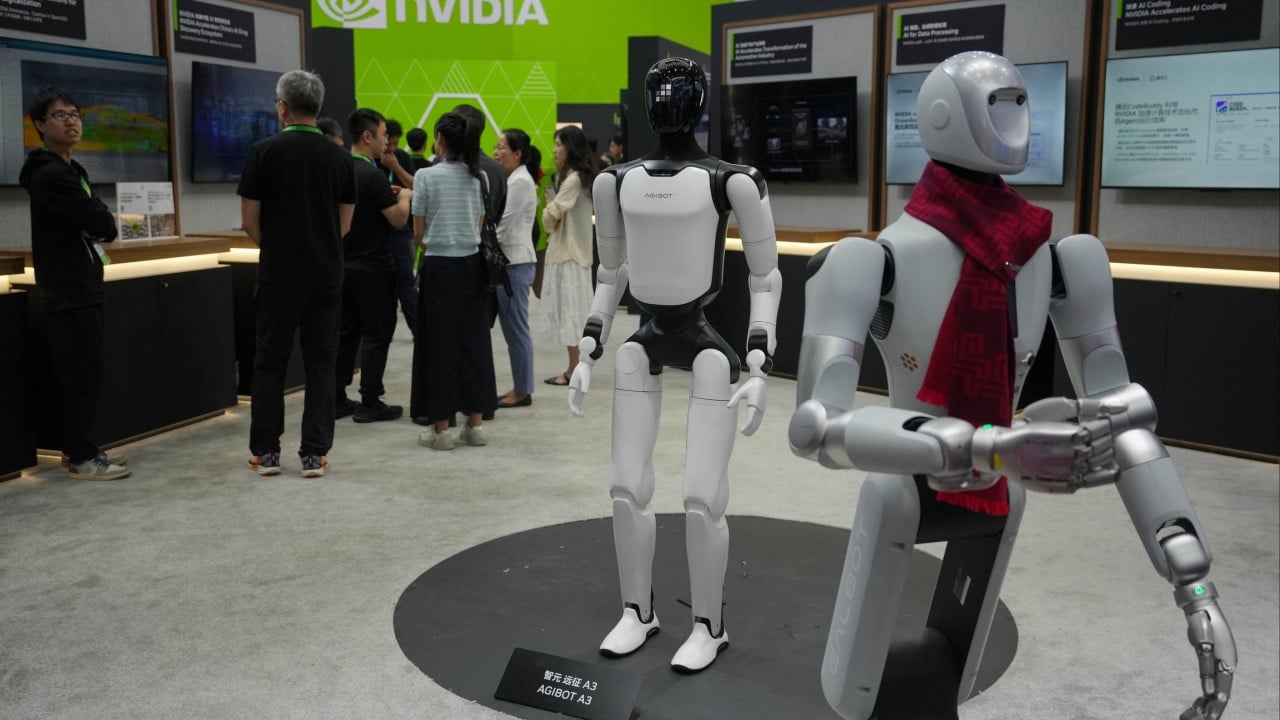
The tech press is swooning over Nvidia expanding its robotics team in China. They call it a brilliant move to capture the "physical AI" wave. They point to humanoids, manufacturing lines, and autonomous systems as the next gold rush.
They are completely wrong.
This isn't a masterstroke. It is an expensive, geopolitically blinded hedge that misunderstands where the real value of automation lies. Silicon Valley and Shenzhen are currently trapped in a collective hallucination, believing that building complex physical bodies for AI is the fastest path to dominance.
I have watched hardware companies blow tens of millions of dollars trying to make metal legs walk across uneven warehouse floors, only to realize a $500 conveyor belt with a basic optical sensor does the job faster, cheaper, and without breaking down every six hours. Nvidia is chasing a mirage.
The Physical AI Trap
The mainstream narrative assumes that because Nvidia dominates data centers, its hardware will automatically dominate the physical world. The media looks at the emergence of embodied AI and concludes that the company building the smartest chips will win the race to build the smartest workers.
This premise misses a fundamental reality of hardware engineering: Moravec's paradox.
In computer science, we learned long ago that high-level reasoning requires remarkably little computation, but low-level sensorimotor skills require enormous computational resources and physical precision. Giving an AI an opinion on a legal contract is easy. Teaching a mechanical hand to pick up a slippery, deformed strawberry without crushing it is agonizingly difficult.
Traditional View: AI Brain + Humanoid Body = Trillion-Dollar Market
The Reality: AI Brain + Physical World = Infinite Maintenance Nightmares
By doubling down on China-based robotics talent, Nvidia is trying to brute-force a solution to a problem that does not need to be solved with humanoids. China is the epicenter of hardware manufacturing, yes. But manufacturing hardware is no longer the bottleneck. Maintenance, physical degradation, and kinetic unpredictability are the actual bottlenecks.
The Geopolitical Blind Spot
Let's address the elephant in the server room. You cannot talk about Nvidia, China, and advanced silicon without talking about export controls.
The United States government has made its intentions perfectly clear: advanced compute staying in or flowing to China is a national security risk. Nvidia has already had to repeatedly redesign its chips (from the A100/H100 to the A800/H800 and subsequent iterations) to comply with shifting Washington directives.
Expanding an R&D footprint for "physical AI" inside China creates an immediate, systemic vulnerability:
- IP Leakage: Local talent trained on Nvidia’s proprietary simulation frameworks (like Isaac Sim) will inevitably migrate to domestic competitors like Huawei or local state-backed robotics firms.
- Regulatory Whiplash: Any breakthrough achieved by a Shanghai-based Nvidia team could be rendered instantly unexportable or unusable by a single stroke of a pen in Washington or Beijing.
- The Dual-Use Dilemma: Physical AI is inherently dual-use. A robotic arm that can stack boxes can load ammunition. A humanoid that can walk through a factory can navigate a combat zone. The moment these systems become truly capable, the regulatory hammer will fall with unprecedented force.
To believe that a US chip giant can smoothly operate a cutting-edge autonomous systems division in China during an era of cold tech warfare is not optimistic; it is delusional.
Why Humanoids Are a Marketing Stunt
Every tech conference now features a sleek, metallic robot walking awkwardly onto a stage, waving to the crowd, and picking up a box. The crowd gasps. The stock price ticks up.
It is pure theater.
If you want to automate a factory, you do not build a five-foot-nine-inch bipedal robot that balances on two legs. Humans are shaped the way we are because of biological evolution, not because we are the optimal shape for logistics. A forklift is better than a humanoid at moving heavy objects. A stationary robotic arm with six axes is faster, more precise, and runs for 100,000 hours without needing a break or a software patch because its ankle joint gave out.
When companies try to deploy these celebrated humanoids in real-world scenarios, they run into the brutal economics of kinetic wear and tear. Silicon does not degrade when it processes data. Actuators, gears, hydraulics, and carbon fiber degrade every single second they fight gravity.
The true cost of physical AI isn't the upfront cost of the GPU training the model. It is the deprecation and maintenance cycle of the physical chassis. Nvidia is a software and silicon company enjoys gross margins hovering around 75%. Stepping into the low-margin, high-friction world of physical hardware support is an operational downgrade.
Dismantling the Consensus
People frequently ask: Won't China's massive manufacturing sector naturally adopt physical AI faster than anyone else?
The short answer is no. China does not need hyper-expensive, GPU-powered humanoids to solve its manufacturing challenges. It already possesses the most sophisticated, highly optimized automated factories in the world. They use specialized, deterministic automation. They use track-based sorting systems, high-speed CNC machines, and fixed robotic arms that cost a fraction of a humanoid's price and operate with zero latency.
Replacing a deterministic machine that works with 99.999% accuracy with a probabilistic AI model that might hallucinate and smash a piece of equipment is a massive step backward for industrial efficiency.
Imagine a scenario where a factory manager has to choose between two systems:
- A standard, fixed automation line that processes 1,000 units an hour, requiring a standard mechanic to fix.
- A fleet of autonomous, learning robots that process 700 units an hour, occasionally get confused by changes in lighting, and require a team of specialized AI engineers to debug when they freeze.
The choice isn't even close. The factory manager chooses option one every single time.
Shift Your Strategy: The Real Play
If you are an investor or an enterprise leader looking at this space, stop tracking how many roboticists Nvidia is hiring in Asia. Stop looking at humanoid startup valuations.
Instead, look at Contextual Automation.
The real money will not be made by giving robots human forms and putting them in human environments. It will be made by redesigning environments so that simple, dumb machines can operate perfectly. Amazon did not revolutionize its logistics by building humanoids to walk down aisles; it bought Kiva Systems, flattened its warehouse floors, put barcodes on the ground, and let simple, puck-shaped robots slide under shelves.
The value is in the infrastructure, not the avatar.
Nvidia’s smartest move wouldn't be trying to win the physical AI race in China. It would be focusing entirely on the digital twins of these environments—allowing other companies to simulate their simple, specialized factories in virtual space before building them in reality.
Chasing the physical humanoid dream is an admission of creative bankruptcy. It assumes the human form is the pinnacle of utility. It isn't. It's just what we're used to.
Stop investing in the metal. Invest in the environment. Turn off the demo videos of robots doing backflips and look at the unglamorous, boring, highly profitable world of fixed industrial logic. That is where the margins are. Everything else is just a very expensive science project.